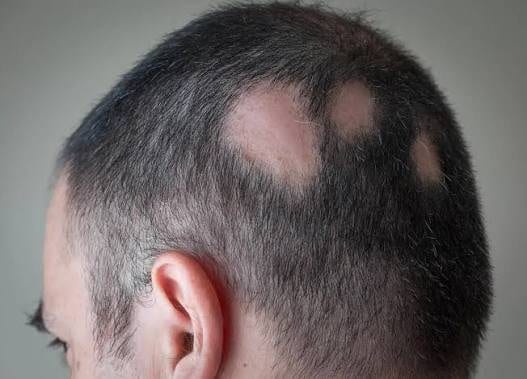
Donor area and retrograde alopecia
Retrograde alopecia is thinning that advances upward from the nape and around the ears, eroding the lower border of the safe donor zone.
Retrograde alopecia is thinning that advances upward from the nape and around the ears, eroding the lower border of the safe donor zone. It is easy to miss and it shrinks the reserve a plan is built on.
What is retrograde alopecia?
Retrograde alopecia is thinning that moves opposite to typical pattern loss: upward from the nape hairline and around the ears, eating into the lower and lateral edges of the safe donor zone. It varies between individuals — some show none at all, while others lose meaningful donor area even while the occipital centre stays dense.
Most descriptions of androgenetic alopecia focus on loss advancing backwards from the hairline and outwards from the crown. Retrograde alopecia describes the less-discussed movement in the opposite direction: thinning that advances upward from the nape hairline and around and above the ears, eating into the lower and lateral edges of what is normally treated as the safe donor zone.
It varies enormously between individuals. Some men show none at all. Others show progressive thinning of the nape and retroauricular regions that materially reduces the usable donor area, sometimes while the occipital centre remains dense.
Why does retrograde alopecia matter so much when planning a donor harvest?
The nape and above-ear regions retrograde alopecia affects are exactly where an over-ambitious harvest reaches when the central zone can't supply the promised graft count. A patient with retrograde thinning has a smaller reserve than central density suggests, so extending the harvest there both takes grafts that may not persist and thins an already-thinning area.
The regions retrograde alopecia affects are precisely the regions an over-ambitious harvest reaches for when the central safe zone will not supply the promised graft number.
That creates a compounding error. A patient with retrograde thinning has a smaller true reserve than his central density suggests. If his plan was built on that central density and the harvest then extends into the affected periphery, he has both taken grafts that may not persist and thinned an area that was already thinning on its own.
The result can be a visibly ragged neckline and thinning above the ears, on top of grafts that fade over the following decade.
How is retrograde alopecia detected?
Retrograde alopecia is found by examining the donor periphery under magnification — the nape hairline, above and behind the ears, and the lower occipital border — not just the dense centre. Signs include miniaturisation, shaft diameter diversity between neighbouring hairs, a softening nape hairline, and reduced density above the ears relative to the occipital centre.
It is found by examining the donor periphery under magnification, which means the nape hairline, the region behind and above the ears, and the lower occipital border — not just the dense centre where density measurements are usually taken.
- Miniaturisation — a mixture of full-calibre and noticeably finer hairs in the same area.
- Shaft diameter diversity — variation in thickness across neighbouring hairs, which is the trichoscopic signature of androgen-driven thinning.
- A softening nape hairline — the transition from scalp hair to vellus becoming higher and less defined than it was.
- Reduced density above the ears relative to the occipital centre.
A single density reading taken at the mid-occipital region will miss all of this, which is why measurement at multiple points across the zone matters.
How does retrograde alopecia relate to the broader question of donor-zone safety?
Retrograde alopecia sits on a spectrum with the broader question of whether the donor zone is spared, raised directly by Maas and colleagues and by Xu and colleagues. At the spectrum's end is diffuse unpatterned alopecia, where transplantation is inadvisable; retrograde thinning is milder and more common, but belongs to the same category of evidence.
Retrograde alopecia sits on a spectrum with the broader question of whether the donor zone is truly spared. Recent publications have raised that question directly — Maas and colleagues questioning the occipital scalp's status as an unaffected control in advanced androgenetic alopecia, and Xu and colleagues arguing from paired vertex-occipital assessment that occipital sparing is assumed rather than verified.
At the far end of that spectrum is diffuse unpatterned alopecia, where the whole scalp including the donor area is involved and transplantation is generally inadvisable. Retrograde thinning of the periphery is a milder and much more common finding, but it belongs to the same category of evidence: signals that the donor zone is not automatically safe.
What should patients do if retrograde alopecia is a concern?
Ask whether your donor periphery — the nape and the area above and behind the ears — was examined under magnification, and what was found. If retrograde thinning is present, expect tighter harvest boundaries and a smaller graft number. Photograph your neckline and above your ears before surgery so future change can be assessed.
- Ask whether your donor periphery — nape, above and behind the ears — was examined under magnification, and what was found.
- If retrograde thinning is present, expect the harvest boundaries to be drawn more tightly and the graft number to be smaller. That is the correct response.
- Treat any proposal to harvest the nape or the region immediately above the ears as requiring specific justification.
- Discuss medical therapy with a doctor. Retrograde thinning is androgen-driven thinning, and it is the native hair that treatment can act on.
- Photograph your neckline and the area above your ears before surgery, at consistent length and lighting, so future change can be assessed against something.
Sources
- Xu Y, et al. Case Report: Paired vertex-occipital assessment reveals donor-area involvement in diffuse unpatterned alopecia. Frontiers in Medicine, 2026;13:1797275. pubmed.ncbi.nlm.nih.gov/41982548
- Maas D, et al. Rethinking the occipital scalp as a control in advanced androgenetic alopecia. Journal of the American Academy of Dermatology, 2026 (ahead of print). pubmed.ncbi.nlm.nih.gov/42398778
- Jimenez F, Ruifernández JM. Distribution of human hair in follicular units. A mathematical model for estimating the donor size in follicular unit transplantation. Dermatologic Surgery, 1999;25(4):294-298. pubmed.ncbi.nlm.nih.gov/10417585
- Gupta AK, Venkataraman M, Talukder M, Bamimore MA. Finasteride for hair loss: a review. Journal of Dermatological Treatment, 2022;33(4):1938-1946. pubmed.ncbi.nlm.nih.gov/34291720
This article summarises published research and standard clinical practice. It is general educational information, not medical advice, and it does not replace the instructions your own surgical team gives you. Where their guidance differs from anything here, follow theirs.
Get a no-obligation assessment against fixed criteria, directly on WhatsApp.