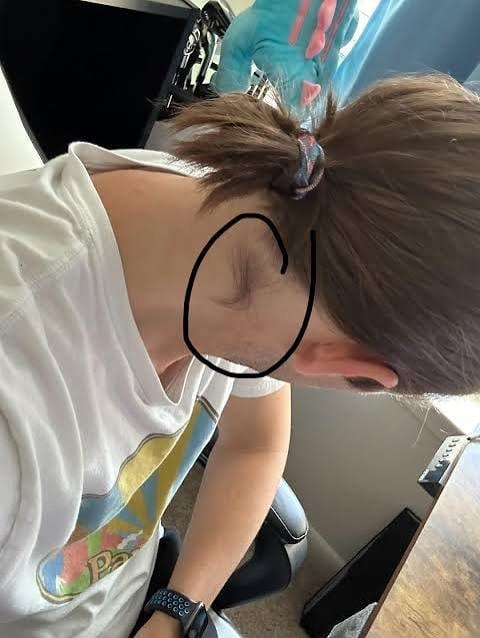
Nape hair: why surgeons avoid it
The fine hair at the nape sits below the safe donor zone, is frequently affected by retrograde thinning, and has a different texture and growth cycle from occipital hair.
The fine hair at the nape sits below the safe donor zone, is frequently affected by retrograde thinning, and has a different texture and growth cycle from occipital hair. Harvesting it is a common sign of a plan reaching beyond its reserve.
Where does the nape sit relative to the safe donor zone?
The nape sits below the safe donor zone's lower border, where hair becomes finer, often shorter, and grows differently from the dense occipital hair above it. This region is generally regarded as lying outside the zone reliably resistant to DHT, making it prone to recede over time — a pattern called retrograde thinning.
Why is nape hair a poor donor source for hair transplants?
Nape hair is a poor donor source because it sits outside the DHT-resistant zone and can miniaturise after transfer, meaning grafts may eventually disappear; it is finer than occipital hair, contributes less coverage, and has a shorter growth cycle; and harvesting it exposes visible scars and can leave a ragged, hard-to-correct neckline.
- It may not last. The whole basis of transplantation is donor dominance. A follicle taken from outside the resistant zone can miniaturise after transfer, which means the graft eventually disappears from the recipient area — after you have paid for it and spent a donor wound getting it.
- It is finer. Nape hair typically has a smaller shaft diameter than occipital hair, so it contributes less visual coverage per graft.
- Different growth cycle. Nape hairs frequently have a shorter anagen phase and do not reach the same length.
- Scars are exposed. The nape is one of the most visible parts of the donor area at short hair lengths, and dot scars there sit right at the hairline edge where the eye naturally goes.
- It compromises the neck hairline. Thinning the nape can leave the neckline looking ragged, which is difficult to correct.
Why do surgeons sometimes harvest nape hair despite the risks?
Nape harvesting is usually a symptom of an oversized plan: when a promised graft number exceeds what the safe zone can supply, an operator can reduce the number, extract more densely, or extend the harvest beyond it — into the nape, crown, or temples — the option least visible on the day but most damaging long-term.
Nape harvesting is usually a symptom rather than a technique choice. It happens when a graft number has been promised that the safe zone cannot supply.
Faced with a target of several thousand grafts and a donor area that will not yield them at conservative density, an operator has three options: reduce the number, extract more densely within the safe zone, or extend the harvest area beyond it. The third is the least visible on the day and the most damaging over time.
The same logic applies at the upper border, where harvesting drifts up toward the crown, and around the temples. All three are ways of borrowing from hair that may not be permanent.
How can patients check whether their nape hair was harvested?
Patients can check by photographing the donor area from behind before surgery at consistent length and lighting, asking for the intended harvest boundaries to be marked beforehand, then looking after surgery for extraction dots below the occipital protuberance or at the neck hairline, and comparing the neckline to that photo at twelve months.
This is worth knowing because nape harvesting is not usually disclosed.
- Photograph your donor area before surgery, from behind, at a consistent hair length and lighting.
- Ask before surgery for the boundaries of the intended harvest area to be described, and ideally marked.
- After surgery, look for extraction dots below the level of the occipital protuberance or right at the neck hairline.
- At twelve months, compare your neckline against the pre-operative photograph.
If the extraction extended into the nape, that is a finding worth raising with the clinic, though the practical remedy is limited.
Are there any legitimate uses for nape hair as a donor source?
Nape hair is not universally off-limits: its fine calibre occasionally suits deliberate, small-scale use at a hairline's leading edge or for eyebrow work, where thick occipital hair would look wrong — but only in patients whose nape shows no thinning. That differs entirely from harvesting the nape at volume because the occipital zone has run out.
Nape hair is not universally off-limits. Its fine calibre makes it occasionally useful for specific fine-detail work — some surgeons use a small number of fine nape or temporal hairs at the very front edge of a hairline or for eyebrow work, where thick occipital hair would look wrong.
That is a deliberate use of a small number of grafts for a purpose their characteristics suit, in a patient whose nape shows no sign of thinning. It is quite different from harvesting the nape at volume because the occipital zone has run out.
The distinction is one of intent and scale, and it is a reasonable thing to ask about if fine hair is being proposed for your hairline.
Which zones are considered safe is the subject of our page on donor supply.
Sources
- Maas D, et al. Rethinking the occipital scalp as a control in advanced androgenetic alopecia. Journal of the American Academy of Dermatology, 2026 (ahead of print). pubmed.ncbi.nlm.nih.gov/42398778
- Xu Y, et al. Case Report: Paired vertex-occipital assessment reveals donor-area involvement in diffuse unpatterned alopecia. Frontiers in Medicine, 2026;13:1797275. pubmed.ncbi.nlm.nih.gov/41982548
- Jimenez F, Ruifernández JM. Distribution of human hair in follicular units. A mathematical model for estimating the donor size in follicular unit transplantation. Dermatologic Surgery, 1999;25(4):294-298. pubmed.ncbi.nlm.nih.gov/10417585
- Rassman WR, Bernstein RM, McClellan R, Jones R, Worton E, Uyttendaele H. Follicular unit extraction: minimally invasive surgery for hair transplantation. Dermatologic Surgery, 2002;28(8):720-728. pubmed.ncbi.nlm.nih.gov/12174065
- Romera de Blas C, Vega Díez D, Ricart Vayá JM, Gómez Zubiaur A. Complications in follicular unit excision hair transplantation: current evidence and practical approaches. Frontiers in Medicine, 2026;13:1750989. pubmed.ncbi.nlm.nih.gov/41709896
This article summarises published research and standard clinical practice. It is general educational information, not medical advice, and it does not replace the instructions your own surgical team gives you. Where their guidance differs from anything here, follow theirs.
Get a no-obligation assessment against fixed criteria, directly on WhatsApp.