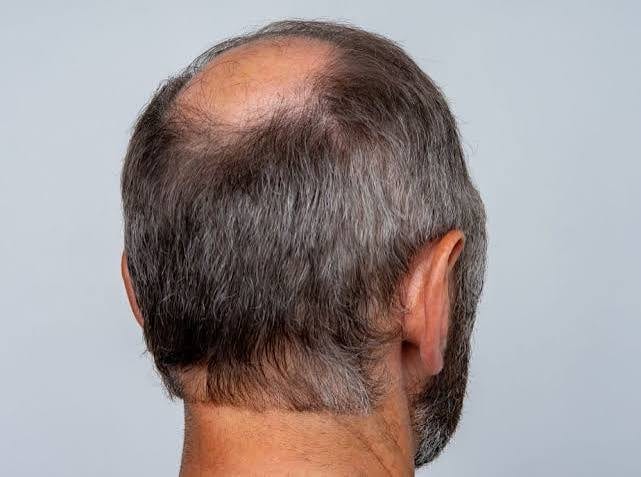
Donor hair miniaturisation over time
Miniaturisation in the donor zone means follicles producing progressively finer hairs — the signature of androgen-driven thinning.
Miniaturisation in the donor zone means follicles producing progressively finer hairs — the signature of androgen-driven thinning. Finding it before surgery changes the plan; finding it afterwards explains why a result faded.
What does 'miniaturisation' mean in the context of hair loss?
Miniaturisation is the process by which DHT-susceptible follicles produce successively finer, shorter and less pigmented hairs each growth cycle, until they produce only a barely visible vellus hair instead of a terminal one. It is gradual and invisible to the naked eye at first, since an area can look dense while many follicles are miniaturising.
Androgenetic alopecia does not switch follicles off. It shrinks them. Under the influence of DHT, susceptible follicles produce successively finer, shorter and less pigmented hairs across each growth cycle, until what they produce is a barely visible vellus hair rather than a terminal one.
This process is gradual and, in its early stages, invisible to the naked eye. An area can look normally dense while containing a substantial proportion of miniaturising follicles, because a fine hair still occupies a position and still catches light.
The visible thinning that patients notice is a late finding. What magnification shows is the process well before that point.
Why does miniaturisation in the donor area specifically undermine a transplant?
The operation's premise is that donor follicles are resistant and keep producing terminal hairs after transfer. A follicle miniaturising in the donor area is not resistant, and moving it does not change that — it keeps shrinking there. The result can look good at twelve months, then thin as spent donor supply fails to last.
The entire premise of the operation is that donor follicles are resistant and will keep producing terminal hairs after transfer. A follicle that is already miniaturising in the donor area is not resistant. Moving it to the recipient area does not change that — it continues to shrink in its new position.
The consequence is a result that looks good at twelve months and thins progressively afterwards. The patient has spent donor supply on grafts that were never going to last, and the donor area has the extraction dots to show for it.
This is why donor assessment is not a formality. It is the test of whether the operation's basic premise holds in this particular patient.
What does trichoscopy look for when checking donor hair for miniaturisation?
Trichoscopy checks for shaft diameter diversity — different hair thicknesses side by side, versus the uniform calibre of a stable zone — an increased proportion of thin or vellus hairs, and fewer hairs per follicular unit than before. Assessment should cover multiple points across the zone, since retrograde thinning affects the edges first.
Trichoscopy — magnified examination of the scalp — is the tool. The findings that matter are:
- Shaft diameter diversity. Terminal hairs of markedly different thickness side by side in the same field. A stable donor zone shows relatively uniform calibre; a thinning one shows a mixture.
- An increased proportion of thin and vellus hairs.
- Reduced hairs per follicular unit. Units that once produced three hairs producing two, then one.
- Peripilar signs such as perifollicular pigmentation or a brown halo, associated with the inflammatory component of androgenetic alopecia.
Assessment should cover multiple points across the donor zone, including the periphery, since retrograde thinning affects the edges first while the mid-occipital centre still looks normal.
How does finding miniaturisation change a hair transplant plan?
Finding miniaturisation does not rule out surgery, but it changes the terms. Mild peripheral miniaturisation means tightening the harvest to the unaffected centre and reducing the graft number; moderate, widespread miniaturisation argues for medical therapy first and a smaller, frontal-only plan; widespread miniaturisation with diffuse thinning elsewhere raises diffuse unpatterned alopecia, where transplantation is inadvisable.
Finding miniaturisation does not automatically rule out surgery. What it does is change the terms.
- Mild peripheral miniaturisation: tighten the harvest boundaries to the unaffected centre and reduce the graft number accordingly.
- Moderate, more widespread miniaturisation: a strong argument for medical therapy first, and for a smaller, more conservative plan focused on the frontal third.
- Widespread donor miniaturisation, particularly with diffuse thinning elsewhere: this raises diffuse unpatterned alopecia, in which transplantation is generally inadvisable. Xu and colleagues have argued that donor-area involvement in this pattern is under-recognised precisely because occipital sparing is assumed rather than verified.
Is the assumption that the donor zone is stable being questioned even without miniaturisation?
Even without frank miniaturisation, the assumption that the donor zone is stable is being examined more critically than before. Maas and colleagues' 2026 publication challenges treating the occipital scalp as an unaffected control in advanced androgenetic alopecia. Donor hair should therefore be called largely resistant rather than permanent, and assessed rather than assumed.
What should patients ask about donor hair miniaturisation before surgery?
Ask whether your donor area was examined under magnification, at how many points, and including the periphery. Ask specifically whether there is any miniaturisation or shaft diameter diversity, and whether diffuse unpatterned alopecia has been ruled out. Finally, ask how what was found changes the plan being proposed to you, and who examined it.
- Was my donor area examined under magnification, at how many points, and including the periphery?
- Is there any miniaturisation or shaft diameter diversity?
- Have you ruled out diffuse unpatterned alopecia?
- How does what you found change the plan you are proposing?
Sources
- Xu Y, et al. Case Report: Paired vertex-occipital assessment reveals donor-area involvement in diffuse unpatterned alopecia. Frontiers in Medicine, 2026;13:1797275. pubmed.ncbi.nlm.nih.gov/41982548
- Maas D, et al. Rethinking the occipital scalp as a control in advanced androgenetic alopecia. Journal of the American Academy of Dermatology, 2026 (ahead of print). pubmed.ncbi.nlm.nih.gov/42398778
- Jimenez F, Ruifernández JM. Distribution of human hair in follicular units. A mathematical model for estimating the donor size in follicular unit transplantation. Dermatologic Surgery, 1999;25(4):294-298. pubmed.ncbi.nlm.nih.gov/10417585
- Gupta AK, Venkataraman M, Talukder M, Bamimore MA. Finasteride for hair loss: a review. Journal of Dermatological Treatment, 2022;33(4):1938-1946. pubmed.ncbi.nlm.nih.gov/34291720
- Romera de Blas C, Vega Díez D, Ricart Vayá JM, Gómez Zubiaur A. Complications in follicular unit excision hair transplantation: current evidence and practical approaches. Frontiers in Medicine, 2026;13:1750989. pubmed.ncbi.nlm.nih.gov/41709896
This article summarises published research and standard clinical practice. It is general educational information, not medical advice, and it does not replace the instructions your own surgical team gives you. Where their guidance differs from anything here, follow theirs.
Get a no-obligation assessment against fixed criteria, directly on WhatsApp.