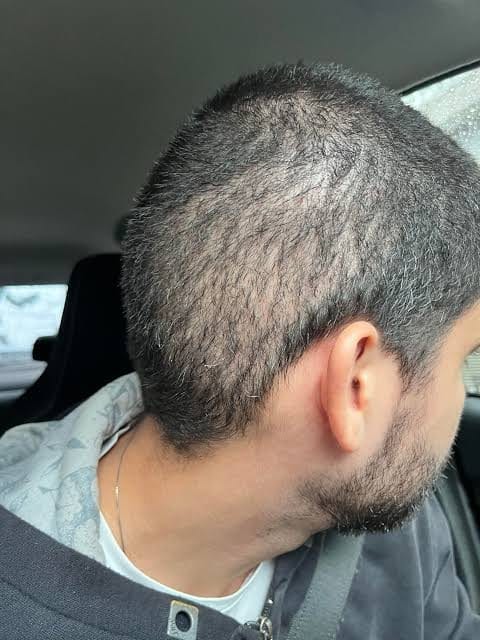
Donor depletion after multiple sessions
Each session takes from the same finite area, and the second and third are extracted from a donor zone already reduced by the first.
Each session takes from the same finite area, and the second and third are extracted from a donor zone already reduced by the first. Depletion is cumulative, and the arithmetic of a later session is not the same as the first.
Why isn't a second hair transplant session the same arithmetic as the first?
Patients treat sessions as independent — 2 000 grafts now, more later — but each session draws from a reduced density, so the same number is a larger proportional loss each time. A 70-unit-per-cm² donor area might drop to 50 after the first session, 30 after the second, and an unviable 10 after a third.
Patients often think of sessions as independent transactions: 2 000 grafts now, another 2 000 in three years. The donor area does not work that way.
The first session removes follicular units from a zone at its original density. The second removes them from the same zone at a reduced density. The same absolute number therefore represents a larger proportional loss the second time, and a larger one again the third.
A donor area at 70 follicular units per cm² that gives up 20 is left at 50 — still comfortable. Give up another 20 and it is at 30, which is where thinning becomes apparent. The third 20 would take it to 10, which is not a viable donor area at all.
The numbers are illustrative rather than a rule, but the shape is real: the margin shrinks faster than the graft count suggests.
What effects accumulate across multiple donor-harvesting sessions?
Five things accumulate: reduced density from each harvest; dot scars that add up across sessions, visible at a shorter hair length each time; reduced camouflage, since less hair remains to hide old scars; harvest-area drift toward the crown, nape and temples, where grafts are less reliably permanent; and fibrosis, which makes extraction harder.
- Reduced density. The direct effect, and the one that determines when the area starts to look thin.
- Accumulated dot scars. Each session adds to the same finite surface. Even at safe per-session density, total scarring adds up, and the hair length at which it becomes visible rises.
- Reduced camouflage. Lower remaining density means less hair available to cover the dots from all previous sessions, so the effects compound rather than add.
- Harvest area drift. Later sessions tend to reach further out — higher toward the crown, lower toward the nape, further around the temples — because the central zone is already worked. That is where grafts stop being reliably permanent.
- Fibrosis. Previously harvested tissue can be firmer, which makes subsequent extraction technically harder and can raise transection.
Why do some patients end up needing session after session of hair transplant surgery?
Some multi-session plans are deliberate and sound — a large plan staged across sessions with reserve held back is proper management. Many are not planned at all: the first session addresses the pattern as it stood, the pattern continues, a gap appears, and a reactive second session spends reserve without any plan ever existing.
Some multi-session plans are deliberate and good: a surgeon who stages a large plan across two sessions three years apart, with a reserve held back, is managing donor supply properly.
Many are not planned at all. They happen because the first session addressed the pattern as it was, the pattern continued, and a gap appeared. Then the second session addressed the new gap, the pattern continued again, and so on. Each step is reactive, and the reserve is consumed without a plan ever having existed.
The distinguishing question is whether the second session was anticipated at the time of the first. If it was, someone was managing the budget. If it appeared as a surprise, nobody was.
What signals that another donor-harvesting session is not advisable?
A further session is inadvisable when measured donor density has fallen near or below roughly 50 follicular units per cm² across the harvested zone, dot scars are visible at your normal hair length, the harvest would need to extend outside the defined safe zone, trichoscopy shows miniaturisation, or the target is a still-progressing crown.
This is the hardest judgement in the field, because the patient's motivation to continue is strongest exactly when the donor area can least afford it.
Signals that a further session is not advisable:
- Measured donor density has fallen near or below roughly 50 follicular units per cm² across the harvested zone.
- Dot scars are visible at your normal hair length.
- The harvest would have to extend outside the previously defined safe zone.
- Trichoscopy shows miniaturisation in the donor area.
- The area you want covered is the crown, and your pattern is still progressing.
A surgeon who declines a third session is giving you real information. A clinic that will always find grafts is telling you something different.
What options are left for a patient who has already run out of donor reserve?
A depleted donor area leaves the same limited options as any: scalp micropigmentation to reduce contrast, beard or body hair to supplement if available, medical therapy to preserve remaining native hair, or accepting the result at a workable length. None restores the reserve, which is why decisions made before the first session matter most.
Planning around a finite reserve is covered on our page about donor supply.
Sources
- Romera de Blas C, Vega Díez D, Ricart Vayá JM, Gómez Zubiaur A. Complications in follicular unit excision hair transplantation: current evidence and practical approaches. Frontiers in Medicine, 2026;13:1750989. pubmed.ncbi.nlm.nih.gov/41709896
- Jimenez F, Ruifernández JM. Distribution of human hair in follicular units. A mathematical model for estimating the donor size in follicular unit transplantation. Dermatologic Surgery, 1999;25(4):294-298. pubmed.ncbi.nlm.nih.gov/10417585
- Umar S, Khanna R, Maldonado JC, Chouhan K, Gonzales A. Beard and Body Hair Transplantation by Follicular Unit Excision Using a Skin-Responsive Device: A Multicenter Study. Dermatologic Surgery, 2024;50(3):306-308. pubmed.ncbi.nlm.nih.gov/38127669
- Maas D, et al. Rethinking the occipital scalp as a control in advanced androgenetic alopecia. Journal of the American Academy of Dermatology, 2026 (ahead of print). pubmed.ncbi.nlm.nih.gov/42398778
- Rassman WR, Bernstein RM, McClellan R, Jones R, Worton E, Uyttendaele H. Follicular unit extraction: minimally invasive surgery for hair transplantation. Dermatologic Surgery, 2002;28(8):720-728. pubmed.ncbi.nlm.nih.gov/12174065
This article summarises published research and standard clinical practice. It is general educational information, not medical advice, and it does not replace the instructions your own surgical team gives you. Where their guidance differs from anything here, follow theirs.
Get a no-obligation assessment against fixed criteria, directly on WhatsApp.