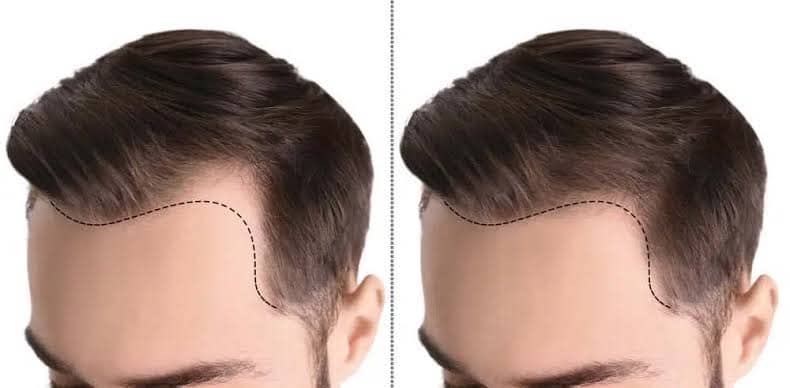
Donor area after a failed transplant abroad
Repair cases frequently arrive with a depleted donor area as well as a poor recipient result, and the donor damage is the harder problem.
Repair cases frequently arrive with a depleted donor area as well as a poor recipient result, and the donor damage is the harder problem. Assessment has to start with what reserve remains, not with what the front looks like.
Why is a donor-area assessment more important than the recipient area in hair transplant repair cases?
Repair patients usually complain about the recipient area — a low hairline, visible plugs, poor density — but the outcome is determined by the donor area, since repair requires grafts and the available reserve is whatever survived the first operation. In many cases the donor area was heavily harvested, meaning the patient's goal may not be achievable.
Patients seeking repair after a poor result usually present with a list of complaints about the recipient area: a hairline that is too low or too straight, visible plugs or pitting, poor density, unnatural angles.
The assessment that determines what can be done, though, is of the donor area. A repair requires grafts, and the reserve available is whatever survived the first operation. In a substantial proportion of these cases the donor area was heavily harvested, and that constrains everything.
This inverts the usual consultation. In a primary case the donor area is assessed to see what is possible; in a repair case it frequently determines that the patient's stated goal is not achievable at all.
What donor-area problems are commonly found in hair transplant repair cases?
Repair cases commonly show reduced donor density (sometimes below the threshold for further extraction), extensive dot scarring, harvesting outside the safe zone into the nape, crown or temples, fibrosis that raises transection risk, a stretched strip scar in prior FUT patients, and often no records of density, graft count, photographs or operative notes.
- Reduced donor density across the harvested zone, sometimes substantially below the threshold at which further extraction is sensible.
- Extensive dot scarring, sometimes clustered where extraction was uneven.
- Harvesting outside the safe zone — into the nape, up toward the crown, or forward into the temporal region. Grafts from those areas may thin over time, and the donor sites there are visible.
- Fibrosis in previously harvested tissue, making further extraction technically harder and raising transection.
- A stretched strip scar, in patients whose first procedure was FUT.
- No records. Often no density measurement, no graft count, no photographs and no operative note.
What must a donor-area assessment include before planning a hair transplant repair?
A proper repair assessment requires measured density at multiple points including the periphery, magnified examination for miniaturisation, mapping of where extraction actually occurred, a stated numerical estimate of remaining reserve, evaluation of beard and body hair as supplementary sources, and photographic documentation — only after which a realistic plan can be discussed.
- Measured density at multiple points across the donor zone, including the periphery.
- Magnified examination for miniaturisation, which may have been missed the first time and may be the reason the result failed.
- Mapping of where extraction actually occurred, including whether it went outside the safe zone.
- An estimate of the remaining reserve, stated as a number.
- Assessment of beard and body hair as supplementary sources.
- Photographic documentation of the donor area as it now stands.
Only after that can a realistic repair plan be discussed — and 'realistic' frequently means considerably less than the patient hoped for.
What treatment options are used to repair a failed hair transplant?
Repair is usually a staged, conservative process: softening a bad hairline with fine single-hair grafts, removing or redistributing misplaced grafts in selected cases, scalp micropigmentation (which costs no donor supply), beard or body hair when scalp reserve is exhausted, medical therapy to preserve native hair, and accepting a smaller, more natural-looking goal than originally promised.
Repair is generally a staged, conservative process rather than a single corrective operation.
- Softening a bad hairline with fine single-hair grafts in front of and among existing coarse grafts, which improves naturalness without high graft consumption.
- Removing or redistributing misplaced grafts in selected cases — punching out badly angled or oversized grafts, sometimes recycling them.
- Scalp micropigmentation, which costs no donor supply and often does more for the appearance of density than further grafting would.
- Beard or body hair where scalp reserve is exhausted, for bulk behind the frontal zone.
- Medical therapy to preserve the native hair, discussed with a doctor.
- Accepting a smaller goal. Frequently the right answer is a natural-looking, less dense result rather than the one originally promised.
What should patients look for when choosing a surgeon for hair transplant repair?
Choose a surgeon who does repair work regularly, since it is a distinct skill, and insist on a donor assessment before discussing graft numbers. Be suspicious of a clinic proposing a large corrective session, since the donor area has been overspent once. Ask for the remaining reserve as a number and get a second opinion.
- Go to someone who does repair work regularly. It is a distinct skill.
- Insist on the donor assessment before any discussion of graft numbers.
- Be suspicious of a clinic that proposes a large corrective session. Your donor area has already been overspent once.
- Ask for the remaining reserve as a number, and for what is being held back.
- Ask about micropigmentation explicitly. A repair surgeon who never raises it is not considering the option that costs nothing.
- Get a second opinion. You had one bad experience; the cost of a consultation fee is trivial against repeating it.
Sources
- Romera de Blas C, Vega Díez D, Ricart Vayá JM, Gómez Zubiaur A. Complications in follicular unit excision hair transplantation: current evidence and practical approaches. Frontiers in Medicine, 2026;13:1750989. pubmed.ncbi.nlm.nih.gov/41709896
- Jimenez F, Ruifernández JM. Distribution of human hair in follicular units. A mathematical model for estimating the donor size in follicular unit transplantation. Dermatologic Surgery, 1999;25(4):294-298. pubmed.ncbi.nlm.nih.gov/10417585
- Umar S, Khanna R, Maldonado JC, Chouhan K, Gonzales A. Beard and Body Hair Transplantation by Follicular Unit Excision Using a Skin-Responsive Device: A Multicenter Study. Dermatologic Surgery, 2024;50(3):306-308. pubmed.ncbi.nlm.nih.gov/38127669
- Maas D, et al. Rethinking the occipital scalp as a control in advanced androgenetic alopecia. Journal of the American Academy of Dermatology, 2026 (ahead of print). pubmed.ncbi.nlm.nih.gov/42398778
- Zhu DC, He Y, Fan ZX, Wang J, Qu Q, Hu ZQ, Miao Y. Large-Scale Beard Extraction Enhances the Cosmetic Results of Scalp Hair Restoration in Advanced Androgenetic Alopecia in East Asian Men: A Retrospective Study. Dermatology and Therapy, 2020;10(1):151-161. pubmed.ncbi.nlm.nih.gov/31784942
This article summarises published research and standard clinical practice. It is general educational information, not medical advice, and it does not replace the instructions your own surgical team gives you. Where their guidance differs from anything here, follow theirs.
Get a no-obligation assessment against fixed criteria, directly on WhatsApp.