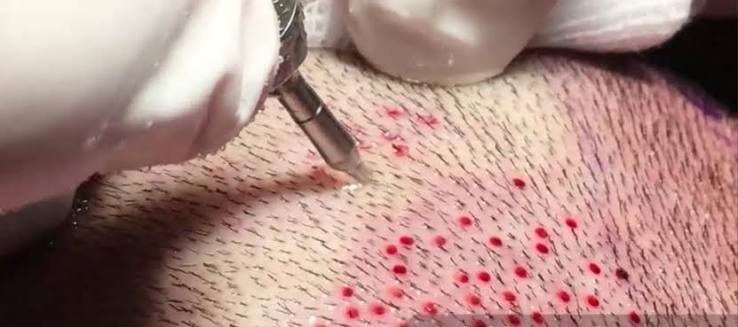
Robotic vs manual extraction: long-term comparison
Comparative work exists at short follow-up but no study compares robotic and manual extraction over years.
Comparative work exists at short follow-up but no study compares robotic and manual extraction over years. Since both remove follicles from the same donor zone, the durable differences are in donor-area appearance rather than in graft longevity.
What does the research comparing robotic and manual hair transplant extraction actually cover?
Short-term technical comparisons only. Robotic systems automate part of extraction — identifying units, aligning the punch, scoring around the follicle — under operator supervision, while manual extraction relies entirely on the operator's hand and judgement. A 2024 study compared robotic versus traditional extraction in male androgenetic alopecia, but none of this literature follows patients for years.
Robotic extraction systems automate part of the follicular unit excision process — identifying units, aligning the punch, and scoring around the follicle — under operator supervision. Manual extraction relies entirely on the operator's judgement and hand.
Zhu and colleagues published a comparative study in the Journal of Cosmetic Dermatology in 2024 on robotic hair restoration technology versus traditional follicular unit excision in male androgenetic alopecia. Reviews of the evolution of advanced follicular unit excision systems place robotic extraction in the broader arc of punch and device development.
None of this literature follows patients for years.
Should robotic or manual FUE produce more durable hair transplant results?
No, in principle. Graft longevity is governed by donor dominance — which zone a follicle came from and whether that zone is genuinely resistant — not by the device that removed it. If both a robot and a human extract a follicle intact from the safe zone and implant it competently, its twenty-year behaviour should be identical.
The premise of the whole field is donor dominance: a follicle keeps its characteristics, and what determines whether a graft lasts decades is which zone it came from and whether that zone was genuinely resistant.
A device does not change that. If a robot and a human both extract a follicle intact from the mid-occipital safe zone and it is implanted competently, its twenty-year behaviour should be identical.
So the honest answer to 'which holds up better long-term' is that there is no mechanism by which they should differ, and no data showing that they do.
Where do robotic and manual extraction actually differ in the long term?
In extraction quality and donor-area appearance, not in graft longevity. Transection rate is one measurable difference — a comparison of punching methods found 90.5% yield with an oscillatory method versus 88.3% with a rotary one. Automated systems don't fatigue across long sessions the way human operators do, but curved hair remains technically demanding regardless of device.
The differences that matter are in extraction quality and donor-area appearance, both of which have long-term consequences.
- Transection rate. A transected follicle costs a donor wound and produces no graft — the worst exchange against a finite reserve. Device and technique differences here are real: a comparison of punching methods reported yield rates of 90.5% with an oscillatory method against 88.3% with a rotary one.
- Consistency across a long session. Human extraction quality degrades with fatigue over many hours. Automated systems do not fatigue, which is one of the genuine arguments for them in large sessions.
- Distribution. Even extraction across the donor zone matters as much as the total taken. Whether automation or an attentive operator does this better is not established.
- Hair type limitations. Curved follicles — Afro-textured and tightly curly hair — are technically demanding, and operator experience with the specific hair type may matter more than the device.
Do robotic hair transplant systems actually produce better or less-scarred results?
Not necessarily. Precision affects transection rate and donor appearance, but not hairline design, placement angle, density distribution or graft handling, which is where most of a result's quality comes from. Scarring depends on punch diameter, density and distribution, so a robot using the same settings leaves the same dots as a human operator.
Robotic extraction is marketed heavily, partly because it is visible, expensive equipment that signals sophistication. Two claims deserve scrutiny.
'More precise, therefore better results.' Precision in extraction affects transection and donor appearance. It does not affect hairline design, angle of placement, density distribution or graft handling — which is where most of a result's quality actually comes from.
'Less scarring.' Scarring is a function of punch diameter, extraction density and distribution. A robot using the same punch at the same density leaves the same dots.
The operator's planning remains the dominant variable either way. A robot cannot decline an over-ambitious graft number.
What should you ask a clinic about robotic or manual extraction?
Ask what transection rate the system achieves and how it's audited, what punch diameter and density are used across what area, who supervises the system throughout, and who performs recipient site creation and placement — the parts no device does. Requesting donor photographs at twelve months at short hair length reveals the most.
- What transection rate do you achieve with this system, and how do you audit it?
- What punch diameter, and what extraction density across what area?
- Who supervises the system, and are they present throughout?
- Who performs recipient site creation and placement — the parts the device does not do?
- Can I see donor photographs at twelve months at short hair length?
That last question is, as always, the one that reveals the most, and it is independent of which device was used.
Sources
- Zhu Y, Yang K, et al. A Comparative Study on the Application of Robotic Hair Restoration Technology Versus Traditional Follicular Unit Excision in Male Androgenetic Alopecia. Journal of Cosmetic Dermatology, 2024;23(12):4213-4222. pubmed.ncbi.nlm.nih.gov/39297414
- Kim J, Ko YU, Yi KH. The condition of hair follicles produced by different punching methods during FUE surgery. Journal of Cosmetic Dermatology, 2024;23(12):4202-4207. pubmed.ncbi.nlm.nih.gov/39152658
- Chauhan K, Tandon M, Kumar A, Taneja N, Hamid SAT. A comprehensive review of evolution of advanced follicular unit excision systems. Journal of Cutaneous and Aesthetic Surgery, 2025;18(2):69-77. pubmed.ncbi.nlm.nih.gov/40212421
- Rassman WR, Bernstein RM, McClellan R, Jones R, Worton E, Uyttendaele H. Follicular unit extraction: minimally invasive surgery for hair transplantation. Dermatologic Surgery, 2002;28(8):720-728. pubmed.ncbi.nlm.nih.gov/12174065
- Romera de Blas C, Vega Díez D, Ricart Vayá JM, Gómez Zubiaur A. Complications in follicular unit excision hair transplantation: current evidence and practical approaches. Frontiers in Medicine, 2026;13:1750989. pubmed.ncbi.nlm.nih.gov/41709896
This article summarises published research and standard clinical practice. It is general educational information, not medical advice, and it does not replace the instructions your own surgical team gives you. Where their guidance differs from anything here, follow theirs.
Get a no-obligation assessment against fixed criteria, directly on WhatsApp.