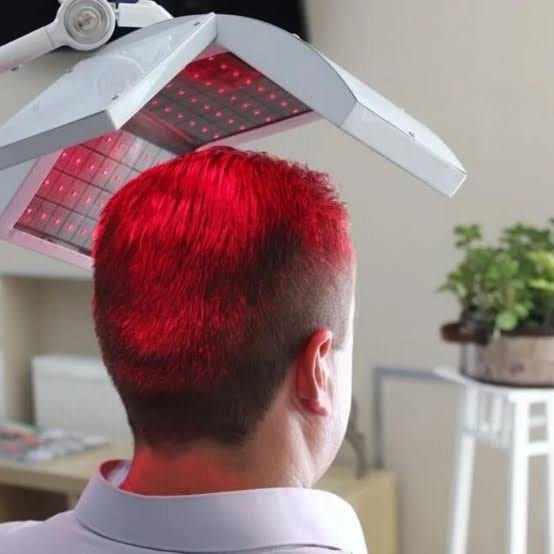
Long-term outcomes when LLLT is used ongoing
LLLT has randomised evidence in androgenetic alopecia, mostly at months rather than years and mostly alongside Minoxidil.
LLLT has randomised evidence in androgenetic alopecia, mostly at months rather than years and mostly alongside Minoxidil. Its relevance after a transplant is to the native hair, not to the grafts — which do not need it.
What is LLLT used for, and does it affect transplanted grafts?
LLLT, also called photobiomodulation or red light therapy, stimulates existing follicles in androgenetic alopecia and is delivered by caps, combs or in-clinic devices over months to years. In a transplanted patient it targets the native hair around the grafts, not the transplanted follicles themselves, which are already largely DHT-resistant.
Low-level laser therapy, also called photobiomodulation or red light therapy, is used to stimulate existing follicles in androgenetic alopecia. It is delivered by caps, combs or in-clinic devices, typically over months to years.
In a transplanted patient it is relevant to the native hair — the hair around and behind the grafts that is still androgen-sensitive and still miniaturising. The grafts themselves came from a largely DHT-resistant zone and are not the target.
This is the same distinction that applies to medical therapy, and it is worth holding onto: adjuncts sold as protecting your transplant are, at best, protecting its surroundings.
Does research support LLLT for androgenetic alopecia?
A 2025 meta-analysis of seven randomised trials by Mawu and colleagues, published in Lasers in Medical Science, found that LLLT combined with topical Minoxidil increased hair density and diameter more than Minoxidil alone, with higher satisfaction and comparable safety — though follow-up was measured in months, not years.
Mawu and colleagues published a systematic review and meta-analysis of seven randomised trials in Lasers in Medical Science in 2025, finding that combining LLLT with topical Minoxidil produced a greater increase in hair density and diameter than Minoxidil alone, with higher patient satisfaction and comparable safety.
That is a real evidence base, and it is stronger than most adjuncts in this field can claim. Two qualifications matter for a long-term question.
- It is mostly combination evidence. The finding is about adding LLLT to Minoxidil, not about LLLT as a standalone equivalent to medication.
- Follow-up is months, not years. As with essentially everything in hair restoration, nobody has published multi-year outcomes.
Where does LLLT fit in a long-term hair loss plan after a transplant?
For protecting native hair long-term, medical therapy has the strongest evidence — Finasteride with five-year follow-up, Minoxidil with randomised trials — while LLLT offers shorter-horizon randomised evidence, mostly as a Minoxidil addition, and PRP has weaker evidence. LLLT's advantage is being a low-burden home device with a safety profile comparable to control.
If the goal is protecting native hair over decades — which is the goal that determines whether a transplant still looks coherent at ten years — then LLLT is one option among several, and not the best-evidenced one.
- Medical therapy has the longest evidence horizon in the field: Finasteride with five-year multinational follow-up, Dutasteride compared in meta-analysis, Minoxidil with randomised evidence including head-to-head trials and consensus guidance on low-dose oral use. What is appropriate is a matter for a doctor.
- LLLT has randomised trial evidence at shorter horizons, largely as an addition to Minoxidil.
- PRP has a larger but methodologically weaker literature, mostly in AGA rather than in transplant maintenance.
LLLT's practical advantages are real: it is a home device, low burden, with an adverse-effect profile generally comparable to control in the trials. For patients who cannot or will not take medication, that combination matters.
What is the long-term cost of using LLLT?
LLLT is typically a one-off device purchase rather than a recurring fee, giving it a more favourable ten-year cost profile than PRP courses, though devices need replacing eventually. The real limiting factor is adherence: a device used for months and then abandoned delivers no benefit, and the trials measured only people who followed protocol.
What questions should you ask about LLLT claims?
Before trusting an LLLT claim, ask what outcome is claimed and from which study, whether the evidence is for LLLT alone or added to Minoxidil, and what the protocol is. The key question is whether LLLT is proposed instead of medical therapy or alongside it — trials only tested it as an addition.
- What outcome are you claiming, and from which study?
- Is that evidence for LLLT alone or LLLT added to Minoxidil?
- What is the protocol — how often, for how long, indefinitely?
- How will we measure whether it is working?
- Is this instead of medical therapy or alongside it?
That last question is the important one. LLLT presented as a replacement for medication is going beyond what the trials examined; presented as an addition, it reflects what they actually tested.
Sources
- Mawu FO, et al. Comparative efficacy and safety of low-level laser therapy and topical Minoxidil combination vs. topical Minoxidil monotherapy for androgenetic alopecia: a systematic review and meta-analysis. Lasers in Medical Science, 2025;40(1):338. pubmed.ncbi.nlm.nih.gov/40826200
- Long-term (5-year) multinational experience with Finasteride 1 mg in the treatment of men with androgenetic alopecia. European Journal of Dermatology, 2002. pubmed.ncbi.nlm.nih.gov/11809594
- Gupta AK, Venkataraman M, Talukder M, Bamimore MA. Finasteride for hair loss: a review. Journal of Dermatological Treatment, 2022;33(4):1938-1946. pubmed.ncbi.nlm.nih.gov/34291720
- Penha MA, Miot HA, Kasprzak M, Muller Ramos P. Oral Minoxidil vs Topical Minoxidil for Male Androgenetic Alopecia: A Randomized Clinical Trial. JAMA Dermatology, 2024. pmc.ncbi.nlm.nih.gov/articles/PMC11007651
- Sindhusen S, Tawanwongsri W, Eden C. Efficacy of Platelet-Rich Plasma as an Adjunct to Hair Transplantation: A Systematic Review. Cureus, 2025;17(10):e94116. pubmed.ncbi.nlm.nih.gov/41069573
This article summarises published research and standard clinical practice. It is general educational information, not medical advice, and it does not replace the instructions your own surgical team gives you. Where their guidance differs from anything here, follow theirs.
Get a no-obligation assessment against fixed criteria, directly on WhatsApp.