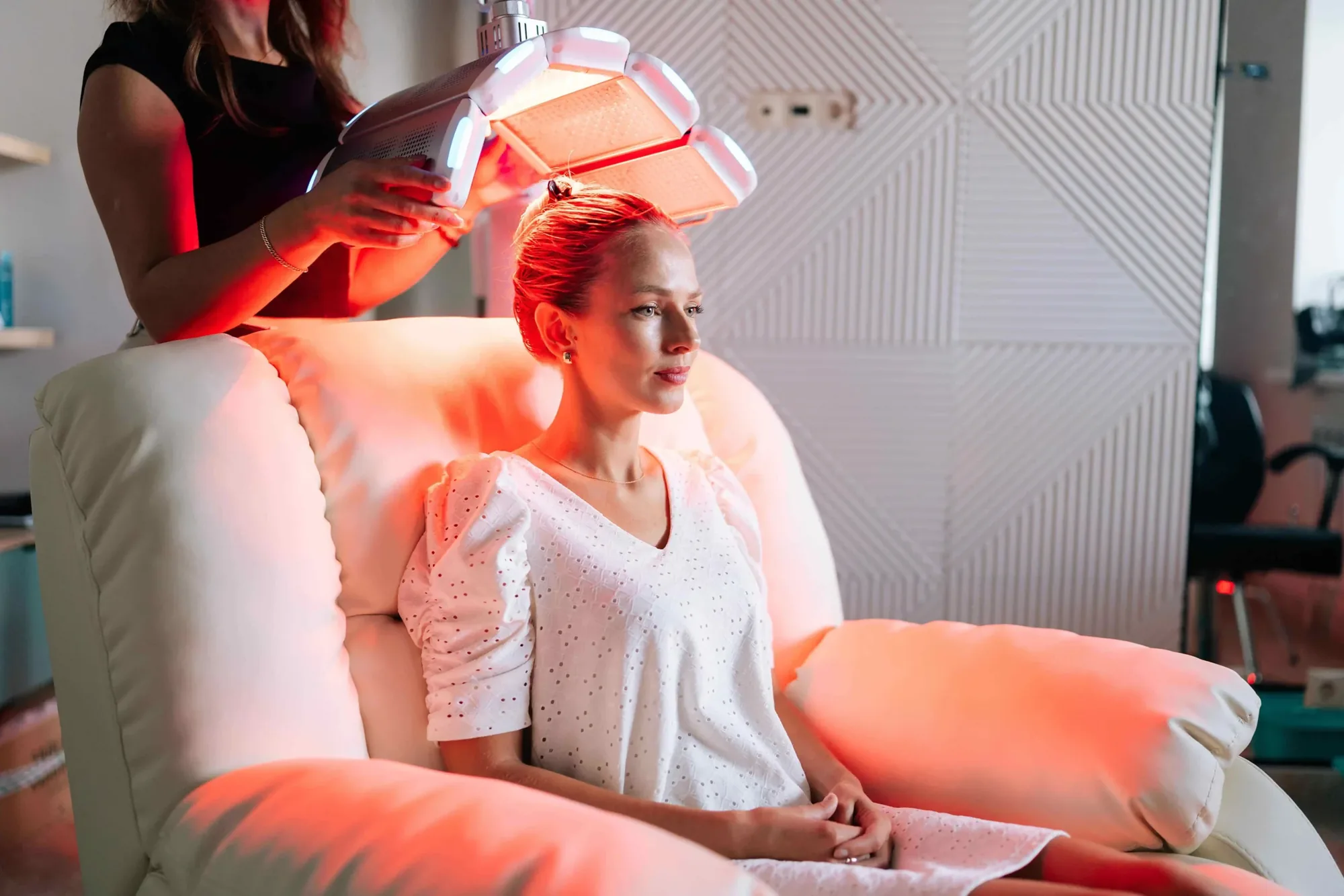
Red light therapy (LLLT) for hair loss and after a transplant: does it work?
Laser combs, helmets and panels promise more hair with red light. I explain the mechanism, what the evidence really shows, and the pros and cons.
What is red light therapy?
Red light therapy, also called low-level laser therapy (LLLT), photobiomodulation or simply laser therapy, uses low intensity red and near infrared light, typically at wavelengths around 650-670 nanometres, to irradiate the scalp. The treatment is delivered through various devices: combs, brushes, caps, helmets and panels, available both for clinic use and home use. Unlike the powerful lasers used for hair removal, LLLT light is so weak that it neither heats nor damages the tissue, hence the name 'low-level'.
The treatment has become widespread, partly because it is painless, non-invasive and almost free of side effects. But because it is marketed so aggressively, with expensive home devices, you need to understand what it can and cannot realistically do. As a surgeon I regularly meet patients who either have great hopes for their newly purchased laser helmet or, conversely, write the whole thing off as humbug. The truth, as so often, lies somewhere in between.
How is it supposed to work?
The proposed mechanism behind LLLT is called photobiomodulation. The idea is that the red light is absorbed by the enzyme cytochrome c oxidase in the cells' mitochondria, the 'power stations' of the cell. This absorption is thought to increase the production of ATP, the cell's energy molecule, and thereby stimulate the follicle cells to greater activity. In practice that should prolong the growth phase (anagen), wake resting follicles and improve the thickness of the hair.
There is also a theory that the light improves the microcirculation in the scalp and reduces local inflammation around the follicles. Both would theoretically create a better growing environment for the hair. The mechanism is biologically plausible and is supported by laboratory experiments, but as with all hair treatment the leap from the laboratory to real, noticeable hair growth in a human being is what counts. And here the picture is more mixed.
What does the evidence say?
LLLT is in fact one of the better documented among the 'alternative' hair treatments, and several devices have obtained regulatory approval (for example FDA clearance) for treating androgenetic hair loss. Several randomised studies have shown a statistically significant improvement in hair density compared with placebo (sham treatment). That is more than can be said for many of the supplements and serums sold for hair loss.
But, and it is an important but, 'statistically significant' is not the same as 'dramatic'. The effect is generally mild to moderate, it varies a great deal from person to person, and it is best documented for slowing loss and giving a modest thickening, not for restoring hair in bald areas. And some of the research is funded by the device manufacturers themselves, which calls for a critical eye. The conclusion: LLLT works for some people, but modestly. It is a supplement, not a miracle cure.
Advantages of red light therapy
- Very few side effects: Painless, non-invasive and without the systemic side effect profile that Finasteride, for example, can have. For many people this is the greatest attraction.
- Reasonable documentation: Better than most alternative treatments, with several approved devices and randomised studies behind it.
- Can be combined: LLLT does not interfere with Minoxidil or Finasteride; on the contrary, it is often used as a supplement that attacks the problem from another angle.
- Suitable after a transplant: Because the light can promote circulation and reduce inflammation, some clinics use it to support healing and growth after an operation.
- Home treatment: Once the device is bought, the treatment can be carried out at home without ongoing clinic visits.
Disadvantages and pitfalls
- A modest effect: Expect a mild improvement or stabilisation, not a rebuilding of lost hair. Unrealistic expectations lead to disappointment.
- A demand for persistence: The effect requires regular use several times a week for months, and disappears if you stop. Many people give up before they see results.
- Price: Quality devices, especially helmets with many diodes, can cost thousands. Cheap combs with few diodes probably deliver too little light to make a difference.
- Differences in quality: The market is full of devices of varying quality. The number of diodes, the wavelength and the output vary enormously, and not everything called 'laser therapy' delivers a meaningful dose.
- It does not work for everyone: A considerable proportion of users experience no noticeable effect, and there is no reliable way to predict who responds.
My clinical position
I place LLLT in the category of 'low risk, modest and uncertain gain'. For a patient who wants to do everything reasonable to preserve their hair, and who either cannot tolerate or does not want medication, it is a sensible supplement with acceptable documentation and almost no drawbacks beyond price and time. I rarely advise against it, but I never oversell it.
What I always emphasise is the order: LLLT is a supplement, not a foundation. The foundation in treating hereditary hair loss is still Finasteride and Minoxidil, which have far stronger evidence. Using an expensive laser helmet instead of well documented medication is putting the weakest tool first. Used on top of a solid foundation, however, it can for some people give the extra margin that preserves a little more hair.
Get a free hair analysis
- 1Start
- 2Info
- 3Done
How to use it sensibly
If you choose to try LLLT, do it properly: choose a device with sufficient diodes and a documented wavelength (around 650-670 nm), use it consistently according to the manufacturer's instructions (typically several times a week), and give it at least 4-6 months before you judge the effect, exactly as with medication. Take date-stamped photographs along the way, since modest changes are hard to see in the mirror from day to day.
And be realistic about the finances: if the choice is between an expensive laser helmet and a year's supply of well documented medication, you now know where the evidence is strongest. After a transplant, LLLT can be used as a gentle supplement once the skin has healed, but always by agreement with your clinic.
Device types: what should you look for?
The market for LLLT devices is large and hard to make sense of, and the difference between an effective and a useless device is above all about how much light of the right wavelength is actually delivered to the scalp. Here are the most important types:
| Type | Coverage | Note |
|---|---|---|
| Laser comb or brush | Spot by spot | Cheap, but often delivers too little light; requires slow, systematic use. |
| Cap or helmet | The whole scalp | More expensive, but treats everything at once, often the most practical choice. |
| Panel or clinic device | A large area | Powerful, but requires clinic visits. |
Pay particular attention to the number of diodes and the stated wavelength. A device with few diodes covers too little to make a meaningful difference, whatever the marketing says. In general, a helmet with many diodes that treats the whole scalp at once gives the most consistent treatment, but also carries the highest price.
LLLT after a hair transplant
A question I am often asked is whether red light can be used to support healing and growth after an operation. In theory there is a reasonable case: increased microcirculation and reduced inflammation are exactly what a healing recipient area can benefit from, and some clinics integrate LLLT into their recovery protocol for that very reason.
My position is one of cautious optimism. I do not advise against it, but I always recommend waiting until the skin has healed enough for the device to rest against the scalp without disturbing the new grafts, typically some way into the process and always by agreement with your clinic. And again: it is a gentle supplement, not the thing that determines whether your transplant succeeds. That is down to the technique and the aftercare.
Realistic expectations in numbers
Let me put the expectations in perspective with the figures I share with my patients. Where Finasteride and Minoxidil give the majority a clear stabilisation and many a visible thickening, LLLT's documented effect is lower and more unevenly distributed: a modest improvement in density in some users, no noticeable effect in others. There is no reliable way to predict in advance which group you will land in.
So my advice is always to treat LLLT as an investment with an uncertain return that you make on top of a solid foundation, not as something that can carry a treatment plan on its own. With that attitude most people are not disappointed, because they are not expecting miracles.
Frequently asked questions about red light therapy
Can LLLT restore lost hair? No. The documentation supports the idea that red light can slow loss and give a modest thickening of existing, weakened hairs, but it cannot restore hair in areas where the follicles have already been destroyed. That requires a transplant.
Can I use it together with Minoxidil and Finasteride? Yes, and that is in fact how it is best used. LLLT attacks the problem from a different angle than the medication and does not work against it. The combination is logical for anyone who wants to do everything reasonable to preserve their hair.
How long do I have to use it before I see anything? Allow at least 4-6 months of consistent use, exactly as with medication. And the effect disappears again if you stop; it is an ongoing treatment, not a one-off.
Are expensive helmets worth the money? That depends on whether you actually use them. An expensive helmet that sits in the cupboard after a month is money wasted. If, on the other hand, you are the type who keeps to routines, a quality device with sufficient diodes can be a sensible investment, but never in place of well documented medication.
Conclusion
Red light therapy is one of the better documented alternative treatments for hair loss, with a plausible mechanism, approved devices and real, if modest, results in studies. It is practically free of side effects, but it requires persistence and money, and the effect is mild and unpredictable.
Regard LLLT as a low risk supplement to, not a replacement for, well documented medication and a well considered treatment plan. With realistic expectations it can be a sensible part of an overall strategy. This article is for general information and does not replace an individual medical assessment.
© IdealofMeD Research Academy. Republished with permission.
Get a no-obligation assessment against fixed criteria, directly on WhatsApp.