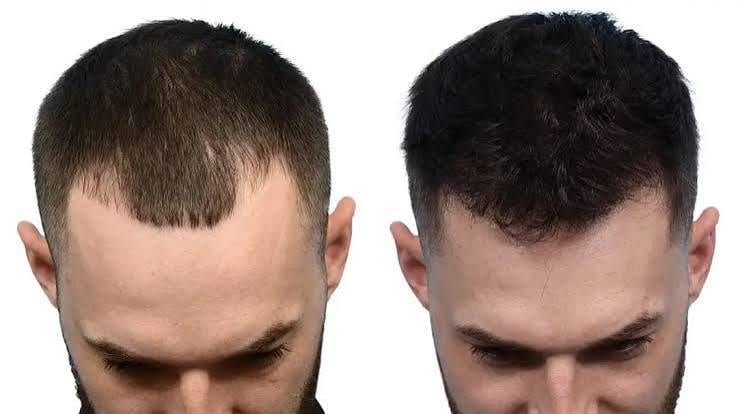
How a transplanted hairline ages aesthetically
A hairline is fixed at surgery while the face and the surrounding hair keep changing.
A hairline is fixed at surgery while the face and the surrounding hair keep changing. Conservative, irregular, age-appropriate designs continue to look right; low, straight, densely packed ones increasingly do not.
What part of a hair transplant result never changes?
The hairline is the one part of a hair transplant result that does not change: it's a line of follicles in fixed positions, staying exactly where drawn, even as native hair thins, the crown opens, and hair greys elsewhere — a permanence that becomes a constraint as the surrounding face and scalp keep ageing.
What design features make a transplanted hairline age well?
A hairline ages well when it has mature height (placed as a man in his forties naturally would have it), an irregular transition zone rather than a straight edge, single-hair grafts at the leading edge, softened rather than rebuilt temporal recession, and a well-covered mid-scalp behind it for support.
- Height. A mature hairline — placed where a man in his forties naturally has one — continues to suit the face as it ages. A juvenile hairline does not, because no older man has one naturally.
- Irregularity. Natural hairlines are not lines. They are irregular transition zones with sentinel hairs in front and varying density behind. A straight, evenly dense edge reads as constructed at any age and more so as the surrounding hair thins.
- Single-hair units at the leading edge. Multi-hair grafts at the front are the classic tell, and they become more conspicuous as the hair behind them thins and the front row stands more alone.
- Softened temporal recession. A hairline that keeps some temporal recession looks like a mature hairline. One that rebuilds full temple points looks like a wig line as the temples continue to recede beside it.
- Support behind it. A hairline with a well-covered mid-scalp behind it reads as hair. One with a thinning zone behind it reads as a band.
What is the most common way a transplanted hairline ages badly?
The characteristic hairline ageing failure is an isolated frontal band: a dense, low hairline left in front of a scalp that keeps thinning, developing over five to fifteen years as native hair recedes on both sides, leaving a strip that looks less natural than ordinary baldness and is very difficult to fix.
The characteristic ageing failure is the isolated frontal band: a dense, low hairline in front of a scalp that has continued to thin.
It develops slowly. At year one, native hair behind the transplant is still contributing and the result reads as a full head of hair. Over five to fifteen years that native hair goes, temporal recession continues on both sides, and the transplanted zone narrows into a distinct strip.
The strip looks worse than the original loss would have, because ordinary male pattern baldness is a shape people recognise as natural. A dense band with bare scalp behind it is not.
It is also very difficult to fix. The grafts cannot be moved back, the temples cannot be un-recessed, and the donor reserve required to fill everything behind the band is usually not there.
Why do patients push for a hairline that's too low?
Patients push for a lower hairline than surgeons recommend because they compare against photos of themselves at twenty rather than how they'll look at fifty; a surgeon who agrees is trading long-term result for short-term satisfaction, and patients talked into a higher, more conservative hairline overwhelmingly report being glad of it later.
Almost every patient wants a lower hairline than the surgeon proposes. The reason is understandable: they are comparing against photographs of themselves at twenty, not against how they will look at fifty.
A surgeon who accedes is choosing short-term satisfaction over long-term result. A surgeon who holds the line is doing the job, and patients who were talked into a higher hairline overwhelmingly report being glad of it later — while the reverse is one of the most common regrets in repair consultations.
The psychological dimension here is recognised in the literature. Tan and Jafferany's narrative review of psychological dimensions of hair transplantation discusses patient expectations and the case for incorporating psychological evaluation into pre-operative assessment, noting screening tools for identifying high-risk individuals.
What questions should you ask before hairline design surgery?
Before hairline surgery, accept the higher hairline your surgeon proposes, ask to see the design marked on your head and photograph it, ask how many single-hair grafts are planned for the leading edge, ask what the design will look like at your projected worst-case Norwood stage, and ask whether the mid-scalp is being treated too.
- Accept the higher hairline. This is the single most reliable piece of advice in the field.
- Ask to see the design marked on your own head before surgery, and photograph it.
- Ask how many single-hair grafts are planned for the leading edge — a specific number indicates a design.
- Ask what the design will look like at your projected worst-case Norwood stage.
- Ask whether the mid-scalp is being treated, or only the hairline.
Sources
- Tan IJ, Jafferany M. Psychological Dimensions of Hair Transplantation: A Narrative Review of Current Evidence. Journal of Cosmetic Dermatology, 2025;24(10):e70475. pubmed.ncbi.nlm.nih.gov/40990054
- Maas D, et al. Rethinking the occipital scalp as a control in advanced androgenetic alopecia. Journal of the American Academy of Dermatology, 2026 (ahead of print). pubmed.ncbi.nlm.nih.gov/42398778
- Jimenez F, Ruifernández JM. Distribution of human hair in follicular units. A mathematical model for estimating the donor size in follicular unit transplantation. Dermatologic Surgery, 1999;25(4):294-298. pubmed.ncbi.nlm.nih.gov/10417585
- Maletic A, et al. Impact of Hair Transplantation on Quality of Life. Aesthetic Plastic Surgery, 2024;48(9):1825-1830. pubmed.ncbi.nlm.nih.gov/38123846
- Rassman WR, Bernstein RM, McClellan R, Jones R, Worton E, Uyttendaele H. Follicular unit extraction: minimally invasive surgery for hair transplantation. Dermatologic Surgery, 2002;28(8):720-728. pubmed.ncbi.nlm.nih.gov/12174065
This article summarises published research and standard clinical practice. It is general educational information, not medical advice, and it does not replace the instructions your own surgical team gives you. Where their guidance differs from anything here, follow theirs.
Get a no-obligation assessment against fixed criteria, directly on WhatsApp.