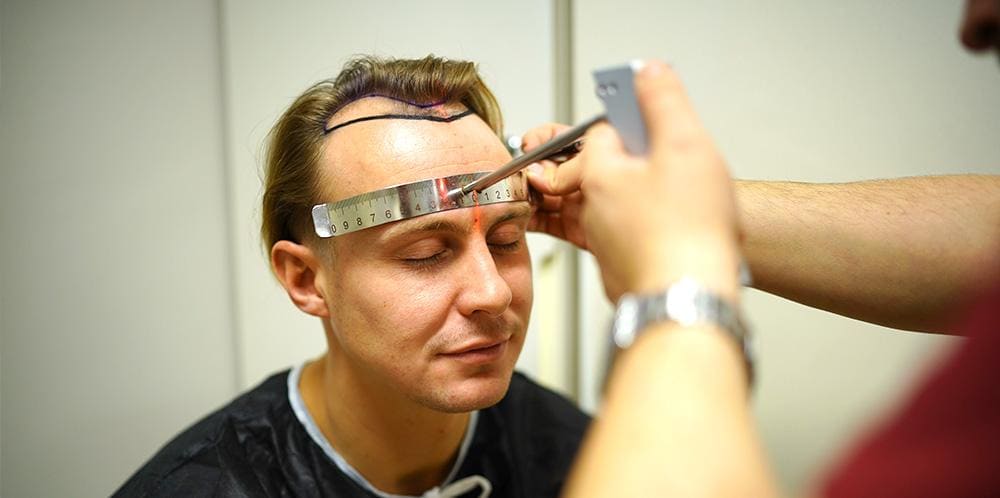
Hairline recession patterns over decades
Androgenetic recession continues around a transplanted hairline unless the underlying process is treated.
Androgenetic recession continues around a transplanted hairline unless the underlying process is treated. The transplanted hairs stay where they were placed, which is why a low hairline can end up isolated from the hair behind it.
Why does a transplanted hairline look different from surrounding hair over time?
A transplanted hairline is a fixed line of largely DHT-resistant follicles that does not recede, while native hair around it does recede in androgenetic alopecia. The result is a front edge that stays put while hair behind and beside it retreats — looking normal if the hairline is conservative, or like a strip if low.
A transplanted hairline is a fixed line of largely DHT-resistant follicles. It does not recede. Everything around it is native hair which, in androgenetic alopecia, does.
That combination produces the characteristic long-term change in transplanted hairlines: not a receding front edge, but a front edge that stays where it is while the hair behind and beside it retreats.
The visible result depends on where the line was drawn and how much the surroundings change. A conservatively placed hairline sitting on a maturing pattern reads as normal. A low hairline sitting in front of an advancing bald zone reads as a strip.
Which regions of the scalp keep changing after a frontal hair transplant?
Four regions keep moving: the mid-frontal zone behind the hairline, often first to gap if untreated; the temples, where temporal recession isolates the frontal band; the mid-scalp, which keeps thinning if only the frontal third was transplanted; and the crown, which expands until it meets the thinning mid-scalp and the result looks disconnected.
- The mid-frontal zone behind the hairline. Usually the first area to show a gap if native hair there was miniaturising at surgery and was not treated.
- The temples and temple points. Temporal recession continues on its own schedule. A restored frontal hairline with continuing temporal recession produces an increasingly narrow, isolated frontal band.
- The mid-scalp. If the transplant covered only the frontal third, the mid-scalp continues to thin behind it.
- The crown. Expands outward, and eventually meets the thinning mid-scalp, which is the point at which a frontal-only restoration starts to look disconnected.
Why is hairline height the most important decision in a hair transplant?
Hairline position has the longest consequences and least flexibility of any surgical decision. A mature hairline, placed where an older man naturally would have one, keeps looking correct as the pattern advances, while a low juvenile hairline looks wrong by fifty and consumes more grafts. A hairline can be softened later but never raised.
Of everything decided at surgery, hairline position has the longest consequences and the least flexibility.
A mature hairline — placed where a man in his forties would naturally have one, with softened temporal recession — continues to look correct as the pattern advances. It sits at a height the face grows into.
A juvenile hairline — low, straight, with rebuilt temple points — looks striking at thirty and increasingly wrong at fifty, because no fifty-year-old has that hairline naturally. It also consumes far more grafts, both immediately and in the further sessions it commits you to.
Patients almost universally push for the lower option, and surgeons who accede are storing up a problem that cannot be fixed. A hairline can be softened and made more irregular; it cannot be raised.
What does an untreated hairline recession pattern look like decade by decade?
Clinical experience describes a consistent progression when native hair is untreated: years 1-3 look as designed; years 3-7 show thinning behind the hairline; years 7-15 bring a widening gap and narrowing frontal band, often prompting a second session; and beyond 15 years the hairline may sit as a distinct band or simply read as thinning.
Clinical experience — again, not published follow-up — describes a fairly consistent progression when native hair is not treated.
- Years 1-3. The result looks as designed. Native hair behind the grafts is still contributing.
- Years 3-7. Thinning behind the hairline becomes apparent. The transplanted zone begins to stand out as denser than its surroundings.
- Years 7-15. The gap widens. Temporal recession narrows the frontal band. A second session is often sought around here.
- Beyond 15 years. Depending on the underlying pattern, the transplanted hairline may sit as a distinct band in front of a substantially bald scalp — or, if the design was conservative and the native hair was treated, may simply read as ordinary thinning.
What can change the long-term trajectory of a transplanted hairline?
Four levers change the trajectory: medical therapy for native hair, the largest lever, backed by finasteride's five-year multinational follow-up; a conservative hairline, which costs fewer grafts and ages correctly; treating the mid-scalp rather than only the hairline, since an unsupported hairline ages worst; and holding back donor reserve so the pattern is followed, not chased.
- Medical therapy for the native hair. The single largest lever, and the one most under your control. Finasteride's five-year multinational follow-up is among the longer-horizon evidence in this field. What is right for you is a matter for a doctor who knows your history.
- A conservative hairline. Costs fewer grafts and ages correctly.
- Treating the mid-scalp, not just the hairline. A hairline without support behind it is the configuration that ages worst.
- Donor reserve held back so the pattern can be followed rather than chased.
Sources
- Maas D, et al. Rethinking the occipital scalp as a control in advanced androgenetic alopecia. Journal of the American Academy of Dermatology, 2026 (ahead of print). pubmed.ncbi.nlm.nih.gov/42398778
- Long-term (5-year) multinational experience with Finasteride 1 mg in the treatment of men with androgenetic alopecia. European Journal of Dermatology, 2002. pubmed.ncbi.nlm.nih.gov/11809594
- Gupta AK, Venkataraman M, Talukder M, Bamimore MA. Finasteride for hair loss: a review. Journal of Dermatological Treatment, 2022;33(4):1938-1946. pubmed.ncbi.nlm.nih.gov/34291720
- Jimenez F, Ruifernández JM. Distribution of human hair in follicular units. A mathematical model for estimating the donor size in follicular unit transplantation. Dermatologic Surgery, 1999;25(4):294-298. pubmed.ncbi.nlm.nih.gov/10417585
- Xu Y, et al. Case Report: Paired vertex-occipital assessment reveals donor-area involvement in diffuse unpatterned alopecia. Frontiers in Medicine, 2026;13:1797275. pubmed.ncbi.nlm.nih.gov/41982548
This article summarises published research and standard clinical practice. It is general educational information, not medical advice, and it does not replace the instructions your own surgical team gives you. Where their guidance differs from anything here, follow theirs.
Get a no-obligation assessment against fixed criteria, directly on WhatsApp.