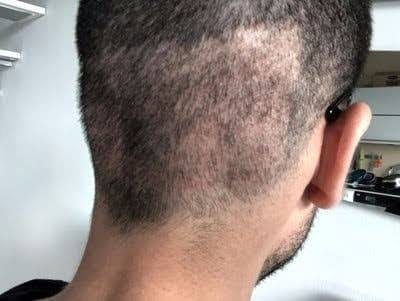
Overharvesting: what it looks like and why it's irreversible
Overharvesting means removing more follicular units from the donor area than the remaining hair can camouflage.
Overharvesting means removing more follicular units from the donor area than the remaining hair can camouflage. It produces a permanently thin, patchy or moth-eaten donor zone, and there is no procedure that restores the extracted follicles.
What is overharvesting in hair transplant surgery?
Overharvesting is removing more follicular units from the donor area than the remaining hair can conceal — a planning decision, not a surgical slip. As density falls below the level needed for coverage, the extraction points show through, and the small hypopigmented dots left by each punch become visible.
Overharvesting is the removal of more follicular units from the donor area than the hair left behind can conceal. It is not a technical error in the sense of a slip during surgery. It is a planning decision — a graft number chosen without regard for what the donor area can give up.
The mechanism is simple. Donor hair covers the extraction points because the surviving follicles lie over them. Remove enough and the density falls below the level where that coverage works. The area then reads as thin, and the small hypopigmented dots left by each punch begin to show through.
What are the visible signs of an overharvested donor area?
Signs include diffuse thinning of the back and sides most visible under bright light or in photos from behind, a moth-eaten appearance from densely clustered extraction sites, visible white FUE punch-scar dots at short hair lengths, a hard edge between heavily harvested and untouched regions, and an inability to wear the hair short.
- Diffuse thinning of the back and sides, most obvious under bright overhead light or in photographs taken from behind.
- A moth-eaten appearance, where clusters of extraction sites left too close together create visible patches of lower density.
- Visible white dots at short hair lengths. Every FUE punch leaves a small round hypopigmented scar; at normal density they are hidden, and at low density they are not.
- A hard edge where a heavily harvested region meets an untouched one.
- An inability to wear short hair. For many patients this is the practical injury: the transplant succeeded at the front, and they can no longer clip the back.
Hypopigmentation, hypertrophic scarring, epithelial cysts and donor depletion are all documented among donor-area complications of follicular unit excision. Depletion is the one with no route back.
Why isn't overharvesting obvious right after surgery?
In the weeks after surgery the shaved, slightly red donor area masks density changes, and regrowing hair drapes over the extraction zone so it looks acceptable. The problem typically surfaces later — at a shorter cut, in stronger light, or in a photo from behind — which is why judgement waits until around twelve months.
This is the part patients find hardest to hear afterwards. In the weeks following surgery the donor area is shaved or short and often slightly red, which masks density changes. As it grows out over the first months, the remaining hair drapes over the extraction zone and things look acceptable.
The picture that reveals overharvesting usually emerges later — at a shorter haircut, in stronger light, or from a photograph taken by someone else from behind. By that point the extraction happened many months ago and nothing can be undone.
Some patients also experience temporary donor shedding after extraction, which recovers. That is not the same as depletion, and telling them apart requires waiting, which is why an honest surgeon will not make a judgement about donor damage before around twelve months.
Can an overharvested donor area be repaired?
No — there is no treatment that regenerates an extracted follicle. Scalp micropigmentation, a tattoo that reduces the contrast of visible dots, is the most reliable camouflage option; beard or body hair can sometimes add density, though its characteristics don't match; and growing the hair longer is the free option most patients end up choosing.
There is no treatment that regenerates an extracted follicle. The options after overharvesting are camouflage, not restoration.
- Scalp micropigmentation can reduce the contrast between white dots and surrounding skin and make a thin donor area look denser at short lengths. It is the most reliable option, and it is a tattoo, not hair.
- Beard or body hair can sometimes be placed into a depleted scalp donor area to add density, with the caveat that the characteristics do not match.
- Growing the hair longer is the free option and often the one patients end up living with.
None of these gives back what was taken. That asymmetry — the harvest is fast and the consequence is permanent — is the reason donor conservatism matters more than any other decision in a transplant.
How can patients avoid overharvesting during a hair transplant?
Be sceptical of graft numbers far above what other clinics quote, ask what extraction density will be used and over what area, ask what the plan leaves for the future, and request donor-area photos of the surgeon's patients at twelve months, taken from behind. Don't chase crown coverage first if your pattern is still progressing.
- Be sceptical of very large single-session numbers. A graft count far above what other clinics quote for the same head is usually a donor-area decision made in your absence.
- Ask what extraction density will be used, in grafts per cm², and over what area.
- Ask what the plan leaves for the future. If the answer is 'we'll see', the plan does not have a future in it.
- Ask to see donor-area photographs of the surgeon's own patients at twelve months, at short hair length, taken from behind. This is the single most informative thing you can ask for and the request most often deflected.
- Do not chase coverage of the crown in a first session if your pattern is still progressing. The crown consumes grafts faster than any other region and is the commonest reason a donor area gets stripped.
Sources
- Romera de Blas C, Vega Díez D, Ricart Vayá JM, Gómez Zubiaur A. Complications in follicular unit excision hair transplantation: current evidence and practical approaches. Frontiers in Medicine, 2026;13:1750989. pubmed.ncbi.nlm.nih.gov/41709896
- Jimenez F, Ruifernández JM. Distribution of human hair in follicular units. A mathematical model for estimating the donor size in follicular unit transplantation. Dermatologic Surgery, 1999;25(4):294-298. pubmed.ncbi.nlm.nih.gov/10417585
- Rassman WR, Bernstein RM, McClellan R, Jones R, Worton E, Uyttendaele H. Follicular unit extraction: minimally invasive surgery for hair transplantation. Dermatologic Surgery, 2002;28(8):720-728. pubmed.ncbi.nlm.nih.gov/12174065
- Maas D, et al. Rethinking the occipital scalp as a control in advanced androgenetic alopecia. Journal of the American Academy of Dermatology, 2026 (ahead of print). pubmed.ncbi.nlm.nih.gov/42398778
This article summarises published research and standard clinical practice. It is general educational information, not medical advice, and it does not replace the instructions your own surgical team gives you. Where their guidance differs from anything here, follow theirs.
Get a no-obligation assessment against fixed criteria, directly on WhatsApp.