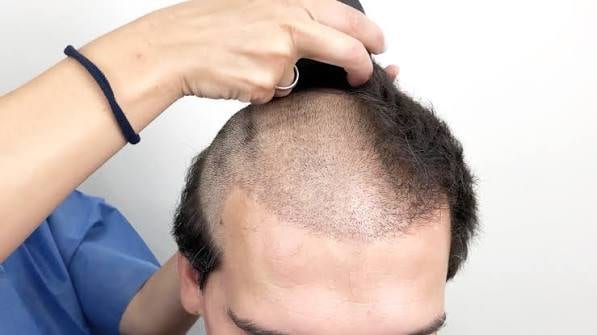
Can you shave your head after FUE
Sometimes, but it depends on how much was taken.
Sometimes, but it depends on how much was taken. A conservatively harvested donor area can usually tolerate a very short clip; a heavily harvested one shows diffuse lightening and visible dot scars at any length below about 6 mm.
Is it true that FUE always lets you shave your head afterward?
Only conditionally. FUE avoids the linear scar that blocks a short back after strip surgery, but replaces it with hundreds or thousands of small hypopigmented dots whose visibility depends on placement density and skin-hair contrast. FUE can leave you able to shave only if harvested conservatively — it is not guaranteed, whatever a clinic's marketing implies.
One of the standard selling points for FUE over strip surgery is that it leaves you free to shave your head. It is the single most repeated line in FUE marketing, and it is conditionally true rather than simply true.
FUE does avoid the linear scar that makes a very short back impossible after strip surgery. But it replaces it with hundreds or thousands of small hypopigmented dots spread across the donor zone. Whether those are visible at a given hair length depends on how densely they were placed and on your individual contrast.
So the accurate version is: FUE can leave you able to shave, if the donor area was harvested conservatively. It does not guarantee it, and a clinic that promises it while planning a very large extraction is promising two incompatible things.
What factors determine the hair-length threshold at which FUE dots become visible?
Five factors: extraction density (dominant — modest, evenly spread harvesting reads normal even short; heavy harvesting reads as a lighter zone), punch diameter (smaller dots show only at shorter lengths), skin-hair contrast (dark hair on pale skin is hardest), distribution (even scatter hides better than clustering), and total sessions, adding dots to the same finite area.
- Extraction density. The dominant factor. A donor area that has given up a modest proportion of its follicular units, evenly spread, reads as normal at very short lengths. One that has been heavily harvested reads as a lighter zone.
- Punch diameter. Smaller dots are visible only at shorter lengths.
- Skin-hair contrast. Dark hair on pale skin is the hardest combination. The dots are pale, the surrounding skin is pale, and the hair is dark — so at short lengths the eye sees a stippled lightening. Lower contrast is more forgiving.
- Distribution. Evenly scattered extraction hides far better than clustered.
- Total sessions. Each session adds dots to the same finite area.
At what hair length do FUE donor dots typically become visible?
No universal number exists, but as a pattern: above roughly 6mm, a competently harvested area is essentially indistinguishable from untouched scalp; 3-6mm is the grey zone, where conservative harvesting passes but heavy harvesting reads lighter; below 3mm or shaved, dots are visible up close and diffuse lightening shows at conversational distance if extraction was heavy.
There is no universal number, and any clinic quoting one without seeing your donor area is guessing. As a general pattern:
- Above roughly 6 mm: a competently harvested donor area is essentially always indistinguishable from untouched scalp.
- Around 3-6 mm (roughly a number two to four): the usual grey zone. A conservatively harvested donor area passes; a heavily harvested one starts to read as lighter across the back.
- Below about 3 mm, or fully shaved: dots are visible on close inspection in most patients, and diffuse lightening is visible at conversational distance if extraction was heavy.
If keeping the shaved option matters to you, it must be stated at consultation and it must constrain the graft number. It cannot be added afterwards.
What can you do if your donor area is already too depleted to shave?
Options exist even after the fact. Scalp micropigmentation is most effective: pigment deposited between and over the dots reduces contrast, making a shaved look viable again, though it needs maintenance. Growing the donor hair out is free and immediate. Grafting beard or body hair into the depleted zone raises density but spends further supply.
Patients who discover after surgery that they can no longer shave have limited options, but they are not none.
- Scalp micropigmentation is the most effective. Pigment deposited between and over the dots reduces the contrast, and a shaved or very short look becomes viable again. It is a tattoo and requires maintenance, but for this specific problem it works well.
- Growing the donor hair out is free and immediate.
- Beard or body hair grafted into the depleted zone can raise density, at the cost of spending further donor supply.
What question should you ask a clinic before booking FUE if you want to keep the shaved-head option?
Ask directly: 'given my density and the graft number proposed, will I be able to clip to a number two afterwards?' Then ask to see the surgeon's own twelve-month clipper-length photographs taken from behind — conservative clinics have and show these readily. An answer of 'yes, FUE is scarless' is a warning, not a reassurance.
Sources
- Rassman WR, Bernstein RM, McClellan R, Jones R, Worton E, Uyttendaele H. Follicular unit extraction: minimally invasive surgery for hair transplantation. Dermatologic Surgery, 2002;28(8):720-728. pubmed.ncbi.nlm.nih.gov/12174065
- Romera de Blas C, Vega Díez D, Ricart Vayá JM, Gómez Zubiaur A. Complications in follicular unit excision hair transplantation: current evidence and practical approaches. Frontiers in Medicine, 2026;13:1750989. pubmed.ncbi.nlm.nih.gov/41709896
- Chauhan K, Tandon M, Kumar A, Taneja N, Hamid SAT. A comprehensive review of evolution of advanced follicular unit excision systems. Journal of Cutaneous and Aesthetic Surgery, 2025;18(2):69-77. pubmed.ncbi.nlm.nih.gov/40212421
- Kim J, Ko YU, Yi KH. The condition of hair follicles produced by different punching methods during FUE surgery. Journal of Cosmetic Dermatology, 2024;23(12):4202-4207. pubmed.ncbi.nlm.nih.gov/39152658
This article summarises published research and standard clinical practice. It is general educational information, not medical advice, and it does not replace the instructions your own surgical team gives you. Where their guidance differs from anything here, follow theirs.
Get a no-obligation assessment against fixed criteria, directly on WhatsApp.