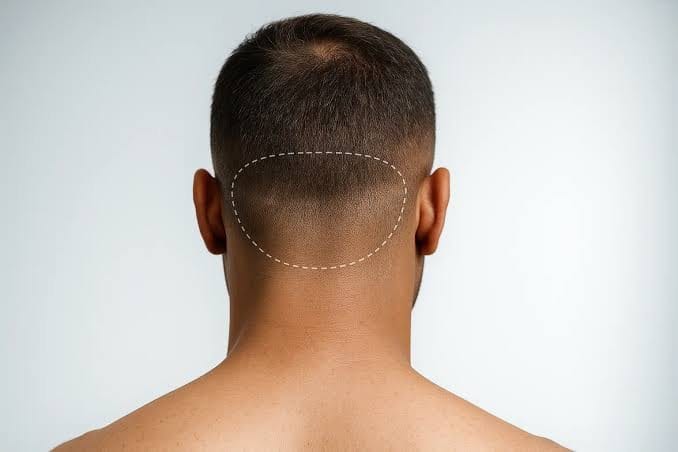
Punch size and donor scarring
Every FUE extraction leaves a round hypopigmented scar roughly the diameter of the punch.
Every FUE extraction leaves a round hypopigmented scar roughly the diameter of the punch. Smaller punches leave less visible dots but demand more precision, and the trade-off against transection is the central technical tension in donor harvesting.
What does the punch actually do during FUE extraction?
A small cylindrical punch scores around each follicular unit to separate it from surrounding tissue, described by Rassman, Bernstein and colleagues in 2002 as minimally invasive surgery. It leaves a circular full-thickness wound that heals into a small round scar, usually slightly paler than surrounding skin — the visible white dots.
In follicular unit excision, a small cylindrical punch is used to score around a follicular unit, separating it from the surrounding tissue so it can be lifted out. Rassman, Bernstein and colleagues described the approach in Dermatologic Surgery in 2002 as minimally invasive surgery for hair transplantation, using small punch excisions in place of strip harvesting.
The punch leaves a circular full-thickness wound. It heals by secondary intention into a small round scar which, in most patients, ends up slightly paler than the surrounding skin. These are the white dots that become visible when the donor hair is cut very short.
That scarring is unavoidable. What varies is how big each dot is, how many there are, and how well the remaining hair covers them.
What is the trade-off between smaller and larger FUE punches?
Smaller punches leave smaller dots and less total wound area, tolerating shorter haircuts, but need precise centring since less clearance raises transection risk. Larger punches are more forgiving — lower transection, more surrounding tissue for protection — at the cost of bigger scars and more total wounding. Neither is universally right.
Punch diameters used in practice sit in a narrow range measured in tenths of a millimetre, and the difference between the ends of that range is meaningful in both directions.
Smaller punch
A smaller punch leaves a smaller dot and less total wound area across a session, which means a donor zone that tolerates shorter haircuts. The cost is margin: the punch must be centred and angled precisely on the follicular unit, because there is less clearance between the cutting edge and the follicles themselves. Misalignment produces transection — cutting through the follicle rather than around it — which loses the graft and leaves a wound that has yielded nothing.
Larger punch
A larger punch is more forgiving. Alignment errors are absorbed by the extra clearance, transection rates fall, and grafts come out with more surrounding tissue, which some surgeons regard as protective during handling. The cost is a bigger dot scar at every extraction site and more total wounding.
Neither choice is universally right. It depends on the operator's precision, the patient's hair characteristics and skin, and how short the patient intends to wear their hair.
How has punch design evolved to reduce the scarring-versus-safety trade-off?
Punch design has evolved toward small-punch scarring with large-punch safety through successive geometry and drive-mechanism changes. A 2024 comparison found 90.5% yield with an oscillatory method versus 88.3% rotary. A 2026 case series using a flared ring punch reported a 3% mean transection rate, though that comes from one small series, not a comparative trial.
The evolution of extraction systems has largely been an effort to get small-punch scarring with large-punch safety. Reviews of advanced follicular unit excision systems describe successive generations of punch geometry and drive mechanism aimed at exactly this.
A 2024 comparison of punching methods reported yield rates of 90.5% with an oscillatory method against 88.3% with a rotary method, which gives a sense of the scale of difference these design choices make — real, but incremental.
A 2026 case series of a modified no-shave technique using a flared ring punch reported a mean transection rate of 3%. That figure comes from a small case series rather than a comparative trial, so it should be read as what a technique achieved in one reported setting rather than as a benchmark.
What factors determine how visible punch scarring is in your donor area?
Five factors: total extraction count (small dots still add up at high volume), distribution (even spread hides better than clustering), skin-hair contrast (pale skin under dark hair shows dots most), healing tendency (hypertrophic scarring is a recognised though uncommon complication), and how short you wear your hair — the biggest practical determinant.
Punch diameter is one input among several, and on its own it does not decide the outcome.
- Total number of extractions. Small dots multiplied by a very large graft count still add up to substantial total wounding.
- Distribution. Evenly spread dots disappear into normal density; clustered ones do not.
- Your skin and hair contrast. White dots on pale skin under dark hair show most.
- Healing tendency. Some patients hypopigment more than others, and hypertrophic scarring in the donor area is a recognised though uncommon complication.
- How short you wear your hair. The single biggest practical determinant of whether the dots are ever seen.
What questions should you ask about punch size and transection before FUE?
Ask what punch diameter is used for your hair type and why, what transection rate the clinic audits itself against, whether extracted and implanted grafts are counted separately, and to see twelve-month donor photographs at clipper length. If you want the option of very short hair later, say so at consultation.
- What punch diameter do you use for my hair type, and why that size?
- What transection rate do you audit yourself against?
- Do you count extracted grafts and implanted grafts separately?
- Can I see donor photographs at twelve months at clipper length?
If you intend to keep the option of very short hair, say so at consultation. It changes what a sensible plan looks like, and it is a preference the surgeon cannot infer from a photograph of your current haircut.
Sources
- Rassman WR, Bernstein RM, McClellan R, Jones R, Worton E, Uyttendaele H. Follicular unit extraction: minimally invasive surgery for hair transplantation. Dermatologic Surgery, 2002;28(8):720-728. pubmed.ncbi.nlm.nih.gov/12174065
- Chauhan K, Tandon M, Kumar A, Taneja N, Hamid SAT. A comprehensive review of evolution of advanced follicular unit excision systems. Journal of Cutaneous and Aesthetic Surgery, 2025;18(2):69-77. pubmed.ncbi.nlm.nih.gov/40212421
- Kim J, Ko YU, Yi KH. The condition of hair follicles produced by different punching methods during FUE surgery. Journal of Cosmetic Dermatology, 2024;23(12):4202-4207. pubmed.ncbi.nlm.nih.gov/39152658
- Brigante R, Wells A. Direct No-Shave Follicular Unit Excision (DNS FUE): A Modified Technique and Case Series. Cureus, 2026;18(1):e102271. doi.org/10.7759/cureus.102271
- Romera de Blas C, Vega Díez D, Ricart Vayá JM, Gómez Zubiaur A. Complications in follicular unit excision hair transplantation: current evidence and practical approaches. Frontiers in Medicine, 2026;13:1750989. pubmed.ncbi.nlm.nih.gov/41709896
This article summarises published research and standard clinical practice. It is general educational information, not medical advice, and it does not replace the instructions your own surgical team gives you. Where their guidance differs from anything here, follow theirs.
Get a no-obligation assessment against fixed criteria, directly on WhatsApp.