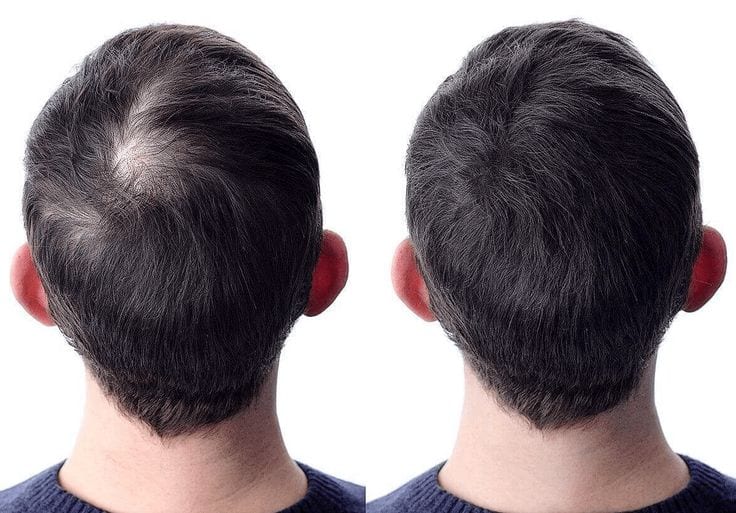
Extraction density: how many grafts per cm² is safe
There is no single safe extraction figure.
There is no single safe extraction figure. What matters is the proportion of follicular units removed relative to starting density, and how evenly they are distributed — clustered extraction at moderate density looks worse than even extraction at higher density.
Why is there no single safe number of grafts per cm² to extract?
There is no universal safe extraction number because it depends on starting density: removing 20 follicular units per cm² from an 80-per-cm² donor area leaves 60 (unnoticeable), while removing 20 from a 45-per-cm² area leaves 25 (visibly thin). The meaningful figure is the proportion extracted relative to your measured density, not an absolute count.
Patients often ask how many grafts per square centimetre can safely be taken, expecting a number. The number does not exist independently of starting density, and quoting one without that context is meaningless.
Removing 20 follicular units per cm² from a donor area with 80 per cm² leaves 60 — still dense enough to look untouched. Removing the same 20 from an area with 45 per cm² leaves 25, which will read as visibly thin at most hair lengths.
So the meaningful figure is the proportion extracted, and the meaningful input is your measured density. If a clinic quotes an extraction density without having measured yours, the figure is decorative.
Does how extraction is spread across the donor area matter as much as the total taken?
Yes: two donor areas losing the same graft count can look very different depending on spread. Even, scattered extraction reads as normal low density; clustered extraction — heavy in the easy-to-reach mid-occipital region, sparing the periphery — creates a visibly damaged patch. Pattern is operator-controlled and often abandoned first in rushed, high-volume sessions.
Two donor areas that have given up the same number of grafts can look completely different depending on how the extraction was spread.
Even, scattered extraction across the whole safe zone leaves the remaining follicles distributed regularly, and the eye reads regular low density as normal. Clustered extraction — taking heavily from the easiest-to-reach mid-occipital region and leaving the periphery alone — creates a patch of markedly reduced density surrounded by normal hair, which the eye reads immediately as damage.
This is a technique question as much as a planning one. Extraction pattern is under the operator's control, and a rushed high-volume session is where even distribution tends to be abandoned first.
What individual factors change what extraction density is safe?
Six factors: starting density (the dominant variable), hair calibre (coarse hair camouflages extraction better than fine), colour contrast (dark hair on pale skin shows thinning and scars more), hair-length habits (short clippers leave less margin), hair type (curly or Afro-textured hair covers better but is harder to extract), and prior surgery (reduces the baseline).
- Starting density. The dominant variable, as above.
- Hair calibre. Coarse hair camouflages extraction sites better than fine hair, so a fine-haired patient's donor area shows depletion sooner.
- Colour contrast. Dark hair on pale skin shows both thinning and white dot scars more readily than a low-contrast combination.
- Hair length habits. A patient who intends to wear a number two clipper has far less margin than one who keeps their hair at 3 cm.
- Hair type. Curly and Afro-textured hair provides more visual coverage per follicle, which is a real advantage in the donor area — though extraction itself is technically harder.
- Previous surgery. A donor area that has already been harvested starts from a reduced baseline, and the second session's arithmetic is different.
How does punch size interact with safe extraction density?
Punch diameter sets scar size at each extraction site: smaller punches leave smaller, less visible dots but raise transection risk if the operator lacks precision. Design has evolved to address this trade-off — a comparison of punching methods reported 90.5% yield with an oscillatory method versus 88.3% with a rotary method.
Each extraction leaves a scar the size of the punch. Smaller punches leave smaller dots, which is better for donor appearance, but they raise the risk of transecting the follicle if the operator is not precise.
The trade-off has been an active area of technical development. Reviews of the evolution of follicular unit excision systems describe how punch design and mechanism have changed to address it, and a comparison of punching methods reported a yield rate of 90.5% with an oscillatory method against 88.3% with a rotary method.
For the donor area specifically, the point is that punch diameter is a real determinant of how the harvested zone looks in five years, not just a technical detail.
What should you ask a clinic about donor extraction density?
Ask what is my measured donor density and what proportion will you extract; over what area will extraction spread; what punch diameter; who performs it and for how many hours; and can I see twelve-month donor photographs at short hair length — the most useful question, since over-harvesting clinics avoid answering it.
- What is my measured donor density, and what proportion of it do you plan to extract?
- Over what area will the extraction be spread?
- What punch diameter will be used?
- Who performs the extraction, and how many hours will it take?
- Can I see donor photographs of your patients at twelve months at short hair length?
The last question remains the most useful. A clinic that routinely harvests too heavily cannot produce those photographs, and will steer you toward before-and-after images of the front instead.
Sources
- Romera de Blas C, Vega Díez D, Ricart Vayá JM, Gómez Zubiaur A. Complications in follicular unit excision hair transplantation: current evidence and practical approaches. Frontiers in Medicine, 2026;13:1750989. pubmed.ncbi.nlm.nih.gov/41709896
- Kim J, Ko YU, Yi KH. The condition of hair follicles produced by different punching methods during FUE surgery. Journal of Cosmetic Dermatology, 2024;23(12):4202-4207. pubmed.ncbi.nlm.nih.gov/39152658
- Chauhan K, Tandon M, Kumar A, Taneja N, Hamid SAT. A comprehensive review of evolution of advanced follicular unit excision systems. Journal of Cutaneous and Aesthetic Surgery, 2025;18(2):69-77. pubmed.ncbi.nlm.nih.gov/40212421
- Jimenez F, Ruifernández JM. Distribution of human hair in follicular units. A mathematical model for estimating the donor size in follicular unit transplantation. Dermatologic Surgery, 1999;25(4):294-298. pubmed.ncbi.nlm.nih.gov/10417585
This article summarises published research and standard clinical practice. It is general educational information, not medical advice, and it does not replace the instructions your own surgical team gives you. Where their guidance differs from anything here, follow theirs.
Get a no-obligation assessment against fixed criteria, directly on WhatsApp.