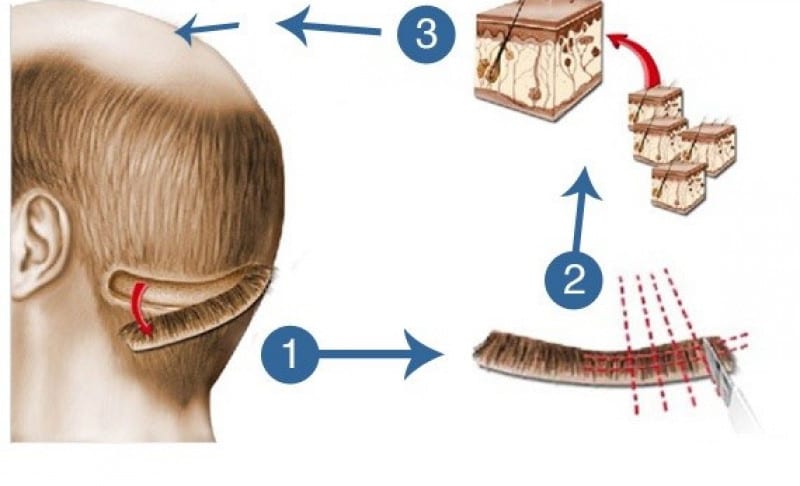
FUE vs FUT: which holds up better long-term
No study has compared FUE and FUT outcomes at five or ten years.
No study has compared FUE and FUT outcomes at five or ten years. Grafts from the same safe zone should behave the same way regardless of how they were harvested; the durable differences are in the donor area, not the result.
Does the harvest method affect how long transplanted hair lasts?
Not directly. Both techniques remove follicular units from the same safe donor zone and place them in the same recipient area, so the follicles are identical. If donor dominance holds, transplanted hair's longevity shouldn't depend on harvest method — meaning the genuine long-term differences lie in the donor area, not the result.
The question 'which holds up better' contains an assumption worth examining. Both techniques remove follicular units from the same safe donor zone and place them in the same recipient area. The follicles are the same follicles.
If donor dominance holds — and it is the premise the entire field rests on — then the longevity of the transplanted hair should not depend on whether it was harvested with a punch or dissected from a strip.
So the long-term differences, to the extent they exist, are mostly in the donor area rather than in the result.
Has any study compared FUE and FUT results over the long term?
No. No published study has compared FUE and FUT outcomes at five or ten years, and no registry collects this data. Technical literature describes each technique individually, including extraction-system reviews and punch-mechanism comparisons, but none follows patients for years, so claims that one technique produces more durable results are not supported by evidence.
The existing technical literature includes Rassman and colleagues' 2002 description of FUE as minimally invasive surgery, plus reviews of extraction-system evolution and comparisons of punch mechanisms and robotic versus manual extraction.
Where do the real long-term differences between FUE and FUT show up?
Mostly in the donor area: FUT leaves one linear scar while FUE leaves thousands of small round ones, so a strip patient generally can't wear the back very short for life, while an FUE patient can. FUT also uses scalp laxity, limiting yield, and causes more extensive, longer-lasting donor numbness than FUE.
Donor scarring
FUT leaves one linear scar; FUE leaves thousands of small round ones. Neither is scarless. The long-term difference is in failure mode: a strip patient generally cannot wear the back very short for life, while an FUE patient can — until enough extraction has accumulated that the dots show.
Donor appearance over multiple sessions
Strip harvesting takes a defined ellipse from the densest area and leaves the rest untouched. FUE scatters extraction across the whole zone. Over three sessions these produce different-looking donor areas, and which looks better depends on hair length habits.
Scalp laxity
Each strip uses laxity, which limits how many can be taken. FUE does not, but is limited instead by how much extraction the zone can absorb before visible thinning.
Numbness
Strip surgery produces more extensive and longer-lasting donor numbness, and a small proportion of patients retain a permanently reduced area of sensation.
Which common claims about FUE and FUT should you be sceptical of?
Be sceptical of four claims: FUE is 'scarless' (it produces more, smaller scars, not fewer); FUT gives better graft survival (plausible, but unproven long-term); FUE always damages the donor area less (depends on how much is extracted); and FUT is 'obsolete' (it remains standard for maximum lifetime yield).
- 'FUE is scarless.' It produces more individual scars than FUT, not fewer. They are smaller and spread out.
- 'FUT gives better graft survival.' Sometimes argued on the grounds that strip dissection is done under direct vision rather than blind punching. It is a plausible mechanism; it is not established by comparative long-term data.
- 'FUE damages the donor area less.' Depends entirely on how much is taken. A heavily harvested FUE donor area is more damaged than a single well-healed strip.
- 'FUT is obsolete.' It remains in use at experienced clinics, particularly for patients needing maximum lifetime yield who wear their hair long.
How should you choose between FUE and FUT without long-term comparison data?
Choose based on your donor area and hair-length habits, since the transplanted result itself shouldn't differ: pick FUE if you might wear hair very short or have a tight scalp; either works at moderate permanent length; and combining both across sessions suits patients needing very large lifetime numbers. The surgeon matters more than the technique.
Since the transplanted result should not differ, the decision comes down to the donor area and to your own habits.
- If you may wear your hair very short: FUE, at conservative extraction density.
- If you keep your hair at moderate length permanently: either works; FUT's scar is fully hidden and it has real advantages for large lifetime yield.
- If your scalp is tight: FUE, since laxity constrains strip yield.
- If you need very large lifetime numbers: many experienced surgeons combine both across sessions.
The more consequential choice is the surgeon, not the technique. Poor FUE and poor FUT both produce bad long-term donor areas.
Sources
- Rassman WR, Bernstein RM, McClellan R, Jones R, Worton E, Uyttendaele H. Follicular unit extraction: minimally invasive surgery for hair transplantation. Dermatologic Surgery, 2002;28(8):720-728. pubmed.ncbi.nlm.nih.gov/12174065
- Romera de Blas C, Vega Díez D, Ricart Vayá JM, Gómez Zubiaur A. Complications in follicular unit excision hair transplantation: current evidence and practical approaches. Frontiers in Medicine, 2026;13:1750989. pubmed.ncbi.nlm.nih.gov/41709896
- Chauhan K, Tandon M, Kumar A, Taneja N, Hamid SAT. A comprehensive review of evolution of advanced follicular unit excision systems. Journal of Cutaneous and Aesthetic Surgery, 2025;18(2):69-77. pubmed.ncbi.nlm.nih.gov/40212421
- Kim J, Ko YU, Yi KH. The condition of hair follicles produced by different punching methods during FUE surgery. Journal of Cosmetic Dermatology, 2024;23(12):4202-4207. pubmed.ncbi.nlm.nih.gov/39152658
- Zhu Y, Yang K, et al. A Comparative Study on the Application of Robotic Hair Restoration Technology Versus Traditional Follicular Unit Excision in Male Androgenetic Alopecia. Journal of Cosmetic Dermatology, 2024;23(12):4213-4222. pubmed.ncbi.nlm.nih.gov/39297414
This article summarises published research and standard clinical practice. It is general educational information, not medical advice, and it does not replace the instructions your own surgical team gives you. Where their guidance differs from anything here, follow theirs.
Get a no-obligation assessment against fixed criteria, directly on WhatsApp.