What hyperbaric oxygen therapy actually is
Hyperbaric oxygen therapy means breathing 100% oxygen inside a sealed chamber pressurised above normal atmospheric pressure, usually 2.0-2.4 ATA. Here is how it works and what the hair-transplant evidence now shows.
Hyperbaric oxygen therapy means breathing 100% oxygen inside a sealed chamber pressurised above normal atmospheric pressure, usually 2.0-2.4 ATA. It is an established hospital treatment with a well-understood mechanism, and the hair-transplant evidence has grown from a single small randomised trial to a 220-patient prospective cohort with blinded photographic review.
What does the term "hyperbaric oxygen therapy" actually mean?
Hyperbaric oxygen therapy means breathing close to 100% oxygen inside a chamber pressurised above normal sea-level pressure — both elements are required, since oxygen alone or pressure alone isn't HBOT. Protocols in hair-transplant literature use 2.0-2.4 ATA (roughly 10-14 metres underwater) for 60-90 minute sessions, letting extra oxygen dissolve directly in blood plasma.
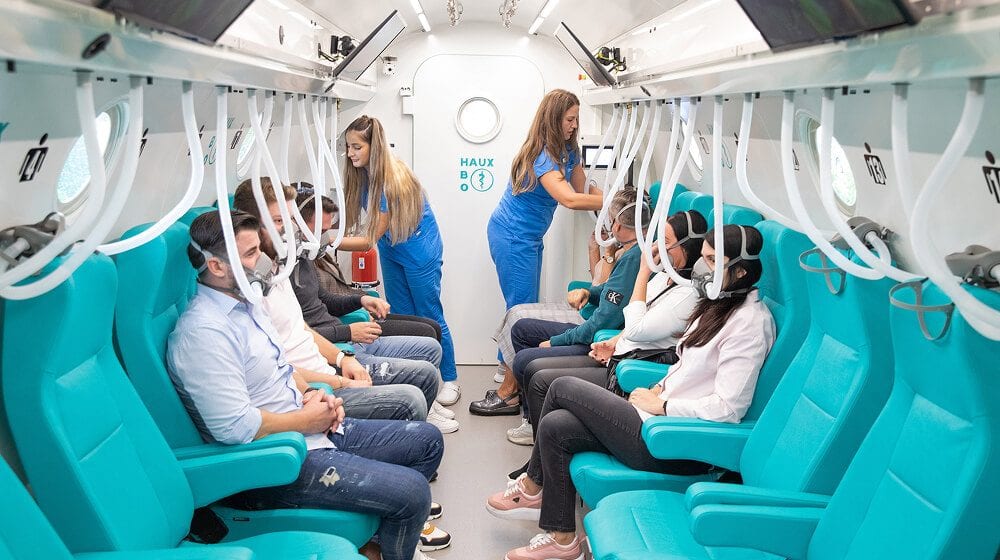
Hyperbaric oxygen therapy (HBOT) has a narrow technical definition. The patient breathes close to 100% oxygen while sitting or lying inside a chamber that has been pressurised above normal sea-level atmospheric pressure. Both halves matter. Breathing pure oxygen through a mask at normal pressure is not HBOT. Sitting in a pressurised chamber breathing ordinary air is not HBOT either. It is the combination — high pressure plus high oxygen fraction — that produces the effect the treatment is named for.
Pressure is expressed in atmospheres absolute, written ATA. One ATA is the pressure at sea level. Clinical protocols in the hair-transplant literature have used 2.0 ATA and 2.4 ATA, which is roughly the pressure you would experience 10 to 14 metres underwater. Sessions typically last 60 to 90 minutes.
The physiological point is simple. At normal pressure, almost all the oxygen your blood carries is bound to haemoglobin, which is already close to fully saturated. You cannot load much more onto it. But the amount of oxygen physically dissolved in blood plasma rises in direct proportion to the partial pressure of the oxygen you are breathing. Raise both the pressure and the oxygen fraction and the dissolved fraction climbs steeply. That dissolved oxygen can reach tissue that red cells struggle to supply.
Which medical conditions is hyperbaric oxygen therapy actually approved to treat?
The Undersea and Hyperbaric Medical Society's approved-indications list, which most health systems defer to, covers decompression sickness, carbon monoxide poisoning, gas embolism, certain necrotising soft-tissue infections, refractory osteomyelitis, late radiation tissue injury, problem wounds including diabetic foot ulcers, and compromised skin grafts and flaps — with strongest evidence for diabetic wounds and radiation injury.
HBOT is not fringe medicine. It is a recognised hospital therapy with a defined list of indications maintained by the Undersea and Hyperbaric Medical Society, which is the body most national health systems and insurers defer to. That list covers conditions such as decompression sickness, carbon monoxide poisoning, gas embolism, certain necrotising soft-tissue infections, refractory osteomyelitis, late radiation tissue injury, selected problem wounds including diabetic foot ulcers, and compromised skin grafts and flaps.
Stephen Thom's review in Plastic and Reconstructive Surgery summarised the state of the evidence for plastic surgeons and drew a clear line through it: systematic reviews and randomised trials support HBOT for refractory diabetic wound healing and radiation injury, while its use for compromised flaps and grafts and for ischaemia-reperfusion injury rests on animal work and a small number of clinical trials, with further study warranted.
That last category is the one hair transplantation borrows from. A transplanted follicular unit is, in a limited sense, a very small free graft that has to survive on diffusion until a blood supply reaches it. The analogy is real, but it is an analogy, and the evidence behind the flap-and-graft indication was already described as needing more work in a general surgical context.
Is hair transplantation an approved indication for hyperbaric oxygen therapy?
No. Hair transplantation, like any cosmetic surgical procedure, does not appear on the UHMS approved-indications list, so HBOT used afterward is off-label and not reimbursed by health systems or insurers. That is a funding and regulatory status, not a verdict on whether it works: the hair-specific evidence now includes a randomised trial, a 220-patient prospective cohort with blinded photographic review, a five-patient case report and a volunteer study.
This is worth understanding before a clinic offers you chamber sessions. Hair transplantation does not appear on the UHMS approved-indications list. Nor does any cosmetic surgical procedure. That has three practical consequences.
- It is off-label. Using HBOT after a hair transplant is not prohibited, and it is not experimental in the sense of being untested in humans. It is an established treatment being extended beyond the conditions the approved list was written for.
- It is self-funded. Public health systems and private insurers reimburse HBOT against the approved list. An elective cosmetic procedure sits outside it, so you pay for the sessions yourself.
- The evidence base is young but no longer thin. The published clinical literature specific to hair transplantation now runs to a randomised controlled trial, a prospective cohort of 220 patients assessed both by patient survey and by blinded independent review of standardised photographs, a case report of five patients, a preliminary study in healthy volunteers, and correspondence. Every one of those points the same way on early recovery. What none of them has yet done is measure twelve-month density at a scale that would settle the long-term question.
What does the published research on HBOT specifically for hair transplantation consist of?
Five items. Fan's 2021 randomised trial of 34 patients found far less early shedding (27.6% vs 69.1%) and less itching and folliculitis (11.8% vs 35.3%); the IdealofMeD Research Academy cohort followed 220 FUE patients and found better healing, less pain and better sleep, confirmed by blinded review of day-10 photographs; Giardiello's 2025 case report of five patients reported scabs clearing in 3-5 days; Lee's 2026 study of nine healthy volunteers found follicle measures trending upward; and Dong and Jin's correspondence questioned the trial's methodology.
It is worth naming the studies, because the total volume is still small enough to list.
Fan and colleagues published a randomised controlled trial in the Journal of Cosmetic Dermatology in 2021. Thirty-four patients with grade II-IV alopecia were split into a control group receiving a routine FUE procedure and an HBOT group receiving the same procedure plus 100% oxygen at 2.0 ATA for 60 minutes daily for seven consecutive days after surgery. Early postoperative shedding was substantially lower in the HBOT group (27.6% versus 69.1%), and itching and folliculitis were less frequent (11.8% versus 35.3%). Survival at nine months was 96.9% with HBOT and 93.8% without. That three-point gap did not reach statistical significance, which is what you would expect from 34 patients: a trial that size cannot resolve a difference that small either way.
The largest piece of work is the prospective cohort run by the IdealofMeD Research Academy. Two hundred and twenty male FUE patients, all operated by the same surgeon with identical technique, medication and aftercare, were followed from April 2025 to June 2026. Recovery was measured two ways that could not contaminate each other: patients scored their own healing, pain, sleep and redness on day 11, and a separate medical team with no involvement in the surgeries, blinded to who had received HBOT, scored standardised day-10 photographs. Both methods favoured HBOT, and they agreed closely. The blinded photographic scores were 5.3/10 with no HBOT, 8.6/10 after one session and 9.7/10 after two. The largest patient-reported gap was sleep quality in the first days after surgery. Patients chose their own group rather than being randomised, so this shows a consistent association rather than proof of cause, but the agreement between what patients said and what blinded reviewers saw in the photographs is the part that is hard to explain away as expectation.
Giardiello and colleagues reported five male FUE patients in Cureus in 2025 who received HBOT at 2.4 ATA for 90 minutes daily over six days starting within 4-6 hours of surgery. Scabs cleared within 3-5 days and graft integration was reported at 97-99%. That is a case report of five patients with no control group, so it can describe an experience but cannot establish an effect.
Lee and colleagues published a preliminary study in Bioengineering in 2026 looking at hair follicle characteristics in nine healthy volunteers after 50 sessions at 2.0 ATA over three months. Follicle density, hairs per follicle and hair volume all trended upward, though with nine volunteers none of those changes reached statistical significance.
Add the correspondence from Dong and Jin, which raised methodological questions about the Fan trial and reported laboratory work on dermal papilla cell proliferation, and that is the hair-specific literature as it stands.
So is hyperbaric oxygen therapy worth it after a hair transplant?
For the first two weeks, the evidence is encouraging and consistent: a randomised trial found less early shedding and less folliculitis, and a 220-patient cohort found better healing, less pain and markedly better sleep, confirmed by blinded review of photographs. What no study has yet shown is an effect on twelve-month density, because none has been designed or sized to measure it. HBOT is best judged on what it has actually been shown to do, which is make the early recovery easier.
The honest summary is that HBOT after a hair transplant has a mechanism that makes sense, and a body of evidence that consistently points the same way on the early recovery. Less shedding in the first weeks and less folliculitis in a randomised trial. Better healing scores, less pain and better sleep in 220 patients, with blinded reviewers looking at photographs reaching the same conclusion as the patients did. Several independent groups, different methods, same direction.
Two things are worth being precise about. First, none of this has been shown to change how much hair is growing at twelve months. Fan's trial recorded 96.9% survival with HBOT against 93.8% without, but 34 patients cannot resolve a three-point difference, so that number is neither evidence for nor against. Second, the 220-patient cohort was observational: patients chose whether to have sessions. That design shows association, not cause.
What it adds up to is this. If you are deciding whether to pay for chamber sessions, the case for them rests on the first two weeks, and on that ground the evidence is real: faster-settling redness, fewer scabs for longer, less discomfort and better sleep at the point in recovery people find hardest. The long-term density question is genuinely open, and a clinic that promises you more hair at twelve months is promising something the research has not yet measured.
Sources
- Undersea and Hyperbaric Medical Society. Indications for Hyperbaric Oxygen Therapy (approved indications list). uhms.org/resources/hbo-indications.html
- Thom SR. Hyperbaric oxygen: its mechanisms and efficacy. Plastic and Reconstructive Surgery, 2011;127 Suppl 1:131S-141S. pubmed.ncbi.nlm.nih.gov/21200283
- Fan Z, Gan Y, Qu Q, Wang J, Lunan Y, Liu B, Chen R, Hu Z, Miao Y. The effect of hyperbaric oxygen therapy combined with hair transplantation surgery for the treatment of alopecia. Journal of Cosmetic Dermatology, 2021;20(3):917-921. pubmed.ncbi.nlm.nih.gov/32770782
- IdealofMeD Research Academy. Hyperbaric oxygen therapy after FUE hair transplantation: a prospective cohort of 220 patients. 2026. Summarised in full on this site.
- Giardiello F, De Medeiros Quirino L, Brigante R, Chumak M. Hyperbaric Oxygen Therapy for Enhanced Postoperative Recovery in Hair Transplantation. Cureus, 2025;17(12):e99635. doi.org/10.7759/cureus.99635
- Lee HY, Lee JY, Kim SC, Lee Y. Preliminary Effects of Hyperbaric Oxygen Therapy on Hair Follicle Characteristics in Healthy Subjects. Bioengineering, 2026;13(2):240. doi.org/10.3390/bioengineering13020240
- Dong X, Jin X. The effect of hyperbaric oxygen therapy combined with hair transplantation surgery for the treatment of alopecia [letter to the editor]. Journal of Cosmetic Dermatology, 2021. doi.org/10.1111/jocd.14131
This article summarises published research and standard clinical practice. It is general educational information, not medical advice, and it does not replace the instructions your own surgical team gives you. Where their guidance differs from anything here, follow theirs.
Get a no-obligation assessment against fixed criteria, directly on WhatsApp.