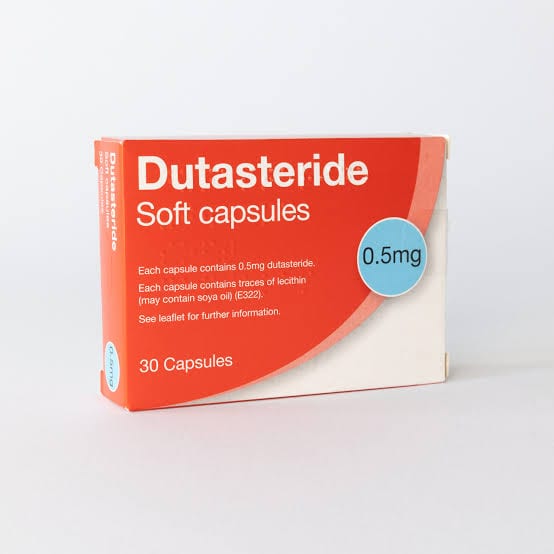
Dutasteride for hair loss: when does the stronger option make sense instead of Finasteride?
Dutasteride is a more powerful DHT inhibitor than Finasteride. I explain the difference, when it is considered, what the evidence and the side effects say, and who it suits.
What is Dutasteride?
Dutasteride belongs to the same family of medicines as Finasteride, the so-called 5-alpha-reductase inhibitors, which work by lowering the level of DHT, the hormone that drives hereditary hair loss. But where Finasteride primarily blocks one type of the enzyme (type 2), Dutasteride blocks both types (type 1 and 2). The result is a stronger and more complete lowering of DHT, both in the scalp and in the body as a whole.
Dutasteride was originally developed and approved for treating benign enlargement of the prostate, but in several places it is used off-label for hair loss because of its stronger DHT-inhibiting effect. That makes it a kind of 'heavier' option in the toolbox: more powerful than Finasteride, but with a correspondingly greater risk of side effects to weigh. As a surgeon I see it as a relevant choice in selected situations, not as a universal upgrade of the first choice.
Because Dutasteride for hair loss is off-label in many countries, it should always be prescribed and monitored by a doctor who can weigh the potentially greater effect against the potentially greater risk of side effects for you specifically.
How does it differ from Finasteride?
The central difference is the strength and breadth of the DHT inhibition. Finasteride lowers DHT in the scalp considerably, but not completely, because it only targets one enzyme type. Dutasteride targets both types and therefore achieves a stronger overall lowering of DHT in the body. In theory that means stronger protection of the DHT-sensitive follicles, and for some patients it can make a noticeable difference, especially if Finasteride has not given a sufficient effect.
But the same property that makes Dutasteride stronger is also the reason it should be considered carefully. A stronger and broader hormonal effect may involve a correspondingly greater risk of the side effects associated with DHT inhibition. So this is not a 'free' stronger option, but a trade-off: a potentially greater effect against a potentially greater risk of side effects. That trade-off is individual and belongs in a conversation with a doctor.
Another practical difference is that Dutasteride has a longer duration of action in the body than Finasteride, which matters among other things if the treatment is paused. That is a further reason why the treatment should be expertly managed.
What does the evidence say?
There are studies showing that Dutasteride can be at least as effective as, and in some comparisons more effective than, Finasteride at increasing hair density in hereditary hair loss. For the patient who responds insufficiently to Finasteride there is therefore a genuine rationale for considering the stronger alternative. The documentation is not as extensive as for Finasteride in the hair context, but it is sufficient for Dutasteride to be a recognised off-label choice in many places.
Keep expectations realistic, though. Even a stronger DHT inhibitor is still a treatment that primarily preserves and to some extent thickens, not one that restores hair from follicles that have already been lost. And as with Finasteride the effect requires continuous use; if you stop, the hereditary loss resumes. So Dutasteride is a stronger version of the same basic strategy, not a fundamentally different solution.
Advantages of Dutasteride
- Stronger DHT inhibition: Blocks both enzyme types and lowers DHT more completely than Finasteride.
- An option where Finasteride is insufficient: A genuine alternative for someone who does not get enough out of Finasteride.
- Documented effect: Studies show at least an equivalent, sometimes better, effect on hair density.
- The same basic mechanism: It attacks the cause (DHT) rather than merely the symptom, just as Finasteride does.
Disadvantages and reservations
- A potentially greater risk of side effects: The stronger hormonal effect may involve a correspondingly greater risk of sexual and other side effects, which must be discussed with a doctor.
- Off-label: For hair loss the use is off-label in many places, which requires a medical prescription and follow-up.
- A longer duration of action: The substance remains in the body longer than Finasteride, which matters if the treatment is paused.
- Not for women of childbearing age: Like other DHT inhibitors it is unsuitable because of the risk of harm to a foetus.
- It requires continuous use: The effect disappears if the treatment is stopped.
Finasteride vs. Dutasteride at a glance
| Finasteride | Dutasteride | |
|---|---|---|
| Inhibits | Type 2 | Type 1 and 2 |
| DHT reduction | Considerable | Stronger/more complete |
| Role | First choice | Often second choice / where the effect is insufficient |
| Duration of action in the body | Shorter | Longer |
| Status in hair loss | Widely recognised | Often off-label |
The simple way to think about it is that Finasteride is the well established first choice, and Dutasteride is the stronger alternative you can consider if the first choice is not enough, always with a correspondingly thorough weighing of side effects.
Get a free hair analysis
- 1Start
- 2Info
- 3Done
When do I consider Dutasteride?
In practice the most common situation in which Dutasteride comes up is the patient who has taken Finasteride faithfully for long enough but finds that the hair loss continues more than he would wish. For this patient, provided he tolerates DHT inhibition and understands the trade-off, a switch to the stronger Dutasteride can be a logical next step, rather than giving up on the hormonal strategy.
Conversely, I rarely see any reason to start with Dutasteride rather than Finasteride in a new patient. When the well established first choice works well for most people and has the longest experience behind it, it makes sense to start there and only escalate if the need arises. Starting with the most powerful tool before you know whether a milder one will do is rarely the wisest approach in medicine.
The decision is individual in any case. It depends on your response to Finasteride, your tolerance of side effects, your general health and your goals, and it should always be taken together with a doctor who knows your situation.
Frequently asked questions
Is Dutasteride better than Finasteride? It is stronger and in studies at least as effective, but 'better' depends on the individual. The stronger effect comes with a correspondingly greater risk of side effects to weigh, so it is an individual trade-off.
Should I start with Dutasteride? Rarely. Finasteride is the well established first choice with the longest experience. Dutasteride is typically considered if Finasteride does not give a sufficient effect.
Does it have more side effects? The stronger DHT inhibition may involve a correspondingly greater risk of side effects. They must be discussed thoroughly with a doctor before starting.
Can women take it? Not women of childbearing age, because of the risk of harm to a foetus. Female hair loss is typically treated with other agents.
A realistic patient example
Let me make the trade-off concrete with a typical case from my daily practice. A man in his late thirties has taken Finasteride for a year and a half. He tolerates it well without side effects, but he finds that his hair loss has stabilised rather than improved, and that the crown is still thinning slowly. He asks whether there is a stronger card to play. Here Dutasteride is an obvious part of the conversation: he has shown that he tolerates DHT inhibition, and he responds insufficiently to the first choice.
In that situation I would go through the trade-off thoroughly with him: the potentially greater effect of the stronger DHT reduction set against the potentially greater risk of side effects and the substance's longer duration of action in the body. If he decides to try it, we do so with follow-up, so that we can adjust if something does not work. For this patient Dutasteride is not a desperate step but a logical, informed next stage in the same hormonal strategy.
Compare that with a completely new patient who has just noticed the beginnings of recession. For him I would almost always start with Finasteride, the well established first choice, and only consider Dutasteride if the need appeared later. The difference between the two examples illustrates the principle: Dutasteride is an escalation choice, not a starting point.
This stepwise approach (start with the well documented first choice, escalate only where needed, and always under medical guidance) is in my experience the wisest way to use the hormonal treatments. It gives the best balance between effect and caution, and it respects the fact that stronger does not automatically mean better for the individual.
Important things to remember about side effects and follow-up
Because Dutasteride is a stronger hormonal treatment, the side effects deserve an honest and thorough conversation before you begin. The side effects most often discussed with DHT inhibitors are the sexual ones: reduced desire, difficulty with erections or changed semen quality. They affect a minority, and for most people they are reversible on stopping, but they should be taken seriously and weighed against the gain. With Dutasteride's stronger action and longer duration in the body, it is all the more important to make this trade-off consciously.
That is why medical follow-up is not a formality but a central part of the treatment. A good practitioner will not merely write the prescription but follow up on how you are, both physically and mentally, and be ready to adjust or stop if the balance between gain and drawbacks is not right for you. You should feel comfortable raising any concerns along the way; that is part of a proper course of care.
I always stress to my patients that there is nothing wrong with prioritising differently. Some choose the stronger effect and accept the slightly greater risk; others prefer to stay with Finasteride or to avoid hormonal treatment altogether and focus instead on other parts of the strategy. There is no single right answer, only what is right for you when you are fully informed. Making that choice with open eyes, together with a doctor, matters far more than which preparation is named on the prescription.
Conclusion
Dutasteride is a stronger DHT inhibitor than Finasteride, because it blocks both enzyme types and lowers DHT more completely. Studies show at least an equivalent effect, and it is a relevant off-label alternative, especially for the patient who does not get a sufficient effect from Finasteride.
But the greater strength comes with a correspondingly greater risk of side effects, and its use should always take place under medical guidance. For most people Finasteride is the sensible first choice, and Dutasteride the stronger card to play if it becomes necessary. This article is for general information and does not replace an individual medical assessment.
The full picture of what is available, and in what order, is in our guide to non-surgical treatment.
© IdealofMeD Research Academy. Republished with permission.
Get a no-obligation assessment against fixed criteria, directly on WhatsApp.