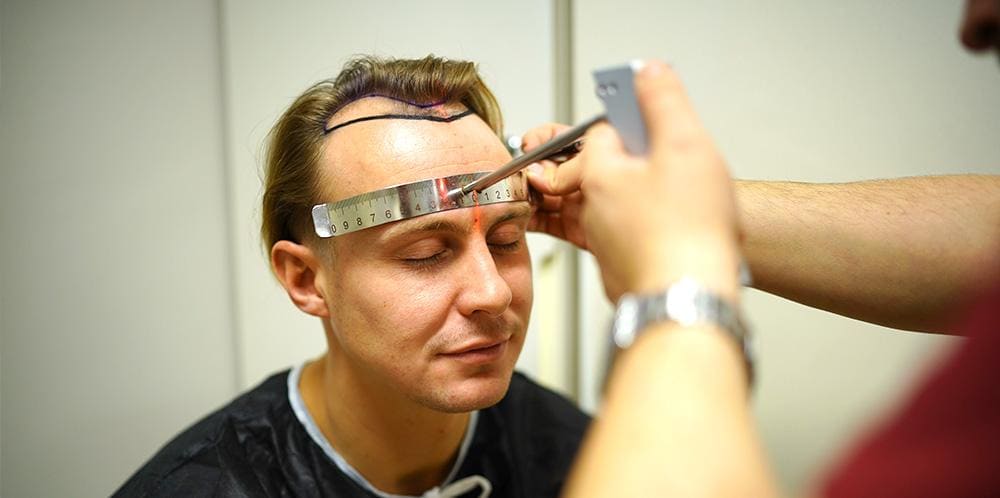
Hairline design principles
A natural hairline is irregular, softly defined, appropriate to the face and, above all, planned for the patient's age in twenty years rather than today.
A natural hairline is irregular, softly defined, appropriate to the face and, above all, planned for the patient's age in twenty years rather than today. Design is the decision that most determines whether a transplant looks like one.
What are the principles of natural hairline design?
A natural hairline follows five principles: irregularity rather than a straight line, a gradual transition zone thickening from single hairs at the front, single-hair grafts only at the leading edge to avoid a tufted look, height set by facial proportions, and a shape suited to the face, including temple angles and any widow's peak.
- Irregularity. Natural hairlines are ragged, with small clusters and gaps. A straight line reads as artificial instantly.
- A transition zone. The leading edge is single hairs at low density, thickening gradually behind. There is no sharp boundary in nature.
- Single hairs at the front. Multi-hair grafts placed at the leading edge produce a tufted, pluggy look.
- Appropriate height. Positioned relative to facial proportions, not to where hair used to be.
- Shape suited to the face, including temple angles and any widow's peak.
Why should a hairline be designed for the future rather than for today?
A hairline placed too low looks good at thirty but increasingly odd at fifty, once loss behind it has progressed and donor supply to support it is spent. A conservative hairline uses fewer grafts, leaves reserve for later loss, and stays plausible as loss advances, the most common disagreement between patients and surgeons.
What are the warning signs in a proposed hairline design?
Warning signs include a straight, sharply defined edge; a hairline placed lower than the patient's original one; no discussion of future loss or donor capacity; a promise to restore a juvenile hairline in an older patient; and refusal to draw the design and show it in a mirror before shaving.
- A straight, sharply defined edge
- A hairline lower than the patient's original one
- No discussion of future loss
- No mention of donor capacity
- A promise to restore a juvenile hairline in an older patient
- Refusal to draw the design and let you see it in a mirror before shaving
What should a patient do at the hairline consultation?
At consultation, ask to see the drawn hairline in a mirror from both the front and in profile, and ask directly how it will look at Norwood 6. A surgeon who cannot answer that question has not adequately planned the hairline design.
Sources
- Parsley WM, Perez-Meza D. Review of factors affecting the growth and survival of follicular grafts. Journal of Cutaneous and Aesthetic Surgery, 2010;3(2). jcasonline.com
This article summarises published research and standard clinical practice. It is general educational information, not medical advice, and it does not replace the instructions your own surgical team gives you. Where their guidance differs from anything here, follow theirs.
Get a no-obligation assessment against fixed criteria, directly on WhatsApp.