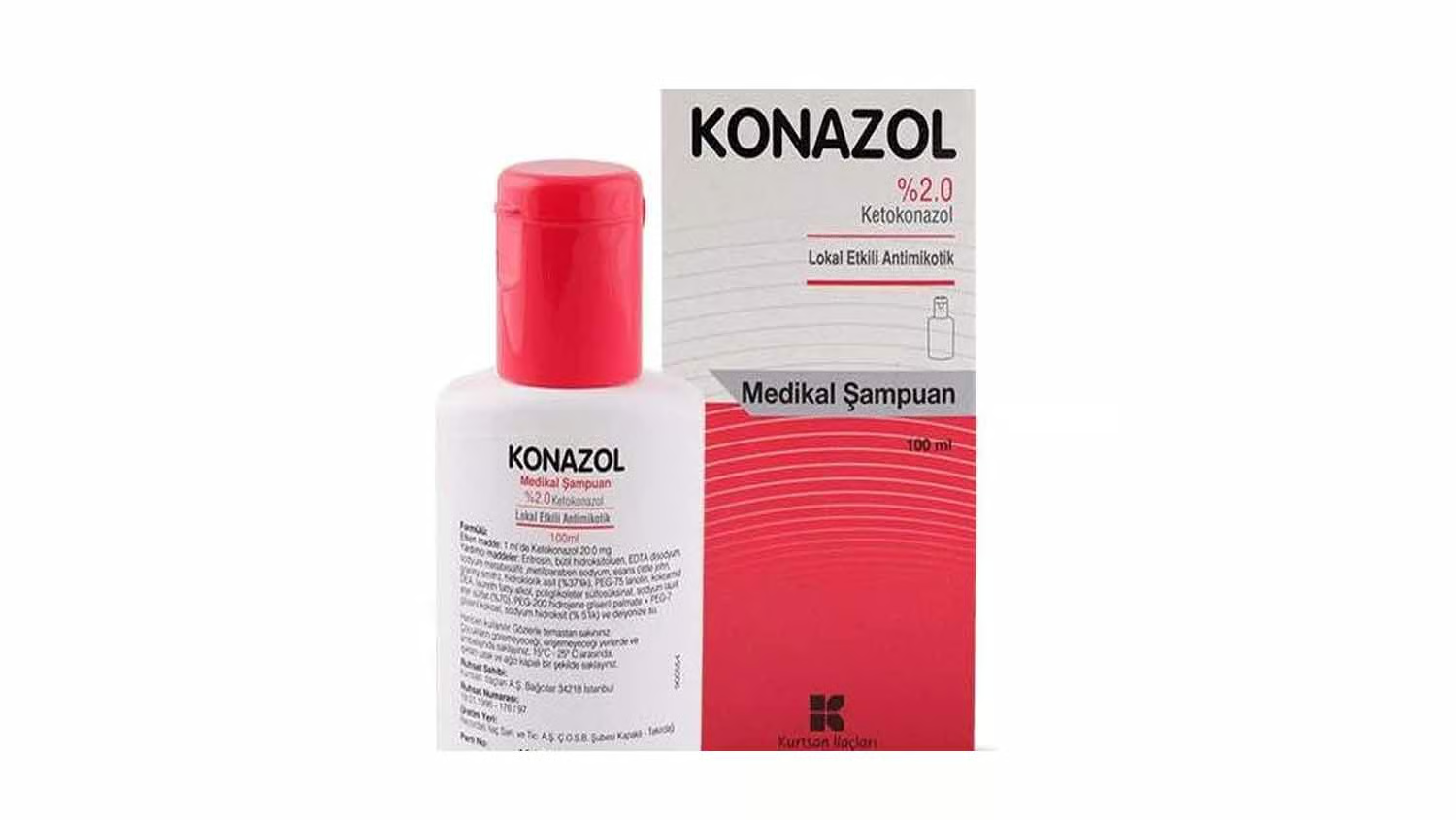
Ketoconazole shampoo for hair loss: a cheap, underrated supplement?
Ketoconazole is known as a dandruff shampoo, but it also has a place in treating hair loss. I explain the possible effect, the evidence and the real pros and cons.
What is Ketoconazole shampoo?
Ketoconazole is an antifungal medicine that most people know from the treatment of dandruff and the greasy, flaking skin condition called seborrhoeic dermatitis. It comes in shampoo form, typically in strengths of 1 % (over the counter) and 2 % (prescription in many countries), and has been used for decades for fungal problems of the scalp. But in recent years Ketoconazole has taken on another, more surprising role: as a cheap supplement in the treatment of hereditary hair loss.
The interest arises because, in addition to its antifungal action, Ketoconazole appears to have a mild anti-androgenic effect locally in the scalp, that is, an effect on the hormonal system that drives hereditary hair loss. That is an unexpected property for a dandruff shampoo, and it has made Ketoconazole one of the more talked about 'do it yourself' additions among people struggling with thinning. As a surgeon I am regularly asked whether it is worth using, and the answer is nuanced but broadly positive, within realistic limits.
Ketoconazole is not a main treatment for hair loss. It is a supplement: a cheap, gentle addition that can support an overall strategy. With the right expectations it is one of the more sensible purchases; with unrealistic hopes it leads to disappointment.
How is it supposed to work?
There are two mechanisms that together may explain Ketoconazole's possible benefit in hair loss. The first is the anti-androgenic effect. Studies suggest that Ketoconazole can locally influence the action of DHT, the hormone that miniaturises genetically sensitive follicles. The effect is mild compared with a genuine DHT-inhibiting medicine such as Finasteride, but it can help to reduce the hormonal burden on the follicles right where the shampoo is applied.
The second mechanism is anti-inflammatory. By treating dandruff and seborrhoeic dermatitis, Ketoconazole removes a source of chronic irritation and inflammation in the scalp. An inflamed, irritated scalp is a poor growing environment for hair, and there is evidence that low grade inflammation can worsen hair loss. By restoring a healthy, calm scalp, Ketoconazole creates better conditions for the follicles that are there.
Together these two mechanisms give a sensible biological rationale for Ketoconazole supporting the health of the hair, not as a powerful standalone treatment, but as a gentle, beneficial element in the environment around the follicle.
What does the evidence say?
The evidence for Ketoconazole in hair loss is limited but promising. There are some smaller studies suggesting a beneficial effect on hair density and thickness, and a few have compared Ketoconazole with established treatments with interesting results. But we are talking about few and small studies, and we lack the large, well designed body of proof that would lift Ketoconazole from 'promising supplement' to 'documented treatment'.
What counts in Ketoconazole's favour in the overall assessment is not so much the strength of the evidence as the relationship between gain, risk and price. Even a modest, not entirely certain effect is attractive when the treatment is cheap, easily available, gentle and almost free of side effects. That is a different situation from expensive, unproven treatments, where weak evidence weighs more heavily. With Ketoconazole the stake is so low that even a small likely gain makes it a sensible addition.
Just remember that Ketoconazole contributes modestly at best. It is not, and will not become, an alternative to the well documented main treatments; it is a supplement that can add a small extra advantage on top.
Advantages of Ketoconazole shampoo
- Cheap and available: A bottle costs very little compared with most hair treatments, and the 1 % version is available over the counter.
- It also treats dandruff: Even if the hair gain is modest, you get a well documented treatment for dandruff and seborrhoeic dermatitis into the bargain.
- Gentle: Very few side effects; most people tolerate it without problems.
- A mild anti-androgenic effect: It attacks the same mechanism the medication does, on a small scale, but locally.
- Easy to combine: It fits easily into a routine with Minoxidil and Finasteride.
Disadvantages and reservations
- A modest effect: A small contribution at best; it does not stop hereditary hair loss on its own.
- Limited evidence: The documentation is promising but thin; the effect is not established with certainty.
- It can dry out the scalp: Frequent use can cause dryness or irritation in some people; it is therefore typically used only a couple of times a week.
- Not a main treatment: Used instead of well documented medication, it means prioritising the weakest tool.
- Differences in strength: The 2 % version often requires a prescription, and the effect of 1 % may be milder still.
Get a free hair analysis
- 1Start
- 2Info
- 3Done
How to use it sensibly
| Element | A sensible approach |
|---|---|
| Frequency | Typically 2-3 times a week, not daily, to avoid drying out the scalp. |
| Contact time | Leave the shampoo on for a couple of minutes so the active substance can work before you rinse. |
| Combination | Use as a supplement to Minoxidil/Finasteride, not as a replacement. |
| Strength | 2 % (prescription) is stronger than 1 % (over the counter); choose according to need and guidance. |
The simple rule of thumb is that Ketoconazole is a cheap, gentle supplement best used a few times a week as a fixed part of a broader routine. If you experience dryness or irritation, reduce the frequency. The real effect comes from your foundation of documented treatment; Ketoconazole simply adds a small, cheap advantage on top.
My clinical position
Ketoconazole is one of the few supplements I rarely have any objection to, simply because the balance is so favourable: a low price, low risk, a well documented bonus effect against dandruff, and a possible, if modest, benefit against hair loss. For the patient who is already struggling with a greasy or flaking scalp it is almost an obvious choice, regardless of the hair gain.
My only real warning is the same as with all supplements: do not let it take the place of what genuinely works. I have met patients who used Ketoconazole faithfully in the belief that it was their primary weapon against hereditary hair loss, while omitting the proven medication that could have made a far greater difference. Used in the right role, as a cheap, gentle addition on top of a solid foundation, Ketoconazole is on the other hand one of the more sensible additions you can make.
An underrated little supplement, then, with a good ratio between effort and possible gain, provided expectations are kept realistic and the order is right.
Frequently asked questions about Ketoconazole
Can Ketoconazole alone stop hair loss? No. The effect is modest at best, and it cannot halt hereditary hair loss on its own. It is a supplement, not a main treatment.
How often should I use it? Typically 2-3 times a week. Daily use can dry out the scalp in some people. Leave the shampoo on for a couple of minutes before rinsing.
1 % or 2 %? 2 % is stronger, but often requires a prescription. 1 % is available over the counter and is milder. Choose according to need and any guidance from a professional.
Can I use it alongside Minoxidil and Finasteride? Yes, that is exactly how it is best used: as a cheap, gentle supplement to a solid foundation.
Ketoconazole in the wider picture
To put Ketoconazole in the right perspective it helps to think in layers, as I often do with my patients. The treatment of hereditary hair loss can be seen as a series of measures of decreasing strength and increasing specialisation. At the bottom lie the proven medicines, Finasteride and Minoxidil, which do most of the work. Above them lie the sensible supplements (microneedling, and Ketoconazole too), which add small, cheap advantages. And finally surgery, when the loss is permanent.
In this picture Ketoconazole is one of the most cost effective layers. It costs almost nothing, it is gentle, and even a modest effect is worth having when the outlay is so small. Compare it with the expensive, unproven treatments where you pay a great deal for an uncertain promise: with Ketoconazole you pay almost nothing for a likely small gain plus a well documented treatment for dandruff. That is a good deal.
The mistake I warn against is the same as with all supplements: confusing the layer with the foundation. Ketoconazole cannot carry a treatment on its own, and the patient who uses it instead of well documented medication has misunderstood its role. But used for what it is (a cheap, gentle addition on top of a solid base), Ketoconazole deserves its place in many patients' routines.
Ketoconazole is a good example of how not everything useful in hair treatment has to be expensive or advanced. Sometimes the wise addition is a cheap shampoo, used a couple of times a week, with realistic expectations and on the right foundation. That is the kind of sober good sense I would like my patients to take away, rather than the chase after the next expensive miracle.
Conclusion
Ketoconazole shampoo is a cheap, gentle and underrated supplement in the treatment of hair loss. It has a mild anti-androgenic and anti-inflammatory effect, treats dandruff at the same time, and has a favourable ratio between low effort and possible gain, even though the evidence for hair gain is limited and the effect modest.
Use it as a regular, cheap addition a few times a week on top of a foundation of well documented medication, not as a replacement for it. With realistic expectations it is one of the more sensible small additions you can make. This article is for general information and does not replace an individual medical assessment.
© IdealofMeD Research Academy. Republished with permission.
Get a no-obligation assessment against fixed criteria, directly on WhatsApp.