Scarring alopecia: when the follicle is replaced by scar tissue
In scarring alopecia the follicle is permanently destroyed by an inflammatory process. I explain the types, why early diagnosis is critical, and when surgery is possible.
What is scarring alopecia?
Scarring alopecia (medically, cicatricial alopecia) is a group of conditions in which the follicle is destroyed by an inflammatory process and replaced by scar tissue. Unlike hereditary hair loss, where the follicle shrinks but still exists, here the follicle is permanently gone. That makes the condition serious, because lost tissue cannot be restored by any medicine.
How it differs from ordinary hair loss
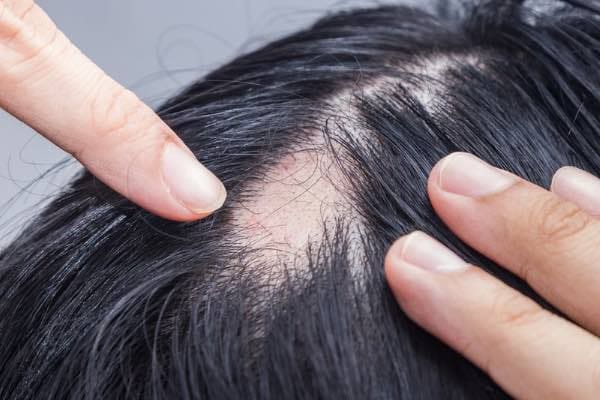
In scarring alopecia the skin often looks smooth and shiny in the affected areas, without the visible openings through which hairs normally emerge. There can be redness, scaling, itching, burning or tenderness, which is rarely seen in hereditary hair loss. The edges of the area can be irregular. Itching and burning together with hair loss are exactly the kind of warning signs that should always be assessed by a doctor.
The main types
There are several forms. Frontal fibrosing alopecia typically affects the hairline and eyebrows in women after the menopause. Lichen planopilaris causes inflammation around the follicles with itching and redness. Folliculitis decalvans is a bacterial and inflammatory form. Discoid lupus can also cause scarring in the scalp. What they have in common is that they require dermatological investigation and often a biopsy to reach the right diagnosis.
Get a free hair analysis
- 1Start
- 2Info
- 3Done
Why early diagnosis is critical
For as long as the inflammation is active, more follicles are destroyed. The goal of treatment is therefore to halt the process before more tissue is lost. What has already turned into scar tissue cannot be saved, but what has not yet been affected can be preserved. That is why rapid referral to a dermatologist is essential, and it is one of the reasons you should never ignore itching, burning or scaling together with hair loss.
Treatment and surgery
The treatment is medical and directed by a dermatologist, typically with anti-inflammatory agents topically or systemically. Neither Minoxidil nor Finasteride treats the underlying disease itself. A hair transplant can in some cases rebuild the area, but only once the disease has been completely quiet for at least six months, and often longer. If surgery is performed in an active area, the inflammation will destroy the new grafts as well. In addition, scar tissue can have a poorer blood supply, which lowers graft survival.
Conclusion
Scarring alopecia is a group of conditions in which the follicle is permanently destroyed by inflammation and replaced by scar tissue. Itching, burning, redness or scaling together with hair loss are warning signs that require prompt medical assessment. The treatment aims to halt the process and preserve the remaining hair. Surgery is only an option once the disease has been quiet for at least six months. This article is for general information and does not replace an individual medical assessment.
Whether a transplant is possible afterwards is covered under repair and correction.
© IdealofMeD Research Academy. Republished with permission.
Get a no-obligation assessment against fixed criteria, directly on WhatsApp.