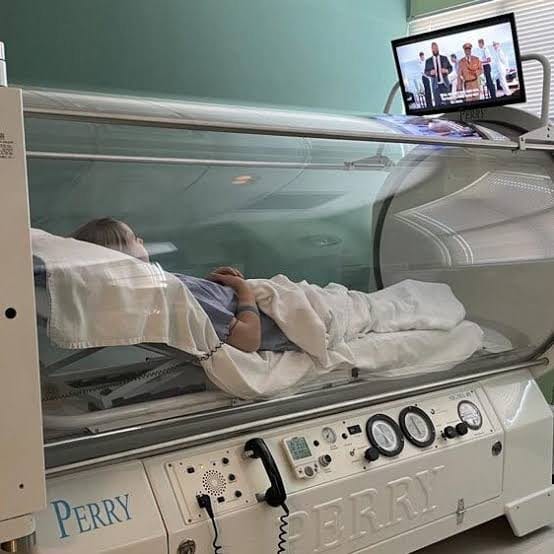
Best timing for HBOT after transplant
Both published protocols start HBOT on the day of surgery or the day after and run daily for about a week, which matches the period when grafts depend on diffusion.
Both published protocols start HBOT on the day of surgery or the day after and run daily for about a week, which matches the period when grafts depend on diffusion. Whether starting within hours rather than the next morning changes anything has never been tested.
Why is timing the most mechanistically important HBOT protocol variable?
Unlike pressure or session length, timing has a clear rationale: HBOT's theoretical benefit is supporting grafts during the diffusion-dependent window before revascularisation, which lasts only days. A session on day one targets different physiology than one on day ten, so front-loading treatment is logical—and both published protocols do exactly that.
Most of the open questions about HBOT protocols — pressure, session length, total number — have no mechanistic answer that points one way. Timing is different. The theoretical benefit of hyperbaric oxygen after a hair transplant is entirely about supporting grafts during the interval when they have no blood supply and survive on diffusion from the surrounding tissue.
That interval starts the moment a graft is placed and ends as revascularisation establishes. It is measured in days. A session delivered on day ten is not operating on the same physiology as a session delivered on day one, because by day ten the graft is no longer diffusion-dependent in the same way.
So if HBOT does anything here, front-loading it is the logical approach — and both published protocols do front-load it.
What start times did the published HBOT protocols actually use?
Giardiello and colleagues started the first session within four to six hours of surgery, continuing daily for six days at 2.4 ATA/90 minutes—the tightest published window. Fan and colleagues ran seven consecutive daily sessions at 2.0 ATA/60 minutes without specifying an hours-level start time. Neither compared same-day versus next-day starts.
Giardiello and colleagues began the first session within four to six hours of the procedure and continued daily for six days at 2.4 ATA for 90 minutes. This is the tightest published start window.
Fan and colleagues describe daily treatment for seven consecutive days after the operation at 2.0 ATA for 60 minutes. The trial does not turn on an hours-level start window in the way the case report does.
Both, then, are 'immediately post-operative, daily, about a week'. Neither compared that against a delayed start, and neither compared same-day against next-day. The difference between four hours and twenty-four hours after surgery is untested.
What practical constraints affect HBOT timing right after a hair transplant?
Four practical issues complicate early HBOT: fatigue after a six-to-eight-hour FUE procedure; sedation, since hyperbaric staff want patients alert to equalise their ears; travel, since a daily week-long course requires staying near the facility throughout recovery; and having to actively equalise ear pressure on a day the scalp is already uncomfortable.
There is a gap between what the mechanism suggests and what is realistic on the day of a hair transplant.
- You have just had a long procedure. A large FUE session can run six to eight hours. Being asked to spend a further 90 minutes in a chamber the same afternoon is a real ask, and fatigue is a legitimate reason to decline.
- Sedation. If you received oral sedation, hyperbaric staff will normally want you alert and able to equalise your ears reliably. That can push the first session to the following day regardless of what the protocol says.
- Travel. Most patients travelling abroad for surgery are not staying near a hyperbaric facility for a week. A daily six- or seven-day course requires you to be in one place, on a schedule, for the whole of your recovery week.
- Ear equalisation with a fresh surgical site. Pressurisation requires actively clearing your ears. That is manageable but it is one more thing to do on a day when your scalp is already uncomfortable.
Does starting HBOT later, such as during the shedding phase, do anything?
No published evidence supports HBOT starting a week or more after surgery, or during weeks two-to-three shedding. Postoperative shedding is a normal cycle event, not an ischaemic problem, so added oxygen has no mechanistic rationale then. The only longer-course study, 50 sessions in nine healthy volunteers, found no statistically significant results.
Some clinics offer HBOT starting a week or more after surgery, or as a separate course during the shedding phase at weeks two to three. There is no published evidence for this in hair transplantation.
The mechanism does not obviously support it either. Postoperative shedding of the transplanted hair shaft is a normal part of the cycle — the follicle enters a resting phase and pushes out the existing shaft while remaining alive. Adding oxygen at that point is not addressing an ischaemic problem, because the ischaemic problem has already resolved one way or the other.
The one longer-course study that exists, Lee and colleagues' 50 sessions over three months, was conducted in nine healthy volunteers rather than post-surgical patients, and the changes it observed in follicle density and hair volume did not reach statistical significance. It cannot be used to support a late post-transplant course.
What is the evidence-based approach to timing an HBOT course as a patient?
The only rationale-backed approach is what both published papers used: start on the day of surgery or the next morning, daily, for six or seven days, then stop. A clinic proposing a fortnight-later start or month-long course has no published study behind it—and even optimal timing only improved early shedding, not nine-month survival.
If you are going to do HBOT at all, the version with a rationale behind it is the version both published papers used: start on the day of surgery or the morning after, daily, for six or seven days, then stop.
If a clinic is proposing something substantially different — a first session a fortnight later, or a course spread over a month — it is fair to ask what that is based on. The answer will not be a published study in hair transplantation, because none exists.
And it is worth keeping the frame from the Fan trial in view throughout. Even with the protocol timed as tightly as the mechanism suggests, the measured difference was in early shedding and inflammation, not in nine-month survival. Getting the timing right optimises a benefit that has not itself been established.
Sources
- Giardiello F, De Medeiros Quirino L, Brigante R, Chumak M. Hyperbaric Oxygen Therapy for Enhanced Postoperative Recovery in Hair Transplantation. Cureus, 2025;17(12):e99635. doi.org/10.7759/cureus.99635
- Fan Z, Gan Y, Qu Q, Wang J, Lunan Y, Liu B, Chen R, Hu Z, Miao Y. The effect of hyperbaric oxygen therapy combined with hair transplantation surgery for the treatment of alopecia. Journal of Cosmetic Dermatology, 2021;20(3):917-921. pubmed.ncbi.nlm.nih.gov/32770782
- Lee HY, Lee JY, Kim SC, Lee Y. Preliminary Effects of Hyperbaric Oxygen Therapy on Hair Follicle Characteristics in Healthy Subjects. Bioengineering, 2026;13(2):240. doi.org/10.3390/bioengineering13020240
- Parsley WM, Perez-Meza D. Review of factors affecting the growth and survival of follicular grafts. Journal of Cutaneous and Aesthetic Surgery, 2010;3(2). jcasonline.com
This article summarises published research and standard clinical practice. It is general educational information, not medical advice, and it does not replace the instructions your own surgical team gives you. Where their guidance differs from anything here, follow theirs.
Get a no-obligation assessment against fixed criteria, directly on WhatsApp.