Which clinics actually offer HBOT
Very few hair clinics own a hyperbaric chamber.
Very few hair clinics own a hyperbaric chamber. Most that advertise HBOT refer patients to a third-party facility, and some are describing soft chambers that do not deliver a clinical hyperbaric dose. Establishing which arrangement you are being offered is the first question.
Why do so few hair transplant clinics own a hyperbaric chamber?

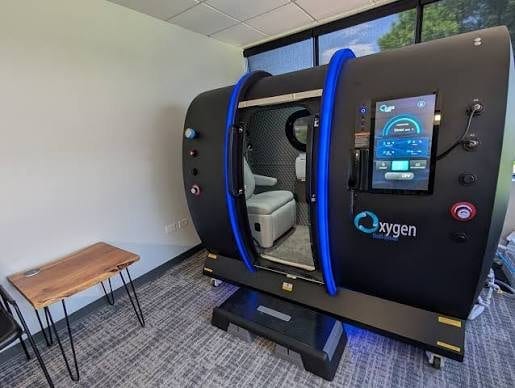
A hard hyperbaric chamber is hospital-grade infrastructure requiring pressure-vessel engineering, fire-safety systems for a high-oxygen environment, and hyperbaric-trained staff to manage equalisation problems, oxygen toxicity, and emergency decompression. A hair transplant clinic has no other reason to own one, so it must either partner with an existing facility or buy something lesser.
A clinical hyperbaric chamber is serious infrastructure. A hard monoplace or multiplace chamber is a pressure vessel with its own engineering, maintenance and inspection regime, fire-safety requirements arising from a high-oxygen environment, and a requirement for staff trained in hyperbaric operations who can manage equalisation problems, oxygen toxicity and emergency decompression.
That is a hospital-grade capability. A hair transplant clinic has no other reason to own one. The realistic options for a clinic that wants to offer HBOT are therefore to partner with an existing hyperbaric facility, or to buy something cheaper that is not the same thing.
What are the three types of HBOT arrangements clinics offer?
Clinics offer three arrangements: referral to an external hyperbaric facility (matches published protocols, properly staffed and screened); an on-site hard chamber (clinically equivalent if operated by trained hyperbaric staff); or an on-site soft chamber, which typically reaches only slightly above one atmosphere with concentrated rather than 100% oxygen and doesn't replicate either published protocol's dose.
1. Referral to a hyperbaric facility
The clinic books your sessions at a hospital or dedicated hyperbaric centre. This is the arrangement most consistent with what the published protocols describe. Sessions are supervised by hyperbaric staff, contraindication screening is done properly, and the pressures reached are real clinical pressures.
The practical downsides are logistical rather than clinical: it is a separate appointment at a separate address, daily, for a week, and the fee may be paid separately.
2. An on-site hard chamber
A small number of larger clinics do operate their own hard chamber. This is convenient and, if properly staffed, clinically equivalent to the referral route. The question to ask is who operates it — a trained hyperbaric technician or a member of the surgical team who has been shown which button to press.
3. A soft chamber on the premises
This is the most common thing marketed as HBOT in cosmetic settings and the one that most often is not. Soft-sided chambers typically reach only slightly above one atmosphere and are frequently used with concentrated rather than 100% oxygen. That combination does not reproduce the dose used in either published hair-transplant protocol.
What pressure do the published HBOT hair-transplant protocols actually require?
Fan and colleagues used 100% oxygen at 2.0 ATA for 60 minutes daily; Giardiello and colleagues used a monoplace chamber at 2.4 ATA for 90 minutes daily—both hard-chamber pressures. A chamber reaching only 1.3 or 1.4 ATA delivers neither protocol regardless of branding, so the pressure figure is the most informative question to ask.
What questions reveal what kind of HBOT you're actually being offered?
Ask six things: is the chamber on-site or elsewhere, and where; what pressure (in ATA) does it reach; is it hard or soft; are you breathing 100% oxygen and by what route; who operates it and what hyperbaric training do they have; and who screens for contraindications, and when. Vagueness on pressure is especially telling.
- Is the chamber on site or at another facility, and what is that facility's name?
- What pressure does it reach, expressed in ATA?
- Is it a hard chamber or a soft chamber?
- Am I breathing 100% oxygen, and by what route — chamber atmosphere, mask or hood?
- Who operates it, and what hyperbaric training do they have?
- Who screens me for contraindications, and when?
A clinic running a genuine service will answer all six without hesitation. Vagueness on the pressure figure in particular is informative.
How should HBOT marketing claims be checked against the evidence?
The published randomised trial found lower early shedding and less folliculitis with HBOT, and no statistically significant nine-month survival difference. A clinic claiming HBOT improves final graft count overstates the research; one claiming it makes early weeks more comfortable and reduces inflammation matches what the trial found. Overstating one adjunct signals overstating others.
HBOT appears prominently in clinic marketing because it signals technical sophistication and it is easy to describe in terms that imply better growth. It is worth holding the actual evidence next to the claim.
The published randomised trial found lower early shedding and less folliculitis with HBOT, and no statistically significant difference in nine-month survival. A clinic advertising HBOT as a way to improve your final graft count is describing something the research has not shown. A clinic advertising it as a way to make the first weeks more comfortable and reduce inflammatory complications is describing something one small trial did find.
Neither the treatment nor the clinic is disqualified by offering it. What matters is whether the description you are given matches what the evidence supports — because a clinic that overstates one adjunct usually overstates others.
Sources
- Fan Z, Gan Y, Qu Q, Wang J, Lunan Y, Liu B, Chen R, Hu Z, Miao Y. The effect of hyperbaric oxygen therapy combined with hair transplantation surgery for the treatment of alopecia. Journal of Cosmetic Dermatology, 2021;20(3):917-921. pubmed.ncbi.nlm.nih.gov/32770782
- Giardiello F, De Medeiros Quirino L, Brigante R, Chumak M. Hyperbaric Oxygen Therapy for Enhanced Postoperative Recovery in Hair Transplantation. Cureus, 2025;17(12):e99635. doi.org/10.7759/cureus.99635
- Undersea and Hyperbaric Medical Society. Indications for Hyperbaric Oxygen Therapy (approved indications list). uhms.org/resources/hbo-indications.html
- Heyboer M, Sharma D, Santiago W, McCulloch N. Hyperbaric Oxygen Therapy: Side Effects Defined and Quantified. Advances in Wound Care, 2017;6(6):210-224. pubmed.ncbi.nlm.nih.gov/28616361
This article summarises published research and standard clinical practice. It is general educational information, not medical advice, and it does not replace the instructions your own surgical team gives you. Where their guidance differs from anything here, follow theirs.
Get a no-obligation assessment against fixed criteria, directly on WhatsApp.