HBOT protocol: sessions, pressure, and duration
Published hair-transplant protocols cluster around 2.0-2.4 ATA, 60-90 minutes per session, once daily for six or seven consecutive days after surgery.
Published hair-transplant protocols cluster around 2.0-2.4 ATA, 60-90 minutes per session, once daily for six or seven consecutive days after surgery. There is no consensus protocol, because there is not enough research to have produced one.
What are the two published HBOT protocols for hair transplants?

Two evidence-based HBOT protocols exist in the literature: Fan et al. (2021) used 100% oxygen at 2.0 ATA for 60 minutes daily for seven days via facemask in 17 patients; Giardiello et al. (2025) used a monoplace chamber at 2.4 ATA for 90 minutes daily for six days, starting within 4-6 hours post-op.
If you want to know what an evidence-based HBOT protocol after a hair transplant looks like, the answer is that there are exactly two described in the published clinical literature, and they differ from each other.
Fan and colleagues, 2021
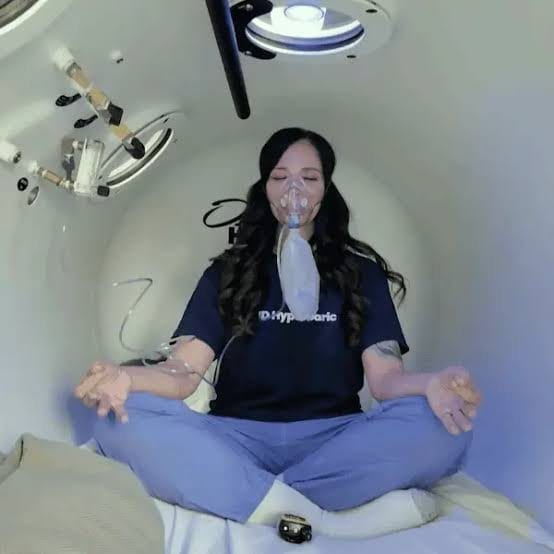
In the randomised trial, patients in the HBOT arm breathed 100% oxygen at 2.0 atmospheres absolute for 60 minutes, delivered through a facemask, once daily for seven consecutive days after the operation. Seventeen patients received it; seventeen controls had the routine FUE procedure alone.
Giardiello and colleagues, 2025
In the five-patient case report, HBOT was administered in a monoplace chamber at 2.4 ATA, 90-minute sessions, once daily for six consecutive days, with the first session beginning within four to six hours of the procedure.
The overlap is real: both are daily, both run for about a week, both sit in the 2.0-2.4 ATA band that is standard across hyperbaric medicine generally. The differences — pressure, session length, mask versus chamber delivery, and how quickly the first session begins — are not trivial, and no study has compared them.
Why do HBOT protocols use 2.0-2.4 ATA instead of higher pressure?
The 2.0-2.4 ATA range is standard clinical hyperbaric practice for wound and tissue indications, balancing benefit against risk rather than maximising dose. Higher pressure increases dissolved oxygen but also raises middle ear barotrauma and seizure risk from central nervous system oxygen toxicity, per Heyboer and colleagues' review of HBOT side effects.
The pressure band is not arbitrary. It is where routine clinical hyperbaric medicine operates for wound and tissue indications, and it reflects a balance rather than a maximum.
Higher pressure means more dissolved oxygen, but it also means more of every pressure-related risk. Heyboer and colleagues, in the standard review quantifying HBOT side effects, describe the dose-dependent relationship: middle ear barotrauma becomes more likely as pressure increases, and central nervous system oxygen toxicity — the seizure risk that governs the upper limit of any protocol — is a function of oxygen partial pressure and exposure time together.
The authors of that review explicitly call for better characterisation of the risk-benefit profile at varying pressures and durations so that protocols can be standardised across institutions. That call applies with particular force to an off-label cosmetic use where no dose-finding work has been done at all.
Why do published HBOT protocols run for less than a week?
Both published protocols last under a week because a graft's ischaemic window—the days it survives on diffusion before revascularisation—is measured in days, not weeks. Courses of fifteen-plus sessions or 'maintenance' programmes aren't supported by either protocol; the only longer study, 50 sessions in healthy volunteers, showed no statistically significant result.
Both published hair protocols run for under a week, and that is the logically consistent choice given the stated mechanism. The ischaemic window a graft has to survive is measured in days, not weeks. Once revascularisation is under way, the rationale for adding dissolved plasma oxygen weakens considerably.
This matters commercially. If a clinic proposes a course of fifteen or twenty sessions, or a 'maintenance' programme extending for weeks, ask what it is aimed at. Neither published protocol supports it, and the mechanism does not obviously extend that far. The one longer course in the literature — Lee and colleagues' 50 sessions over three months — was studying hair follicle characteristics in healthy volunteers, not post-surgical graft survival, and its results did not reach statistical significance.
What remains unresolved about HBOT protocols for hair transplants?
Five questions remain unanswered: whether 2.0 or 2.4 ATA is better, whether 60 or 90 minutes is optimal, how soon after surgery to start, whether six or seven sessions is the right number, and whether facemask or monoplace-chamber delivery matters—none of these variables has been directly compared in published research.
- Optimal pressure. No study has compared 2.0 ATA against 2.4 ATA for this indication. Both have been used; neither has been shown to be better.
- Optimal session length. 60 and 90 minutes both appear in print, again without comparison.
- How soon to start. The case report started within 4-6 hours. The trial does not describe an equivalently tight window. Whether starting on the day of surgery matters is untested.
- Number of sessions. Six and seven have both been used. Whether three would do the same, or ten would do more, is unknown.
- Delivery route. Facemask inside a chamber versus a monoplace chamber flooded with oxygen is a meaningful difference in practice and has not been compared here.
What questions should you ask a clinic about its HBOT protocol?
Ask a clinic five things: the pressure (in ATA) and session length; how many sessions and on which days; whether it's a hard chamber run by trained staff or a soft chamber; who screens for contraindications beforehand; and the total price, separate from the surgical fee. Precise answers signal a defined protocol.
Because there is no consensus protocol, the useful thing a patient can do is establish what specifically is being proposed and whether it resembles anything that has been studied.
- What pressure, in ATA, and how long is each session?
- How many sessions, on which days relative to surgery?
- Is this a hard chamber operated by trained hyperbaric staff, or a soft chamber?
- Who screens me for contraindications before the first session, and what does that screening cover?
- What is the total price, and is it separate from the surgical fee?
A clinic that can answer all five precisely is running a defined protocol. A clinic that cannot is improvising, which is a reasonable thing to know before paying for it.
Hyperbaric oxygen is one of several add-ons we cover under supportive treatments.
Sources
- Fan Z, Gan Y, Qu Q, Wang J, Lunan Y, Liu B, Chen R, Hu Z, Miao Y. The effect of hyperbaric oxygen therapy combined with hair transplantation surgery for the treatment of alopecia. Journal of Cosmetic Dermatology, 2021;20(3):917-921. pubmed.ncbi.nlm.nih.gov/32770782
- Giardiello F, De Medeiros Quirino L, Brigante R, Chumak M. Hyperbaric Oxygen Therapy for Enhanced Postoperative Recovery in Hair Transplantation. Cureus, 2025;17(12):e99635. doi.org/10.7759/cureus.99635
- Heyboer M, Sharma D, Santiago W, McCulloch N. Hyperbaric Oxygen Therapy: Side Effects Defined and Quantified. Advances in Wound Care, 2017;6(6):210-224. pubmed.ncbi.nlm.nih.gov/28616361
- Lee HY, Lee JY, Kim SC, Lee Y. Preliminary Effects of Hyperbaric Oxygen Therapy on Hair Follicle Characteristics in Healthy Subjects. Bioengineering, 2026;13(2):240. doi.org/10.3390/bioengineering13020240
- Undersea and Hyperbaric Medical Society. Indications for Hyperbaric Oxygen Therapy (approved indications list). uhms.org/resources/hbo-indications.html
This article summarises published research and standard clinical practice. It is general educational information, not medical advice, and it does not replace the instructions your own surgical team gives you. Where their guidance differs from anything here, follow theirs.
Get a no-obligation assessment against fixed criteria, directly on WhatsApp.