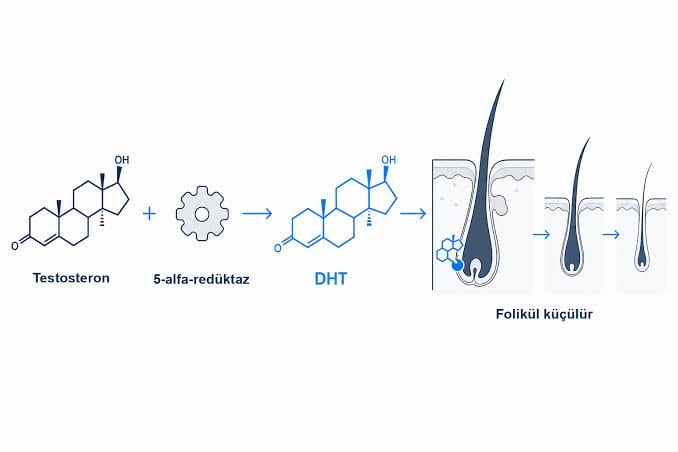
DHT sensitivity in the donor zone: what 'resistant' really means
Donor hair is more resistant to DHT than frontal and crown hair, which is why it survives transfer.
Donor hair is more resistant to DHT than frontal and crown hair, which is why it survives transfer. It is not immune, and recent literature questions how reliably the occipital scalp can be treated as unaffected.
What is donor dominance, and why does it make hair transplantation work?
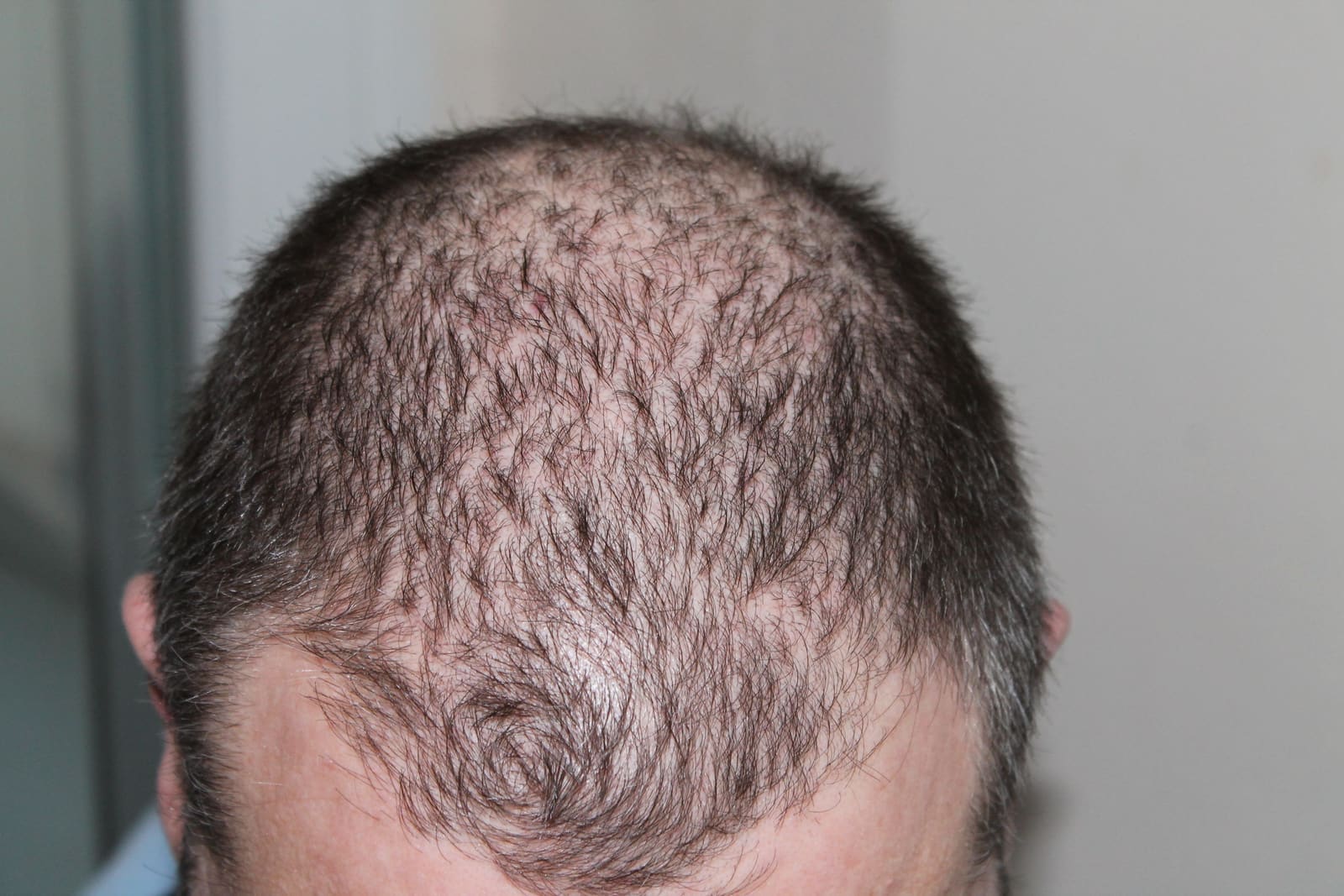
Donor dominance means a follicle keeps behaving like its origin after transplantation: an occipital follicle moved to a bald area still resists DHT as before. Frontal and crown follicles miniaturise under DHT until nothing is visible; occipital follicles respond far less, so donor hair is correctly called largely, not completely, resistant.
Transplantation works because follicles carry their characteristics with them. A follicle taken from the occipital scalp continues to behave like an occipital follicle after it is placed in a bald frontal area. This is donor dominance, and it is the mechanism the entire procedure rests on.
The characteristic that matters is sensitivity to dihydrotestosterone. Frontal and crown follicles in androgenetic alopecia respond to DHT by progressively miniaturising — producing finer, shorter, less pigmented hairs until they produce nothing visible. Occipital follicles respond much less.
The correct description of donor hair is therefore that it is largely resistant to DHT. That is a strong property and it is why the operation works. It is not the same as immunity, and the difference matters over a forty-year horizon.
Why is calling transplanted hair 'permanent' misleading?
Donor hair is far less responsive to DHT, not unresponsive, and the safe zone's boundaries are inferred, not measured, so grafts may come from tissue near the margin. Hair thins with ageing, so a result at seventy differs from one at forty. Most grafts persist for decades, but 'durable' is more accurate than 'permanent'.
Clinic copy routinely describes transplanted hair as permanent, and patients reasonably take that to mean it will be there for life regardless.
Two things make that overstated. First, resistance is relative rather than absolute: donor follicles are far less responsive to DHT, not unresponsive. Second, the safe zone's boundaries are inferred rather than measured, so some grafts in any given session may come from tissue closer to the margin than intended.
There is also the ordinary effect of ageing. Hair thins with age independently of androgenetic alopecia, and transplanted hair ages with the rest of you. A result at seventy is not a result at forty.
None of this means transplants fail. The great majority of properly harvested grafts persist for decades. It means the claim should be calibrated: durable, largely resistant, expected to last — not permanent and not guaranteed.
What recent research questions the assumption that the donor zone is always DHT-resistant?
Two 2026 publications question the assumption directly. Maas and colleagues, in the Journal of the American Academy of Dermatology, challenge treating the occipital scalp as an unaffected control in advanced androgenetic alopecia. Xu and colleagues, using paired vertex-occipital assessment, argue occipital sparing is assumed rather than verified, not that it overturns established practice.
Two 2026 publications are worth knowing about because they question the assumption directly rather than at the margins.
Maas and colleagues published a piece in the Journal of the American Academy of Dermatology titled 'Rethinking the occipital scalp as a control in advanced androgenetic alopecia'. Treating occipital hair as an unaffected reference is standard in both research and clinical assessment; questioning it goes to the foundation of how donor areas are judged.
Xu and colleagues reported a case using paired vertex-occipital assessment, arguing that occipital sparing is assumed rather than verified and that donor-area involvement may be overlooked — a point they raise particularly in the context of diffuse unpatterned alopecia.
A case report and a commentary do not overturn established practice. What they do is support the more careful formulation, and they justify insisting that your donor area be examined under magnification rather than assumed to be fine.
What is diffuse unpatterned alopecia, and why does it matter for donor assessment?
Diffuse unpatterned alopecia (DUPA) is thinning that affects the whole scalp, including the donor area, unlike patterned loss where the donor zone stays resistant. DUPA patients are poor candidates, since grafts taken from a thinning donor zone keep thinning after transfer, fading the result. Confirming DUPA requires trichoscopic examination, not a passing glance.
Most patients have patterned loss with a genuinely resistant donor zone. A minority have diffuse unpatterned alopecia (DUPA), in which thinning affects the whole scalp including the donor area.
DUPA patients are generally poor transplant candidates, because the grafts taken from a thinning donor zone will continue to thin after transfer. The result fades, and the donor area has been spent for nothing.
Identifying DUPA requires trichoscopic examination of the donor area looking for miniaturisation and variation in shaft diameter. It cannot be done by looking at the back of someone's head at conversational distance, and it is the single most important reason to insist on magnified donor assessment.
What should patients do with this information about donor DHT resistance?
Ask whether your donor area was examined under magnification and what was found. Treat the word 'permanent' in clinic copy as a marketing simplification, not a clinical claim. Diffuse rather than patterned thinning calls for closer assessment, not a bigger session. Medical therapy protects the native hair around grafts, not the grafts themselves.
- Ask whether your donor area was examined under magnification, and what was seen.
- Ask specifically whether there is any miniaturisation in the donor zone.
- Be sceptical of the word 'permanent' in clinic copy — it is a marketing simplification, not a clinical claim.
- If your thinning is diffuse rather than clearly patterned, treat that as a reason for a more careful assessment, not a reason for a bigger session.
- Understand that medical therapy protects native hair, not grafts. Grafts are resistant; the hair around them is not.
Sources
- Maas D, et al. Rethinking the occipital scalp as a control in advanced androgenetic alopecia. Journal of the American Academy of Dermatology, 2026 (ahead of print). pubmed.ncbi.nlm.nih.gov/42398778
- Xu Y, et al. Case Report: Paired vertex-occipital assessment reveals donor-area involvement in diffuse unpatterned alopecia. Frontiers in Medicine, 2026;13:1797275. pubmed.ncbi.nlm.nih.gov/41982548
- Jimenez F, Ruifernández JM. Distribution of human hair in follicular units. A mathematical model for estimating the donor size in follicular unit transplantation. Dermatologic Surgery, 1999;25(4):294-298. pubmed.ncbi.nlm.nih.gov/10417585
- Gupta AK, Venkataraman M, Talukder M, Bamimore MA. Finasteride for hair loss: a review. Journal of Dermatological Treatment, 2022;33(4):1938-1946. pubmed.ncbi.nlm.nih.gov/34291720
- Zhou Z, et al. The efficacy and safety of Dutasteride compared with Finasteride in treating men with androgenetic alopecia: a systematic review and meta-analysis. Clinical Interventions in Aging, 2019. pubmed.ncbi.nlm.nih.gov/30863034
This article summarises published research and standard clinical practice. It is general educational information, not medical advice, and it does not replace the instructions your own surgical team gives you. Where their guidance differs from anything here, follow theirs.
Get a no-obligation assessment against fixed criteria, directly on WhatsApp.