Latanoprost and bimatoprost for hair growth
These prostaglandin analogues were developed for glaucoma, and eyelash lengthening was discovered as a side effect.
These prostaglandin analogues were developed for glaucoma, and eyelash lengthening was discovered as a side effect. Bimatoprost is approved for eyelash hypotrichosis; evidence for scalp hair loss is limited.
How were latanoprost and bimatoprost discovered as hair growth treatments?
Latanoprost and bimatoprost are prostaglandin analogues originally used as eye drops for glaucoma. Patients using them developed longer, thicker, darker eyelashes, a side effect that was noted and then developed deliberately, and bimatoprost was subsequently approved in several markets specifically for inadequate eyelashes.
How well do prostaglandin analogues work for eyelashes versus eyebrows?
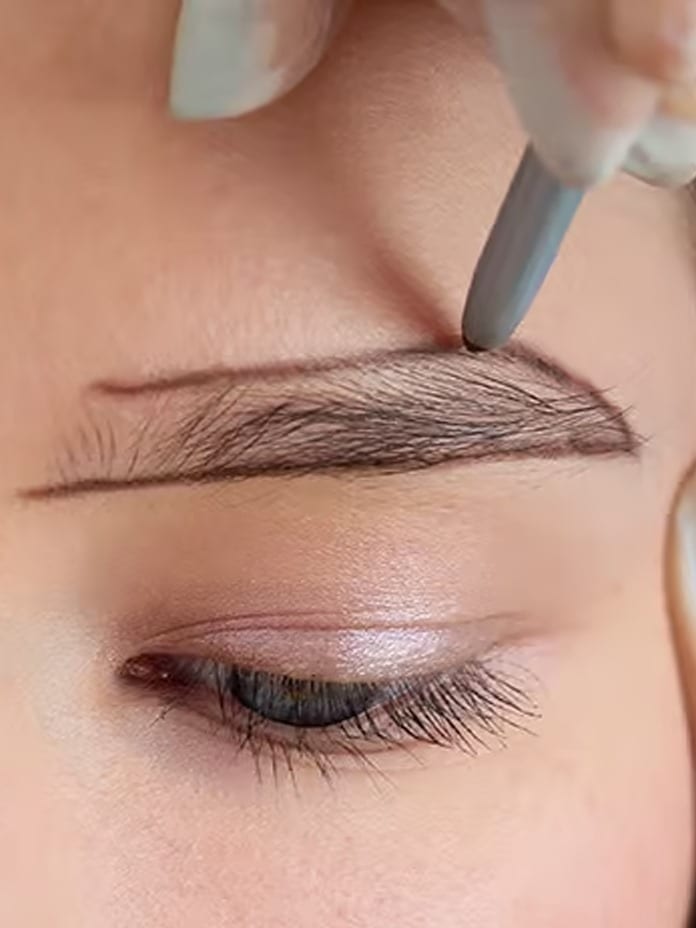
For eyelashes, the lengthening effect of these prostaglandin analogues is established and licensed. For eyebrows, the same mechanism plausibly applies and they are used off-label, backed by a smaller evidence base. In both cases the effect depends on continued use, and hair returns toward baseline after stopping.
How well do prostaglandin analogues work for scalp hair loss?
Only small studies have examined prostaglandin analogues on the scalp, with modest results well short of what supports Minoxidil or Finasteride. There is also a practical problem: the scalp is far larger than a lash line, so cost per treated area becomes substantial, which is why it has not displaced established treatments.
What side effects should you know about prostaglandin analogues for hair growth?
Prostaglandin analogues used for hair growth carry known risks: iris pigmentation change with ocular use, which can be permanent; periorbital skin darkening; eyelid skin changes and orbital fat loss from long-term ocular use, which have been reported to improve after treatment stops; irritation and redness; and unwanted hair growth where product runs onto adjacent skin. Eyebrow use is worth discussing with a clinician, not self-treating.
- Iris pigmentation change with ocular use, which can be permanent
- Periorbital skin darkening
- Eyelid skin changes and orbital fat loss reported with long-term ocular use, and reported to improve after stopping, unlike the iris change
- Irritation and redness
- Unwanted hair growth where the product runs onto adjacent skin
For eyebrow use this is worth discussing with a clinician rather than self-treating with a glaucoma drop.
These remain outside the mainstream options set out under non-surgical treatment.
Sources
- Johnstone MA. Hypertrichosis and increased pigmentation of eyelashes and adjacent hair in the region of the ipsilateral eyelids of patients treated with unilateral topical latanoprost. American Journal of Ophthalmology, 1997;124(4):544-547. pubmed.ncbi.nlm.nih.gov/9323945
- Smith S, Fagien S, Whitcup SM, Ledon F, Somogyi C, Weng E, et al. Eyelash growth in subjects treated with bimatoprost: a multicenter, randomized, double-masked, vehicle-controlled, parallel-group study. Journal of the American Academy of Dermatology, 2012;66(5):801-806. pubmed.ncbi.nlm.nih.gov/21899919
- Glaser DA, Hossain P, Perkins W, Griffiths T, Ahluwalia G, Weng E, et al. Long-term safety and efficacy of bimatoprost solution 0.03% application to the eyelid margin for the treatment of idiopathic and chemotherapy-induced eyelash hypotrichosis: a randomized controlled trial. British Journal of Dermatology, 2015;172(5):1384-1394. pubmed.ncbi.nlm.nih.gov/25296533
- Carruthers J, Beer K, Carruthers A, Coleman WP 3rd, Draelos ZD, Jones D, et al. Bimatoprost 0.03% for the Treatment of Eyebrow Hypotrichosis. Dermatologic Surgery, 2016;42(5):608-617. pubmed.ncbi.nlm.nih.gov/27124878
- Blume-Peytavi U, Lönnfors S, Hillmann K, Garcia Bartels N. A randomized double-blind placebo-controlled pilot study to assess the efficacy of a 24-week topical treatment by latanoprost 0.1% on hair growth and pigmentation in healthy volunteers with androgenetic alopecia. Journal of the American Academy of Dermatology, 2012;66(5):794-800. pubmed.ncbi.nlm.nih.gov/21875758
- Stjernschantz JW, Albert DM, Hu DN, Drago F, Wistrand PJ. Mechanism and clinical significance of prostaglandin-induced iris pigmentation. Survey of Ophthalmology, 2002;47 Suppl 1:S162-S175. pubmed.ncbi.nlm.nih.gov/12204714
- Doshi M, Edward DP, Osmanovic S. Clinical course of bimatoprost-induced periocular skin changes in Caucasians. Ophthalmology, 2006;113(11):1961-1967. pubmed.ncbi.nlm.nih.gov/16935336
- Abalo-Lojo JM, Ferreiro PV, Asorey MK, Colmenero AE, Gonzalez F. Improvement of Prostaglandin-Associated Periorbitopathy after Discontinuing Treatment. Turkish Journal of Ophthalmology, 2023;53(1):8-12. pubmed.ncbi.nlm.nih.gov/36847619
- Wirta D, Pariser DM, Yoelin SG, Arase S, McMichael A, Weng E, et al. Bimatoprost 0.03% for the Treatment of Eyelash Hypotrichosis: A Pooled Safety Analysis of Six Randomized, Double-masked Clinical Trials. Journal of Clinical and Aesthetic Dermatology, 2015;8(7):17-29. pubmed.ncbi.nlm.nih.gov/26203317
This article summarises published research. It is general educational information, not medical advice, and it is not a recommendation to start, stop or change any medication. Prescription drugs carry contraindications and interactions; discuss them with a doctor who knows your medical history.
Get a no-obligation assessment against fixed criteria, directly on WhatsApp.