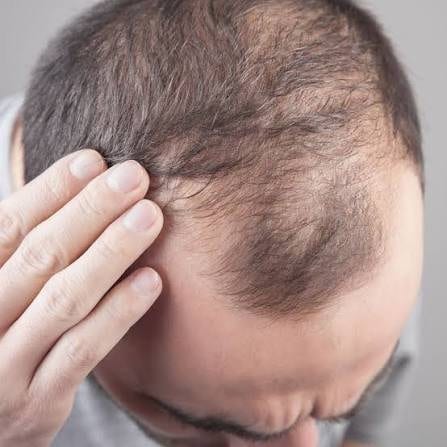
Native hair thinning around a transplanted area
The native hair mixed among and behind the grafts continues to miniaturise unless treated.
The native hair mixed among and behind the grafts continues to miniaturise unless treated. This, rather than graft loss, is what makes a result look thinner over time — and it is the commonest reason patients return.
Why does a transplanted area look thinner over time even if all grafts survived?
Density in a transplanted area comes from two sources: grafts, which don't miniaturise, and surviving native hair, which does. In most recipient areas a substantial share of the hair visible at twelve months is native and androgen-sensitive, so density can fall over years despite full graft survival — it looks like the transplant is thinning.
The apparent density of a transplanted area is not just the grafts. It is the grafts plus whatever native hair was already there and survived.
In most recipient areas — particularly the mid-scalp and any zone that was thinning rather than bald — a substantial proportion of the visible hair at twelve months is native. That hair is androgen-sensitive. The grafts are not.
So the total density falls over time even with 100% graft survival, simply because one of the two contributors is disappearing. Patients experience this as the transplant 'thinning out'. It usually is not.
How do you tell shock loss, graft failure, and native thinning apart?
By timing. Shock loss is temporary shedding in the first months that recovers, following the usual pattern: shedding at weeks two to three, regrowth from months three to four. Graft failure is apparent by twelve months and doesn't progress afterward. Native thinning develops gradually from year two onward and keeps getting worse.
- Shock loss — temporary shedding of native hair triggered by surgical trauma, appearing in the first weeks to months. The follicles survive and regrow, following the usual pattern: shed at weeks two to three, growth returning around months three to four, settled by about twelve months.
- Graft failure — grafts that never grew, apparent by twelve months and not progressive afterwards.
- Progressive native thinning — androgenetic miniaturisation continuing over years. Slow, progressive, and the only one of the three that keeps getting worse.
The timing distinguishes them. Anything that appears in the first months and recovers is shock loss. Anything absent at twelve months and stable thereafter is graft failure. Anything that develops gradually from year two onward is native loss.
Which patients experience the most native thinning around their grafts?
Native thinning is worse when the recipient area was thinning rather than bald before surgery, since more native hair was present to lose; when no medical therapy is used, the dominant modifiable factor; in younger patients, with more pattern still to come; with an aggressive family history; and when only the frontal area was treated.
- Recipient areas that were thinning rather than bald. More native hair present means more to lose.
- No medical therapy. The dominant modifiable factor.
- Young age at surgery. More of the pattern still to come.
- Aggressive family history.
- Frontal-only treatment. If only the hairline was transplanted, the mid-scalp behind it thins visibly against it.
How does native thinning around a transplant progress year by year?
Clinical experience, not published long-term data, describes the pattern: years one to three look as designed; years three to seven bring visible thinning behind and among the grafts, so the transplanted zone reads denser than its surroundings; beyond that, the contrast either resolves into ordinary hair or hardens into a visible band.
Whether it resolves into ordinary maturing hair rather than hardening into a visible band depends on whether the design was conservative and the native hair was treated.
What should you do about native hair thinning around a transplant?
Discuss medical therapy with a doctor who knows your history, since it acts on the actual problem. At the first surgery, treat the mid-scalp, not just the hairline, and hold donor reserve back for continued loss. Photograph the whole scalp annually at consistent length and lighting, and don't answer early thinning with more surgery.
- Medical therapy, discussed with a doctor who knows your history. This is the intervention that acts on the actual problem.
- Treat the mid-scalp, not just the hairline, at the time of the first surgery. A hairline without support behind it is the design that ages worst.
- Hold donor reserve back so continued loss can be answered.
- Photograph the whole scalp annually, at consistent length and lighting. Gradual change is invisible day to day and obvious in a series.
- Do not respond to early apparent thinning with more surgery. If it is within the first year it is probably shock loss; wait for twelve months before judging.
What question should you ask about native hair before transplant surgery?
Ask how much of the density visible at twelve months will be native hair rather than grafts, and what happens to it afterward. In a mid-scalp restoration this can be a large proportion, and knowing the answer in advance changes what the twelve-month photograph really means and what the surgical plan needs to include.
Thinning around a graft is native loss continuing, which we explain under causes of hair loss.
Sources
- Gupta AK, Venkataraman M, Talukder M, Bamimore MA. Finasteride for hair loss: a review. Journal of Dermatological Treatment, 2022;33(4):1938-1946. pubmed.ncbi.nlm.nih.gov/34291720
- Long-term (5-year) multinational experience with Finasteride 1 mg in the treatment of men with androgenetic alopecia. European Journal of Dermatology, 2002. pubmed.ncbi.nlm.nih.gov/11809594
- Maas D, et al. Rethinking the occipital scalp as a control in advanced androgenetic alopecia. Journal of the American Academy of Dermatology, 2026 (ahead of print). pubmed.ncbi.nlm.nih.gov/42398778
- Bernstein RM, Rassman WR. Graft Anchoring in Hair Transplantation. Dermatologic Surgery, 2006;32(2):198-204. pubmed.ncbi.nlm.nih.gov/16442039
- Romera de Blas C, Vega Díez D, Ricart Vayá JM, Gómez Zubiaur A. Complications in follicular unit excision hair transplantation: current evidence and practical approaches. Frontiers in Medicine, 2026;13:1750989. pubmed.ncbi.nlm.nih.gov/41709896
This article summarises published research and standard clinical practice. It is general educational information, not medical advice, and it does not replace the instructions your own surgical team gives you. Where their guidance differs from anything here, follow theirs.
Get a no-obligation assessment against fixed criteria, directly on WhatsApp.