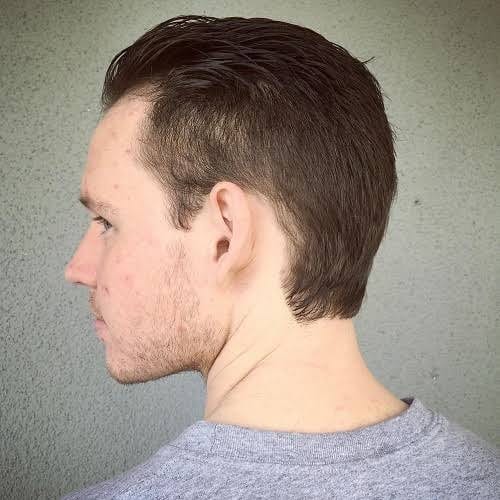
Temporal donor hair: the fine hair at the sides
The hair above and in front of the ears is finer than occipital hair and can recede as part of the pattern.
The hair above and in front of the ears is finer than occipital hair and can recede as part of the pattern. It has a narrow legitimate use for fine detail work and is a warning sign when harvested at volume.
Where is the temporal donor region located?
The temporal region is the hair above and in front of the ears, running toward the temple points, with its lower and posterior parts merging into the safe donor zone. Unlike occipital hair, temporal hair is typically finer in calibre, often shorter in maximum length, and grows at a distinctive flat angle against the scalp.
Why is temporal hair not straightforward donor supply?
Temporal hair often recedes as part of the androgenetic pattern, is finer than occipital hair so covers less per graft, sits in a highly visible area where thinning is exposed, and is awkward to extract because its flat growth angle raises transection risk. Retrograde thinning also affects this zone, making donor stability least assured here.
- It recedes in many men. Temporal recession is part of the androgenetic pattern, and the temple points are among the first areas to go in some patterns. Hair from a region that recedes is not reliably permanent hair.
- It is fine. Lower calibre means less coverage per graft, so it delivers less than an occipital graft of the same count.
- It is visible. The sides of the head are seen constantly and from the front. Thinning or dot scars there are far more exposed than in the occipital centre.
- Extraction is technically awkward. The flat growth angle makes punch alignment harder, which raises transection risk.
Retrograde thinning — which advances upward from the nape and around the ears — also affects this region, so the temporal zone is one of the areas where donor stability is least assured.
What is temporal hair legitimately used for in a hair transplant?
Temporal hair's fine calibre suits three narrow jobs: the very front edge of a hairline, where fine irregular hairs avoid the surgical look coarse occipital hair creates; temple point restoration, which needs hair matching the surrounding fine hair; and eyebrow work. In each case only dozens of grafts are used, not hundreds.
Temporal hair's fineness, which makes it poor bulk supply, makes it genuinely valuable for specific work.
- The very front edge of a hairline. A natural hairline is built from single fine hairs in an irregular line. Coarse occipital hair placed at the leading edge is one of the classic causes of a result that reads as surgical.
- Temple point restoration. Rebuilding temple points requires hair that matches the surrounding fine hair, and occipital hair is too thick.
- Eyebrow work, where fine calibre is essential.
In each case the number of grafts involved is small — dozens rather than hundreds — and they are being used because their characteristics fit the job. That is quite different from harvesting the temporal region for volume.
When is temporal hair harvesting a warning sign?
Substantial temporal harvesting usually signals a graft plan that has outgrown the donor reserve — when the occipital zone cannot supply a promised number, an operator may extend into the crown, nape, or temporal region to borrow hair that may not last. The temporal version is most visible, showing in every side-view photograph.
What should I check regarding temporal donor hair before and after surgery?
Before surgery, ask for the planned harvest boundaries, whether the temporal region is included, how many temporal grafts are proposed for the hairline (a small number is good practice, a large number is not), and whether the area was checked under magnification for miniaturisation. Photograph your temples beforehand, then check for extraction dots afterward.
- Ask for the intended harvest boundaries to be described before surgery, and note whether the temporal region is included.
- If fine temporal hair is proposed for your hairline, ask how many grafts — a small number for detail is good practice, a large number is not.
- Ask whether your temporal region was examined under magnification for miniaturisation.
- Photograph your temples and the area above your ears before surgery.
- After surgery, check for extraction dots forward of the ear and above the temple.
Can temple points be restored if they are already receding?
Yes — restoring temple points is legitimate and can be done well, but it requires fine hair, precise angle control and a conservative design, since points that are too full or too low look artificial. The region keeps receding if the underlying process continues, which calls for medical therapy with a doctor, not more grafts.
Temporal recession is often what brings patients to consultation in the first place, since it changes the shape of the face more than crown loss does.
Restoring temple points is legitimate and can be done well, but it requires fine hair, precise angle control and a conservative design — temple points that are too full or too low look markedly artificial. It is also worth remembering that the region will continue to recede if the underlying process continues, which is a question for medical therapy discussed with a doctor rather than for more grafts.
Sources
- Maas D, et al. Rethinking the occipital scalp as a control in advanced androgenetic alopecia. Journal of the American Academy of Dermatology, 2026 (ahead of print). pubmed.ncbi.nlm.nih.gov/42398778
- Xu Y, et al. Case Report: Paired vertex-occipital assessment reveals donor-area involvement in diffuse unpatterned alopecia. Frontiers in Medicine, 2026;13:1797275. pubmed.ncbi.nlm.nih.gov/41982548
- Jimenez F, Ruifernández JM. Distribution of human hair in follicular units. A mathematical model for estimating the donor size in follicular unit transplantation. Dermatologic Surgery, 1999;25(4):294-298. pubmed.ncbi.nlm.nih.gov/10417585
- Romera de Blas C, Vega Díez D, Ricart Vayá JM, Gómez Zubiaur A. Complications in follicular unit excision hair transplantation: current evidence and practical approaches. Frontiers in Medicine, 2026;13:1750989. pubmed.ncbi.nlm.nih.gov/41709896
- Rassman WR, Bernstein RM, McClellan R, Jones R, Worton E, Uyttendaele H. Follicular unit extraction: minimally invasive surgery for hair transplantation. Dermatologic Surgery, 2002;28(8):720-728. pubmed.ncbi.nlm.nih.gov/12174065
This article summarises published research and standard clinical practice. It is general educational information, not medical advice, and it does not replace the instructions your own surgical team gives you. Where their guidance differs from anything here, follow theirs.
Get a no-obligation assessment against fixed criteria, directly on WhatsApp.