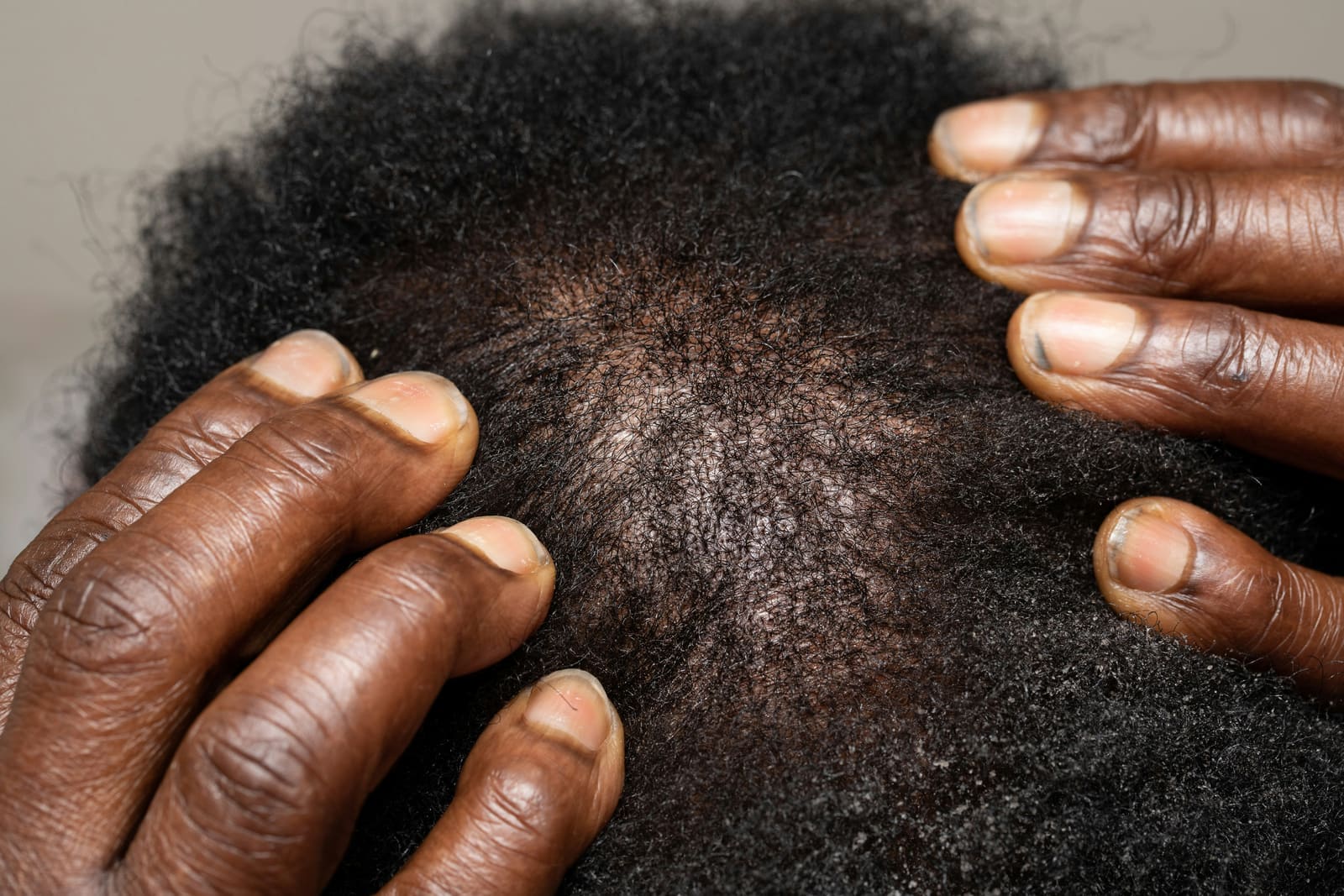
Is my hair getting thin? How to check
Simple, practical ways to establish whether you are genuinely losing hair, before you worry unnecessarily.
First: what is normal?
Before you worry, remember the physiology: an adult typically loses 50-100 hairs a day as an entirely normal part of the hair's growth cycle. Seeing hair on the pillow, in the brush or in the drain is therefore not in itself a warning sign. What counts is whether more hair is leaving the head than is growing back, over time, not a single day's observation.
Four simple home tests
You can get a long way with systematic observation:
- The parting test: make a parting in the same place every month and photograph it. If it becomes visibly wider, the crown is thinning.
- The pillow test: do you notice a clear increase in loose hairs on the pillow or in the drain over a period of weeks?
- The hairline test: compare current photographs with photos from 2-5 years ago, are the temples receding?
- The pull test: take hold of about 40-60 hairs and pull gently. If more than 2-3 hairs come out repeatedly, there may be active loss.
Pattern or diffuse, that reveals a great deal
Note where the hair is disappearing. Are the temples receding and the crown thinning? That points towards androgenetic (hereditary) hair loss in the classic Norwood pattern. If, on the other hand, the hair thins evenly across the whole head over a short period, it looks more like telogen effluvium, often triggered by stress, illness or a deficiency and usually temporary.
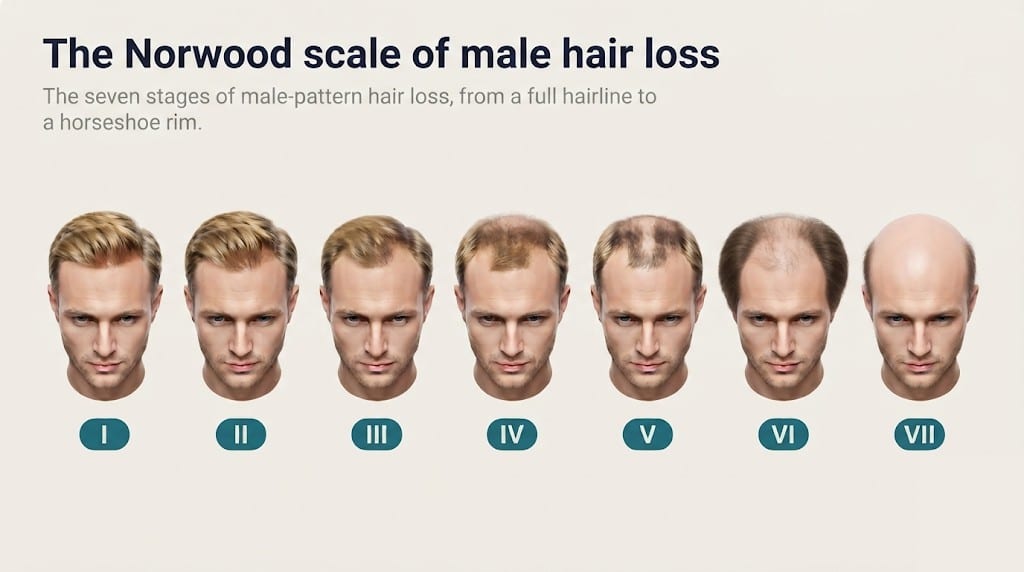
The pattern is one of the most important clues to the cause. See the different types in the overview of the causes of hair loss.
Get a free hair analysis
- 1Start
- 2Info
- 3Done
When is it serious?
Contact a doctor or a dermatologist if you experience persistent thinning over 3-6 months, patchy loss (round bald patches), itching, redness, scaling or tenderness. These can be signs of alopecia areata, a fungal infection or an underlying medical condition that requires different treatment from ordinary hereditary hair loss.
Ask at the same time for blood tests for ferritin, vitamin D and thyroid function (TSH), which are particularly relevant in diffuse loss.
What to do if the test confirms loss
If you establish genuine, active hair loss, the good news is that early action makes the biggest difference. Follicles that have begun to miniaturise but are still alive can often be preserved medically. See the documented options such as Finasteride and Minoxidil in Slowing hair loss without surgery, and wait until the loss has stabilised before considering surgery.
Use light and magnification correctly
Self-assessment becomes unreliable if the light changes. Strong ceiling light from above casts shadows that make the crown look thinner than it is, while soft frontal light can hide genuine thinning. Always take your monitoring photographs in the same, even daylight-like light and from the same angles every time.
If you want to go a step further, a dermatologist can use a trichoscope to measure miniaturisation, signs that follicles in apparently healthy zones are already weakening. That reveals loss before it becomes visible to the eye, and is far more precise than a home test.
© IdealofMeD Research Academy. Republished with permission.
Get a no-obligation assessment against fixed criteria, directly on WhatsApp.