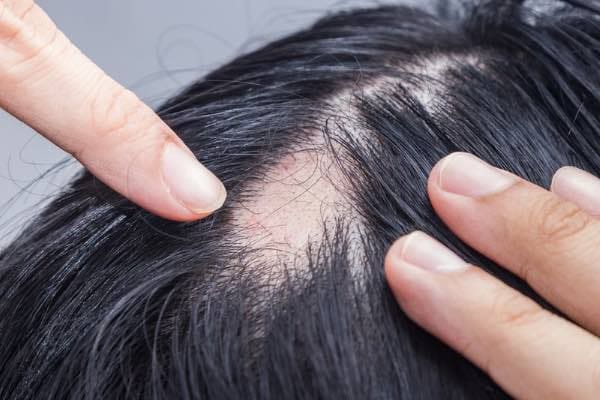
Donor considerations in scarring alopecia
Scarring alopecias destroy follicles permanently and can involve the donor area itself.
Scarring alopecias destroy follicles permanently and can involve the donor area itself. Transplantation is only considered once the condition has been quiet for at least six months, and donor assessment must exclude active disease there.
How is scarring (cicatricial) alopecia different from androgenetic alopecia for hair transplant purposes?
Androgenetic alopecia miniaturises follicles, but scarring (cicatricial) alopecias — including frontal fibrosing alopecia, lichen planopilaris, and folliculitis decalvans — destroy follicles permanently and replace them with fibrous tissue, so nothing regrows. For transplantation this means a scarred, poorly vascularised recipient bed, possible active disease, and, critically, a donor zone that may itself be involved.
How long must a scarring alopecia be quiet before hair transplantation is considered?
A scarring alopecia must have been quiet for at least six months before transplantation is considered, and many clinicians want longer, because grafts placed into an active inflammatory process are attacked by it, causing graft loss and sometimes reactivating the disease. Establishing quiescence is a dermatological judgement requiring diagnosis and follow-up, not a clinic's call.
The standard requirement is that a scarring alopecia must have been quiet for at least six months before transplantation is considered, and many clinicians want considerably longer.
The reason is straightforward: grafts placed into an active inflammatory process are attacked by that process. The result is graft loss, donor supply spent for nothing, and sometimes reactivation of the disease in response to the surgical trauma.
Establishing quiescence is a dermatological judgement, not a cosmetic one. It requires a diagnosis, usually a biopsy, and follow-up over time. A hair transplant clinic is not the right party to make that call, and one willing to operate without a dermatological assessment is not managing this properly.
Can scarring alopecia affect the donor area used for hair transplant grafts?
Yes. Several scarring alopecias can affect the occipital donor scalp — folliculitis decalvans frequently targets the occipital and vertex regions, and lichen planopilaris can appear anywhere. If the donor zone is involved, grafts taken from it carry the disease or are lost to it. Assessment must include trichoscopic examination for scarring changes, not just density.
This is the part specific to donor management, and it is the one most often overlooked.
Several scarring alopecias can affect the occipital scalp. Frontal fibrosing alopecia primarily affects the frontal hairline and eyebrows but can extend. Lichen planopilaris can appear anywhere on the scalp. Folliculitis decalvans frequently affects the occipital and vertex regions specifically.
If the donor zone is involved, grafts taken from it carry the disease with them or are lost to it in place. The donor area is also being wounded in a scalp with an active or recently active inflammatory condition, which carries its own risk of triggering activity.
Donor assessment in these patients therefore has to include specific examination for scarring changes: loss of follicular openings, perifollicular erythema and scale, tufting. That is a trichoscopic and dermatological assessment, not a density count.
In which scarring alopecia cases can hair transplantation still work?
Transplantation works best in burnt-out, localised scarring disease with an unaffected donor area, in quiet traction alopecia (mechanical, not immune, in cause), and in stable, non-inflammatory post-traumatic or post-surgical scars. Even then, graft survival is generally lower than in normal scalp because the bed is poorly vascularised, so test grafting protects the donor reserve.
Not all of these cases are hopeless, and it would be wrong to leave the impression that they are.
- Burnt-out, localised disease with an unaffected donor area is the situation with the best prospects, and results can be good.
- Traction alopecia that has stopped and been quiet is often a favourable case, because the donor area is typically genuinely unaffected — the cause was mechanical rather than immune.
- Post-traumatic and post-surgical scars, which are stable and non-inflammatory, are among the more reliable indications for grafting into scar tissue.
Even in these cases, graft survival in scarred tissue is generally lower than in normal scalp because the bed is poorly vascularised. Test grafting — placing a small number and assessing survival before committing — is a reasonable and conservative approach, and it protects the donor reserve.
What should patients insist on before hair transplant surgery for scarring alopecia?
Patients should insist on a dermatological diagnosis with biopsy before any surgical discussion, documented evidence the condition has been quiet for at least six months, trichoscopic examination of the donor area for scarring changes, a discussion of test grafting rather than a full session, and realistic expectations about survival in scarred tissue.
- A dermatological diagnosis, with biopsy where indicated, before any surgical discussion.
- Documented evidence that the condition has been quiet for at least six months.
- Trichoscopic examination of the donor area for scarring changes, not just density.
- A discussion of test grafting rather than a full session.
- Realistic expectations about survival in scarred tissue.
A clinic that proposes a full session to a patient with an undiagnosed scarring alopecia is risking both a failed result and a spent donor area.
Sources
- Romera de Blas C, Vega Díez D, Ricart Vayá JM, Gómez Zubiaur A. Complications in follicular unit excision hair transplantation: current evidence and practical approaches. Frontiers in Medicine, 2026;13:1750989. pubmed.ncbi.nlm.nih.gov/41709896
- Xu Y, et al. Case Report: Paired vertex-occipital assessment reveals donor-area involvement in diffuse unpatterned alopecia. Frontiers in Medicine, 2026;13:1797275. pubmed.ncbi.nlm.nih.gov/41982548
- Maas D, et al. Rethinking the occipital scalp as a control in advanced androgenetic alopecia. Journal of the American Academy of Dermatology, 2026 (ahead of print). pubmed.ncbi.nlm.nih.gov/42398778
- Parsley WM, Perez-Meza D. Review of factors affecting the growth and survival of follicular grafts. Journal of Cutaneous and Aesthetic Surgery, 2010;3(2). jcasonline.com
- Jimenez F, Ruifernández JM. Distribution of human hair in follicular units. A mathematical model for estimating the donor size in follicular unit transplantation. Dermatologic Surgery, 1999;25(4):294-298. pubmed.ncbi.nlm.nih.gov/10417585
This article summarises published research and standard clinical practice. It is general educational information, not medical advice, and it does not replace the instructions your own surgical team gives you. Where their guidance differs from anything here, follow theirs.
Get a no-obligation assessment against fixed criteria, directly on WhatsApp.