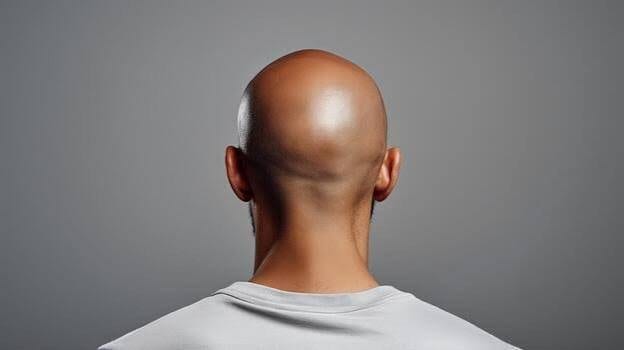
Donor scar repair: SMP, FUE into the scar, and revision
A visible donor scar can be camouflaged but not removed.
A visible donor scar can be camouflaged but not removed. Scalp micropigmentation is the most reliable option, grafting into a strip scar helps in selected cases, and surgical revision trades one scar for a hopefully finer one.
What can and cannot be fixed with a visible donor scar?
A stretched strip scar, an over-harvested FUE donor zone, or hypertrophic scarring can be made less visible but never undone, because follicles removed during extraction are permanently gone. Donor depletion has no restorative treatment — only camouflage. The available repair options are still useful and can change what hair length you can wear.
Does scalp micropigmentation help hide a donor scar?
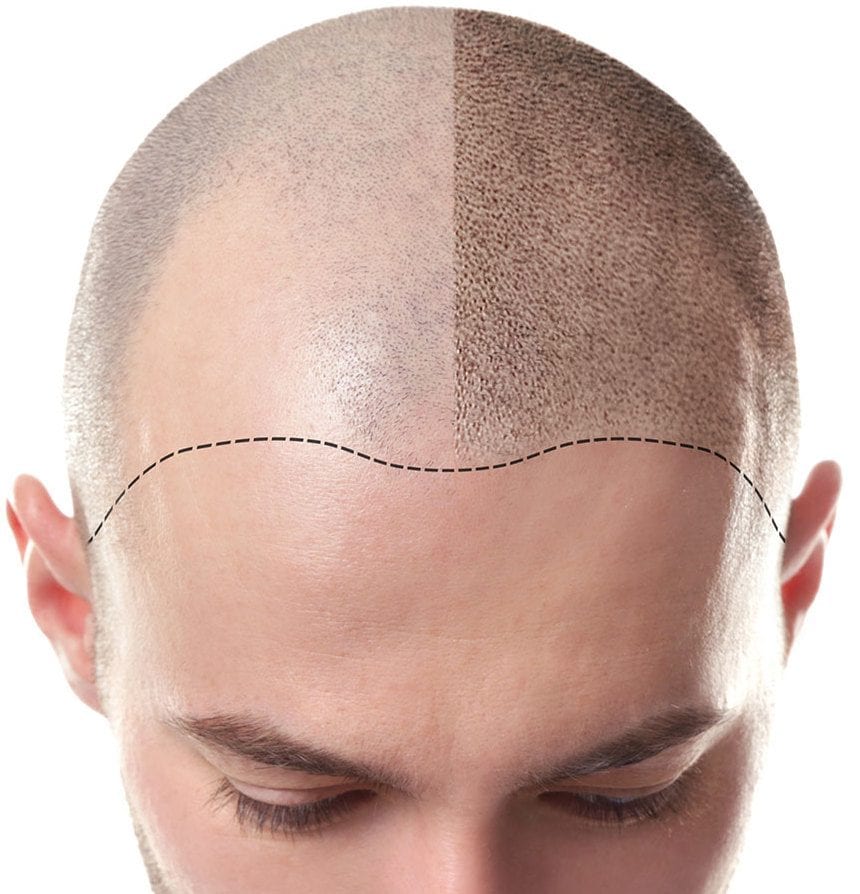
Scalp micropigmentation (SMP) deposits pigment dots to reduce contrast between scar tissue and skin. For donor scars it is the most reliable option — it works on strip and FUE scars, costs no donor hair, and stays effective at short lengths. It is a tattoo that fades and needs maintenance, and practitioner skill varies widely.
SMP deposits small pigment dots in the scalp to reduce the contrast between pale scar tissue and surrounding skin. For donor scarring it is the most reliable and most broadly applicable option.
- Works for both scar types. It can break up a linear strip scar and it can reduce the visibility of thousands of FUE dots.
- No donor cost. This is its key advantage — it spends nothing from a reserve that is usually already depleted.
- Effective at short hair lengths, which is precisely where donor scarring is a problem.
- It is a tattoo. It fades over years and requires maintenance sessions, and colour matching matters as your hair greys.
- Practitioner skill varies enormously. Poor SMP is worse than none, and this is not a field with consistent standards.
For most patients with a visible donor problem, SMP is the first thing to investigate.
Can you graft hair follicles into a strip scar?
Yes — follicular units can be grafted into a linear strip scar to break up its appearance, but scar tissue is poorly vascularised so graft survival is generally lower than normal scalp. It spends limited donor supply, suits fine non-stretched scars better than wide or hypertrophic ones, and often works best combined with scalp micropigmentation.
Follicular units can be placed into a linear strip scar to break up its appearance. It works reasonably well in selected cases and poorly in others.
- Scar tissue is poorly vascularised, so graft survival in a scar is generally lower than in normal scalp. Expect a reduced yield.
- It spends donor supply. Grafts placed into the donor area are grafts not available for the recipient area, which matters most for patients who are already short.
- It suits fine, non-stretched scars better than wide, atrophic or hypertrophic ones.
- Combining with SMP frequently gives a better result than either alone.
Grafting into a depleted FUE donor zone is a related option, sometimes using beard or body hair to add density where scalp reserve is exhausted.
Can a donor scar be surgically revised to make it finer?
Surgical revision excises a stretched strip scar and re-closes it, which can produce a finer line with an experienced surgeon — but it is not guaranteed. It trades one scar for a new one, and a tight scalp, the likely original cause, can make it stretch again. Trichophytic closure lets hair grow through the line.
Excising a stretched strip scar and re-closing it can, in the right hands and the right scalp, produce a finer line. It is not a guarantee — it trades an existing scar for a new one, and the same factors that caused the original to stretch may still be present.
- Scalp laxity is the deciding factor. A tight scalp is why many scars stretched in the first place, and revision under tension repeats the mistake.
- Trichophytic closure — angling the closure so hairs grow through the scar line — is used to improve the result.
- It is a further operation with its own recovery and its own risk of a worse outcome.
Revision is reasonable for a genuinely wide scar in a lax scalp with an experienced surgeon. It is a poor choice for a fine scar that is only visible when the head is shaved.
Which donor scar repair option should I choose?
The best option depends on the scar: SMP suits diffuse FUE thinning and fine strip scars; a wide stretched scar in a lax scalp favours revision first, then SMP; a tight scalp favours SMP alone; hypertrophic scarring needs dermatological assessment first. Always get a second opinion from someone outside the clinic that caused it.
- Diffuse FUE donor thinning and visible dots: SMP, possibly with beard grafts for bulk if reserve allows.
- Fine strip scar visible only at very short length: SMP.
- Wide stretched strip scar, lax scalp: consider revision first, then SMP or grafting on the result.
- Wide stretched scar, tight scalp: SMP, possibly with grafting.
- Hypertrophic scarring: a dermatological question before a cosmetic one — get it assessed.
In all cases, get an opinion from someone who is not the clinic that created the problem.
Correcting earlier work is covered more broadly under repair and correction.
Sources
- Romera de Blas C, Vega Díez D, Ricart Vayá JM, Gómez Zubiaur A. Complications in follicular unit excision hair transplantation: current evidence and practical approaches. Frontiers in Medicine, 2026;13:1750989. pubmed.ncbi.nlm.nih.gov/41709896
- Umar S, Khanna R, Maldonado JC, Chouhan K, Gonzales A. Beard and Body Hair Transplantation by Follicular Unit Excision Using a Skin-Responsive Device: A Multicenter Study. Dermatologic Surgery, 2024;50(3):306-308. pubmed.ncbi.nlm.nih.gov/38127669
- Rassman WR, Bernstein RM, McClellan R, Jones R, Worton E, Uyttendaele H. Follicular unit extraction: minimally invasive surgery for hair transplantation. Dermatologic Surgery, 2002;28(8):720-728. pubmed.ncbi.nlm.nih.gov/12174065
- Jimenez F, Ruifernández JM. Distribution of human hair in follicular units. A mathematical model for estimating the donor size in follicular unit transplantation. Dermatologic Surgery, 1999;25(4):294-298. pubmed.ncbi.nlm.nih.gov/10417585
- Zhu DC, He Y, Fan ZX, Wang J, Qu Q, Hu ZQ, Miao Y. Large-Scale Beard Extraction Enhances the Cosmetic Results of Scalp Hair Restoration in Advanced Androgenetic Alopecia in East Asian Men: A Retrospective Study. Dermatology and Therapy, 2020;10(1):151-161. pubmed.ncbi.nlm.nih.gov/31784942
This article summarises published research and standard clinical practice. It is general educational information, not medical advice, and it does not replace the instructions your own surgical team gives you. Where their guidance differs from anything here, follow theirs.
Get a no-obligation assessment against fixed criteria, directly on WhatsApp.