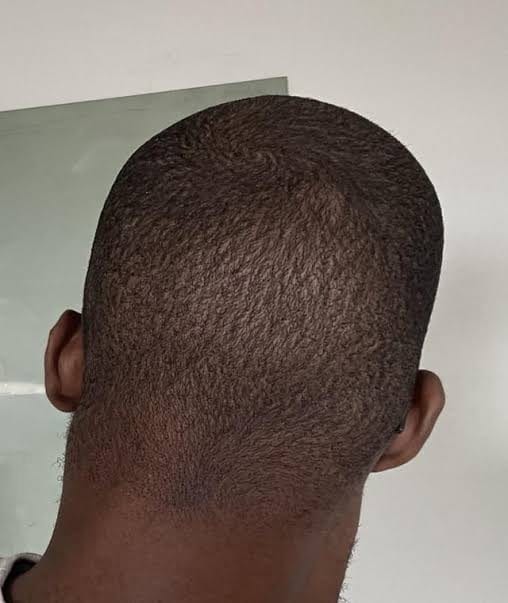
Donor area in Afro-textured hair
Afro-textured hair curves sharply beneath the skin, which raises transection risk and demands specific extraction technique.
Afro-textured hair curves sharply beneath the skin, which raises transection risk and demands specific extraction technique. It also provides excellent visual coverage per follicle, and low hair-skin contrast makes dot scars less visible.
Why is extracting Afro-textured donor hair more technically demanding?
Afro-textured follicles curve sharply beneath the skin, often in a way the surface angle doesn't predict, so a punch following that angle will not follow the follicle. This raises transection risk, and because a transected follicle costs both a donor wound and the graft, it is a donor-management issue, not just a technical one.
Afro-textured hair follicles are not straight beneath the skin. They curve, often sharply and often in a way the surface angle does not predict. A punch that follows the visible emergence angle will not follow the follicle.
The consequence is a higher transection risk than in straight hair. Because a transected follicle costs both a donor wound and the graft, this is a donor-management issue rather than only a technical one — a high transection rate spends the reserve for nothing.
Managing it requires specific technique: punch selection suited to curvature, careful angle judgement, sometimes a slightly larger punch to gain clearance, and an operator who has done a lot of it. This is not a case for a clinic that handles Afro-textured hair occasionally.
What genuine advantages does Afro-textured hair have in transplantation?
Tight curl occupies far more visual space than straight hair, so a given graft count produces more apparent density, and coarse calibre adds to the effect. Low hair-skin contrast means donor thinning and dot scars show less than on paler skin, letting a lower graft number look as full as a larger one would elsewhere.
The picture is not one-sided. Afro-textured hair carries genuine advantages in transplantation that partly offset the extraction difficulty.
- Coverage per follicle is high. Tight curl occupies far more visual space than a straight hair of the same diameter. A given graft count produces more apparent density.
- Hair calibre is often coarse, which adds to that effect.
- Low hair-skin contrast. Dark hair on darker skin shows both donor thinning and dot scars considerably less than dark hair on pale skin.
- The donor area conceals extraction well for the same reasons.
In practice this means the visual result from a conservative graft number can be better than the equivalent in a straight-haired patient — a good reason not to be pushed toward a large session.
What scarring considerations are specific to Afro-textured donor hair?
Keloid and hypertrophic scarring is higher in some patients with darker skin, and hypertrophic scarring is a complication of follicular unit excision, so a family history of keloids must be raised at consultation and can be a reason not to proceed. Hypopigmented dot scars can be more conspicuous against darker skin at short lengths.
Two points require specific attention.
First, keloid and hypertrophic scarring tendency is higher in some patients with darker skin, and hypertrophic scarring in the donor area is a recognised complication of follicular unit excision. A personal or family history of keloids must be raised at consultation — it changes the risk assessment for both FUE and strip surgery, and in some cases is a reason not to proceed.
Second, hypopigmented dot scars can be more conspicuous against darker skin at very short hair lengths, even though the overall contrast picture is favourable. The relevant question is the same as for anyone: how short do you intend to wear your hair.
How does traction alopecia change the donor-area conversation for Afro-textured hair?
Traction alopecia, from sustained pulling by tight braids, weaves, locs or extensions, is typically not androgen-driven, so the donor area is usually unaffected — better candidacy than androgenetic alopecia at similar severity. The conditions are that the traction must have stopped and the process been quiet, at least six months where scarring is involved.
Traction alopecia — hair loss from sustained pulling by tight braids, weaves, locs or extensions — is a common reason for hair restoration in Afro-textured hair, and it changes the donor conversation in a useful way.
Traction alopecia is typically not androgen-driven, so the donor area is usually genuinely unaffected and the reserve is intact. That makes candidacy better than in androgenetic alopecia at a similar apparent severity.
The conditions are that the traction must have stopped, and the process must have been quiet for a meaningful period before surgery. Grafting into an area still under traction repeats the injury. Where a scarring process is involved, the standard requirement is that it has been quiet for at least six months, and often longer.
What should patients ask when choosing a clinic for Afro-textured hair transplantation?
Ask how many Afro-textured cases the surgeon has performed, to see twelve-month donor-area photographs, what transection rate they achieve with this hair type specifically, and what punch size and technique they use for curved follicles. Raise any keloid history explicitly, and ask whether extraction is surgeon-performed throughout the session.
- Ask directly how many Afro-textured cases the surgeon has performed, and ask to see donor-area photographs at twelve months.
- Ask what transection rate they achieve with Afro-textured hair specifically, and how they audit it.
- Ask what punch size and technique they use for curved follicles.
- Raise any keloid or hypertrophic scarring history explicitly.
- Ask whether extraction is surgeon-performed, and by whom throughout the session.
Experience with this hair type is not interchangeable with general experience, and the difference shows in the donor area rather than in the before-and-after photographs of the front.
Sources
- Romera de Blas C, Vega Díez D, Ricart Vayá JM, Gómez Zubiaur A. Complications in follicular unit excision hair transplantation: current evidence and practical approaches. Frontiers in Medicine, 2026;13:1750989. pubmed.ncbi.nlm.nih.gov/41709896
- Kim J, Ko YU, Yi KH. The condition of hair follicles produced by different punching methods during FUE surgery. Journal of Cosmetic Dermatology, 2024;23(12):4202-4207. pubmed.ncbi.nlm.nih.gov/39152658
- Chauhan K, Tandon M, Kumar A, Taneja N, Hamid SAT. A comprehensive review of evolution of advanced follicular unit excision systems. Journal of Cutaneous and Aesthetic Surgery, 2025;18(2):69-77. pubmed.ncbi.nlm.nih.gov/40212421
- Rassman WR, Bernstein RM, McClellan R, Jones R, Worton E, Uyttendaele H. Follicular unit extraction: minimally invasive surgery for hair transplantation. Dermatologic Surgery, 2002;28(8):720-728. pubmed.ncbi.nlm.nih.gov/12174065
- Jimenez F, Ruifernández JM. Distribution of human hair in follicular units. A mathematical model for estimating the donor size in follicular unit transplantation. Dermatologic Surgery, 1999;25(4):294-298. pubmed.ncbi.nlm.nih.gov/10417585
This article summarises published research and standard clinical practice. It is general educational information, not medical advice, and it does not replace the instructions your own surgical team gives you. Where their guidance differs from anything here, follow theirs.
Get a no-obligation assessment against fixed criteria, directly on WhatsApp.