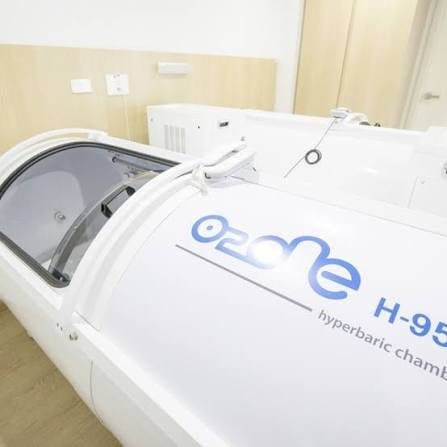
HBOT and graft survival in diabetic patients
HBOT's strongest evidence anywhere is in refractory diabetic wound healing, which makes diabetic transplant patients the group where the extrapolation is most tempting.
HBOT's strongest evidence anywhere is in refractory diabetic wound healing, which makes diabetic transplant patients the group where the extrapolation is most tempting. It remains an extrapolation: no hair-transplant study has enrolled or analysed diabetic patients separately.
Why is diabetes relevant to hair transplant surgery?

Diabetes can damage small blood vessels and impair wound healing, which matters because grafts depend on diffusion from a recipient bed that may be under-perfused, while the donor area must heal thousands of extraction wounds. Surgeons usually operate on well-controlled diabetics with a conservative density plan; poorly controlled diabetes is a reason to postpone.
Diabetes affects hair transplant surgery through microvascular disease and impaired wound healing. Long-standing or poorly controlled diabetes damages small vessels, which reduces perfusion in exactly the tissue beds a transplant depends on, and it impairs several stages of the healing response.
For a hair transplant that means two distinct concerns. Grafts in the recipient area depend on diffusion from a bed whose perfusion may be reduced. And the donor area has to heal thousands of small extraction wounds, which is slower and more infection-prone when glycaemic control is poor.
Most surgeons will operate on a patient with well-controlled diabetes, often with a more conservative density plan. Poorly controlled diabetes is usually a reason to postpone until control improves, and that judgement belongs to your surgical team and your diabetes physician.
Where is HBOT's evidence for wound healing genuinely strong?
HBOT's genuinely strong evidence is in refractory diabetic wound healing — one of only two indications Thom's review found supported by systematic reviews and randomised trials, alongside radiation injury. Diabetic foot ulcers appear on the recognised hyperbaric indication list and generate most hyperbaric volume. Whether that evidence transfers to hair transplants is the open question.
This is the one place in the HBOT story where the underlying evidence is not thin. Refractory diabetic wound healing is among the indications Thom's review identifies as supported by systematic reviews and randomised clinical trials — one of only two categories he places in that tier, alongside radiation injury.
Selected problem wounds including diabetic foot ulcers appear on the recognised hyperbaric indication list, and this is the application that generates most of the clinical hyperbaric volume in many health systems.
So a clinic proposing HBOT for a diabetic hair transplant patient is invoking a real and well-supported use of the treatment. The question is whether the invocation transfers.
Why doesn't the diabetic wound-healing evidence transfer to hair transplants?
Diabetic foot ulcer evidence concerns chronic, non-healing wounds with microvascular disease, often facing amputation — HBOT rescues wounds that failed to heal. A hair transplant in a controlled-diabetes patient is an elective wound in well-perfused scalp, expected to heal normally. No published HBOT study has enrolled or analysed diabetic patients, so the extrapolation is untested.
The diabetic foot ulcer evidence concerns a chronic, non-healing wound in tissue with established microvascular disease, often in patients with peripheral arterial disease, where the alternative outcome is frequently amputation. HBOT is used there to rescue a wound that has already failed to heal by ordinary means.
A hair transplant in a patient with controlled diabetes is not that situation. It is an elective surgical wound in well-perfused scalp tissue, in a patient who by definition has been assessed as fit for elective cosmetic surgery, with an expectation of normal healing.
The scalp is also one of the best-perfused areas of the body, which is why hair transplant infection rates are low and why donor wounds usually heal quickly even in patients who heal slowly elsewhere.
No published hair-transplant study of HBOT has enrolled diabetic patients specifically or reported diabetic outcomes separately. The Fan trial's 34 patients are not described in a way that permits any such analysis, and Dong and Jin's letter to the journal specifically criticised the original report for not clearly describing subgroup differences or the exclusion criteria around medication use.
What actually matters for a diabetic patient planning a hair transplant?
Glycaemic control before booking is the variable that changes surgical risk, and your diabetes team can help. Honest disclosure lets a surgeon plan lower recipient density or stage a large plan across two sessions, easing vascular demand on the recipient bed. Donor-site wound care and healing timelines deserve attention, since they may run slower.
- Glycaemic control before booking. This is the variable that changes surgical risk, and it is the one your diabetes care team can help with. It is not substitutable.
- Honest disclosure at consultation. A surgeon who knows will usually plan a lower recipient density and may stage a large plan across two sessions.
- Session size. A smaller, less dense session places less vascular demand on the recipient bed.
- Donor-site care. Wound care instructions matter more, not less, when healing is slower.
- Realistic timelines. Healing and shedding-to-growth timelines may run slower, which is worth expecting rather than being alarmed by.
What is the bottom line on HBOT for diabetic hair transplant patients?
HBOT has strong evidence for diabetic wound healing but none for diabetic hair transplant patients, a distinction often blurred in marketing. If you have diabetes, achieving good glycaemic control and choosing a conservative surgical plan are the evidence-based steps; discuss any additional chamber sessions with both your diabetes physician and your hair clinic.
Sources
- Thom SR. Hyperbaric oxygen: its mechanisms and efficacy. Plastic and Reconstructive Surgery, 2011;127 Suppl 1:131S-141S. pubmed.ncbi.nlm.nih.gov/21200283
- Undersea and Hyperbaric Medical Society. Indications for Hyperbaric Oxygen Therapy (approved indications list). uhms.org/resources/hbo-indications.html
- Fan Z, Gan Y, Qu Q, Wang J, Lunan Y, Liu B, Chen R, Hu Z, Miao Y. The effect of hyperbaric oxygen therapy combined with hair transplantation surgery for the treatment of alopecia. Journal of Cosmetic Dermatology, 2021;20(3):917-921. pubmed.ncbi.nlm.nih.gov/32770782
- Dong X, Jin X. The effect of hyperbaric oxygen therapy combined with hair transplantation surgery for the treatment of alopecia [letter to the editor]. Journal of Cosmetic Dermatology, 2021. doi.org/10.1111/jocd.14131
- Heyboer M, Sharma D, Santiago W, McCulloch N. Hyperbaric Oxygen Therapy: Side Effects Defined and Quantified. Advances in Wound Care, 2017;6(6):210-224. pubmed.ncbi.nlm.nih.gov/28616361
This article summarises published research and standard clinical practice. It is general educational information, not medical advice, and it does not replace the instructions your own surgical team gives you. Where their guidance differs from anything here, follow theirs.
Get a no-obligation assessment against fixed criteria, directly on WhatsApp.