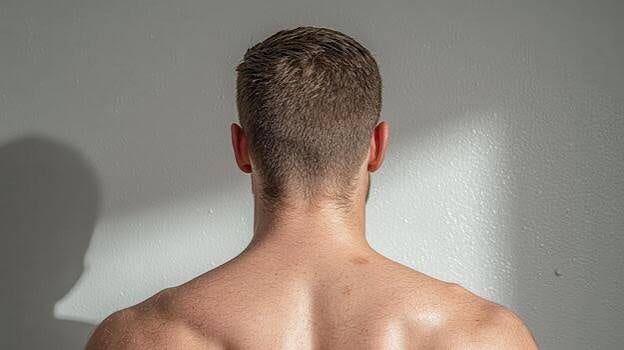
How donor density is measured
Donor density is measured as follicular units per square centimetre, usually with a densitometer or trichoscope over a clipped patch.
Donor density is measured as follicular units per square centimetre, usually with a densitometer or trichoscope over a clipped patch. It should be measured, not estimated by eye, and the number matters less on its own than in combination with hair calibre.
What exactly does 'donor density' measure?
Donor density measures follicular units — groupings of one to four hairs — per square centimetre, the figure surgeons use to plan grafts. That differs from hairs per square centimetre, which is higher by the hairs-per-unit count. Conflating the two is one way graft numbers get inflated, so it's worth knowing which one you're told.
Hair does not grow as evenly spaced single strands. It emerges in follicular units — natural groupings of one to four hairs sharing a follicular structure, sebaceous glands and an erector muscle. Jimenez and Ruifernández set out the distribution of human hair in follicular units in Dermatologic Surgery in 1999, building a mathematical model for estimating donor size in follicular unit transplantation on exactly this basis.
Donor density is conventionally expressed as follicular units per square centimetre. That is the number a surgeon uses to plan how many grafts can be taken. It is not the same as hairs per square centimetre, which is higher by whatever the average hairs-per-unit figure is in that patient.
Conflating the two is one of the ways graft numbers get inflated in quotes, so it is worth being precise about which one you are being told.
How is donor density actually measured at a consultation?
A patch of the donor area is clipped short, then a densitometer or trichoscope counts follicular units within a field of view, repeated at two or three spots to capture how density varies. This reveals hair calibre and miniaturisation. It takes minutes and should happen at consultation — without it, density is an eye estimate.
The standard method is straightforward. A small patch in the donor area is clipped short, a densitometer or trichoscope with a known field of view is placed on it, and the follicular units within that field are counted. Repeating this in two or three locations across the donor zone gives a usable average and shows whether density varies across the area, which it usually does.
Trichoscopy adds information beyond the count. Under magnification, a surgeon can see hair calibre, the proportion of single-hair units, and — most importantly — whether there is miniaturisation in the donor zone, which is the finding that should change a plan.
This should take a few minutes and it should happen at consultation. If nobody has clipped a patch and put a lens on your donor area, your density has been estimated by eye, and eye estimates are unreliable.
What counts as good donor density, in numbers?
Donor density is favourable when it is ideally over 50 follicular units per square centimetre; below that, the same graft number means harvesting a larger area, raising the risk of visible thinning. Density varies by ethnicity and individual, highest at the mid-occipital region — a single number for the whole area is a simplification.
Why isn't donor density alone enough to predict your results?
Coverage depends on the total mass of hair placed, not follicle count. High density with fine hair offers less than the number suggests; moderate density with thick hair gives better coverage from fewer grafts. Hair calibre matters as much as density, and units rich in three or four hairs yield more per graft than singles.
Two patients with identical density can have very different realistic graft counts, because what covers a bald scalp is not follicle count but the total mass of hair placed there.
A patient with high density but very fine hair has less to work with than the number suggests. A patient with moderate density and thick, coarse hair may achieve better visual coverage from fewer grafts. Hair calibre — the diameter of the shaft — is at least as important as density, and it is measured under the same magnification.
The third variable is the mix of follicular unit sizes. A donor area rich in three- and four-hair units yields more hair per graft than one dominated by singles.
What should you ask about how your own donor density was measured?
Ask what your donor density is in follicular units per square centimetre and where it was measured, whether that's units or hairs, your hairs per unit, whether your donor area was checked under magnification for miniaturisation, and how density varies. A clinic that answers has assessed you; one that can't has quoted from a photo.
- What is my donor density, in follicular units per cm², and where was it measured?
- Is that follicular units or hairs?
- What is my average hairs per follicular unit?
- Was my donor area examined under magnification for miniaturisation?
- How does my density vary across the donor zone?
A clinic that can answer these has assessed you. One that cannot has quoted you a graft number from a photograph.
Sources
- Jimenez F, Ruifernández JM. Distribution of human hair in follicular units. A mathematical model for estimating the donor size in follicular unit transplantation. Dermatologic Surgery, 1999;25(4):294-298. pubmed.ncbi.nlm.nih.gov/10417585
- Rassman WR, Bernstein RM, McClellan R, Jones R, Worton E, Uyttendaele H. Follicular unit extraction: minimally invasive surgery for hair transplantation. Dermatologic Surgery, 2002;28(8):720-728. pubmed.ncbi.nlm.nih.gov/12174065
- Maas D, et al. Rethinking the occipital scalp as a control in advanced androgenetic alopecia. Journal of the American Academy of Dermatology, 2026 (ahead of print). pubmed.ncbi.nlm.nih.gov/42398778
- Parsley WM, Perez-Meza D. Review of factors affecting the growth and survival of follicular grafts. Journal of Cutaneous and Aesthetic Surgery, 2010;3(2). jcasonline.com
This article summarises published research and standard clinical practice. It is general educational information, not medical advice, and it does not replace the instructions your own surgical team gives you. Where their guidance differs from anything here, follow theirs.
Get a no-obligation assessment against fixed criteria, directly on WhatsApp.