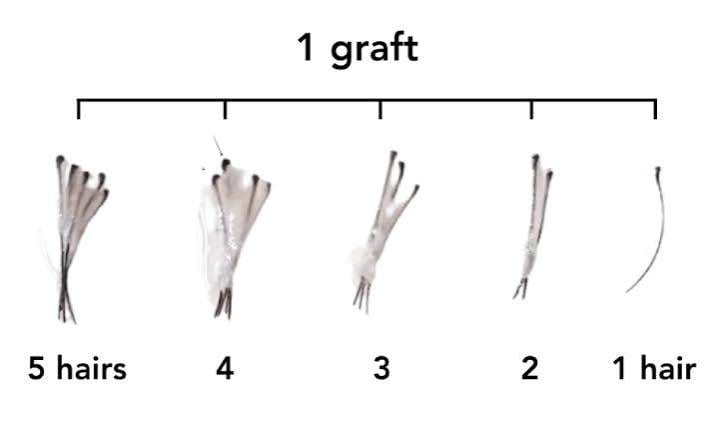
Graft counts vs hairs: the number that gets inflated
A graft is a follicular unit containing one to four hairs; a hair is a single shaft.
A graft is a follicular unit containing one to four hairs; a hair is a single shaft. Quoting hairs instead of grafts roughly doubles the headline number for identical work, and it makes cross-clinic comparison meaningless.
What is the difference between a graft and a hair in hair transplant counts?
A graft is a follicular unit — the natural grouping of one to four hairs removed and placed intact — while a hair is a single shaft. The ratio typically falls between about 1.7 and 2.5 hairs per graft, so a 2 000-graft procedure can mean anywhere from roughly 3 400 to 5 000 hairs for the same operation.
A graft in modern practice is a follicular unit: the natural grouping of one to four hairs that is removed and placed intact. This is the unit surgeons plan in, because it corresponds to one extraction and one recipient incision.
A hair is a single shaft. A graft contains between one and four of them.
The average across a donor area varies by individual and ethnicity, commonly falling somewhere between roughly 1.7 and 2.5 hairs per unit. Jimenez and Ruifernández built their model of donor size estimation on exactly this distribution.
So a 2 000-graft procedure might involve anywhere from about 3 400 to about 5 000 hairs depending on the patient. Both numbers describe the same operation.
How do clinics use graft-vs-hair counting to make offers look better?
Clinics can inflate apparent value by quoting hairs as though they were grafts, pricing per hair while competitors price per graft, quoting extracted rather than implanted grafts (extraction numbers are always larger due to transection losses), or not auditing counts at all — making graft numbers the least comparable figure in hair transplantation.
None of the following is necessarily dishonest, but each changes the apparent size or price of an offer.
- Quoting hairs as though they were grafts. '4 500 grafts' when the figure is actually hairs describes roughly 2 000 grafts of work.
- Pricing per hair while competitors price per graft. A low per-unit price that looks superior is comparing different units.
- Quoting extracted rather than implanted. Grafts are lost to transection and handling. The extracted number is always the larger one.
- Not counting at all. Some clinics quote a package number without auditing what was actually placed.
The result is that graft numbers are the least comparable figure in hair transplantation while being the one patients compare most.
Why is the donor area the real cost when comparing graft counts?
Graft-count shopping treats grafts as the product when the true finite resource is the donor area. Choosing the clinic offering the most grafts for the money means choosing the one taking the most from a reserve that cannot be replenished — the opposite of value. What matters is donor density extracted, which nobody advertises.
What questions make hair transplant quotes actually comparable?
To compare quotes fairly, ask whether the figure is grafts or hairs, your average hairs per unit and how it was measured, whether price is per graft, per hair, or a fixed package, whether the number is extracted or implanted, what proportion of donor density it represents, and what's included versus extra.
- Is this figure grafts or hairs?
- What is my average hairs per follicular unit, and how was it measured?
- Is the price per graft, per hair, or a fixed package?
- Is the number quoted grafts extracted or grafts implanted, and which am I billed for?
- What proportion of my measured donor density does this represent?
- What is included — anaesthesia, medication, follow-up — and what is extra?
With those answers, two quotes can be compared. Without them, comparing headline numbers is comparing different things.
What should graft counts actually be used for?
Graft counts legitimately help a surgeon plan coverage against area and density and help a patient understand a session's scale, but they cannot rank clinics: a clinic quoting fewer grafts may simply have measured your donor area and applied a sensible extraction proportion. The highest graft number is rarely the best proposal.
Graft counts do have a legitimate role: they let a surgeon plan coverage against area and density, and they let a patient understand the scale of a session.
What they cannot do is rank clinics. A clinic quoting fewer grafts may be quoting fewer because it measured your donor area and applied a sensible extraction proportion. That is a better offer, and it looks worse on a comparison spreadsheet.
If you take one thing from this: the highest graft number is rarely the best proposal, and it is often evidence about the clinic rather than about your head.
Sources
- Jimenez F, Ruifernández JM. Distribution of human hair in follicular units. A mathematical model for estimating the donor size in follicular unit transplantation. Dermatologic Surgery, 1999;25(4):294-298. pubmed.ncbi.nlm.nih.gov/10417585
- Romera de Blas C, Vega Díez D, Ricart Vayá JM, Gómez Zubiaur A. Complications in follicular unit excision hair transplantation: current evidence and practical approaches. Frontiers in Medicine, 2026;13:1750989. pubmed.ncbi.nlm.nih.gov/41709896
- Rassman WR, Bernstein RM, McClellan R, Jones R, Worton E, Uyttendaele H. Follicular unit extraction: minimally invasive surgery for hair transplantation. Dermatologic Surgery, 2002;28(8):720-728. pubmed.ncbi.nlm.nih.gov/12174065
- Kim J, Ko YU, Yi KH. The condition of hair follicles produced by different punching methods during FUE surgery. Journal of Cosmetic Dermatology, 2024;23(12):4202-4207. pubmed.ncbi.nlm.nih.gov/39152658
This article summarises published research and standard clinical practice. It is general educational information, not medical advice, and it does not replace the instructions your own surgical team gives you. Where their guidance differs from anything here, follow theirs.
Get a no-obligation assessment against fixed criteria, directly on WhatsApp.