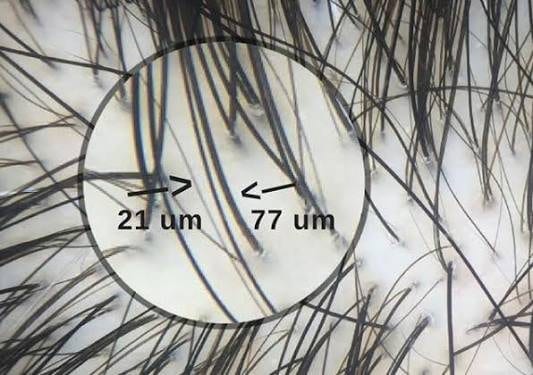
Hair calibre and why it matters more than count
Coverage depends on the total mass of hair placed, not the number of follicles.
Coverage depends on the total mass of hair placed, not the number of follicles. A patient with thick shafts achieves visibly better results from fewer grafts than a fine-haired patient with the same count, which is why calibre belongs in every donor assessment.
Why is graft count a poor predictor of a hair transplant result?
Graft count is easy to quote but a poor predictor of outcome, because coverage depends on total hair mass — follicle number, hairs per follicle, and shaft thickness — and graft count captures only the first. A coarse-haired patient can gain convincing coverage from a count that leaves a fine-haired patient looking thin.
Graft counts dominate hair transplant marketing because they are easy to quote and easy to compare. They are also a poor predictor of what a result will look like, because a graft is a container and what matters is what is in it.
Coverage of a bald scalp is produced by hair mass — the total cross-sectional area of hair shafts standing in a given region. That is a function of three things: how many follicles are there, how many hairs each follicle produces, and how thick each hair is. Graft count captures only the first.
A patient with coarse hair can achieve convincing coverage from a graft number that would leave a fine-haired patient looking thin. This is one of the main reasons two people quoted the same number get very different outcomes.
What is hair calibre and how is it measured?
Hair calibre is the shaft diameter, measured in micrometres; because cross-sectional area rises with the square of diameter, a hair twice as thick covers roughly four times as much. It is assessed under magnification with a trichoscope or densitometer alongside density. Published beard-donor criteria treat grafts below roughly 60 μm as unsuitable.
Hair calibre is the diameter of the hair shaft, measured in micrometres. Fine hair sits at the low end, coarse hair at the high end, and the difference between them is substantial in visual terms because the cross-sectional area rises with the square of the diameter — a hair twice as thick covers roughly four times as much.
It is assessed under magnification at the same time as density, using a trichoscope or densitometer. A surgeon examining your donor area properly is looking at three things at once: units per cm², hairs per unit, and shaft diameter.
The published beard-donor classification work makes the role of calibre explicit: Zhao and colleagues specify that beard grafts are unsuitable below roughly 60 μm in diameter. That is calibre being used as a formal selection criterion rather than a soft impression.
How do hair calibre and density interact in a transplant plan?
Calibre and density combine to set what a plan can achieve: high density with coarse hair is most favourable; high density with fine hair covers less than the count suggests; moderate density with coarse hair often outperforms its count; and low density with fine hair is most constrained, favouring a smaller treated area.
The two combine, and the combination determines what a realistic plan looks like.
- High density, coarse hair. The most favourable combination. Large lifetime reserve and strong coverage per graft.
- High density, fine hair. The count looks good on paper but coverage is weaker than the number suggests. Plans should be more conservative than the density alone implies.
- Moderate density, coarse hair. Often produces better results than the graft count predicts. Extraction must still be conservative because the reserve is smaller.
- Low density, fine hair. The most constrained situation. Both the reserve and the coverage per graft are limited, and honest planning means a smaller area treated well rather than a large area treated thinly.
Why does fine donor hair show extraction damage sooner than coarse hair?
Fine donor hair camouflages extraction sites less effectively than coarse hair because there is less shaft to drape over the gaps, giving fine-haired patients a lower safe extraction proportion at the same density. Their donor area reads as thin earlier, and dot scars become visible at a longer hair length — calibre penalises them twice over.
There is a second effect that is less often mentioned. Fine donor hair camouflages extraction sites less effectively than coarse hair, because there is less shaft to drape over the gaps.
That means a fine-haired patient has a lower safe extraction proportion than a coarse-haired patient at the same starting density. The donor area starts to read as thin earlier, and the white dot scars become visible at a longer hair length.
So calibre works against fine-haired patients twice over: fewer grafts are safely available, and each one covers less.
What should fine or low-density patients expect from a hair transplant plan?
Patients should ask for shaft diameter, not just density, and treat cross-clinic graft-count comparisons with caution. Fine-haired patients should expect a plan focused on the frontal third and mid-scalp, not full crown coverage — though curly hair and low colour contrast with the scalp help offset fine calibre. Judge proposals by likely look, not quoted number.
- Ask what your shaft diameter is, not just your density.
- Treat graft-count comparisons between clinics as much less informative than they appear.
- If your hair is fine, expect a plan focused on the frontal third and mid-scalp rather than full coverage including the crown.
- Remember that curl helps. Curly and wavy hair covers better per follicle than straight hair of the same diameter, which partly offsets fine calibre.
- Colour contrast matters too — hair close in tone to your scalp reads as denser than dark hair on pale skin at the same actual density.
None of this is a reason not to have surgery. It is a reason to judge a proposal by what it will look like rather than by the number attached to it.
Calibre is one of the measures behind a realistic estimate; see donor supply.
Sources
- Zhao Y, Zhang J, Jiang B, Fan Z, Miao Y. Development of an Evaluation System to Classify Beard Donor Area for Hair Transplantation. Dermatologic Surgery, 2025;51(9):882-886. pubmed.ncbi.nlm.nih.gov/40323042
- Jimenez F, Ruifernández JM. Distribution of human hair in follicular units. A mathematical model for estimating the donor size in follicular unit transplantation. Dermatologic Surgery, 1999;25(4):294-298. pubmed.ncbi.nlm.nih.gov/10417585
- Parsley WM, Perez-Meza D. Review of factors affecting the growth and survival of follicular grafts. Journal of Cutaneous and Aesthetic Surgery, 2010;3(2). jcasonline.com
- Maas D, et al. Rethinking the occipital scalp as a control in advanced androgenetic alopecia. Journal of the American Academy of Dermatology, 2026 (ahead of print). pubmed.ncbi.nlm.nih.gov/42398778
This article summarises published research and standard clinical practice. It is general educational information, not medical advice, and it does not replace the instructions your own surgical team gives you. Where their guidance differs from anything here, follow theirs.
Get a no-obligation assessment against fixed criteria, directly on WhatsApp.