
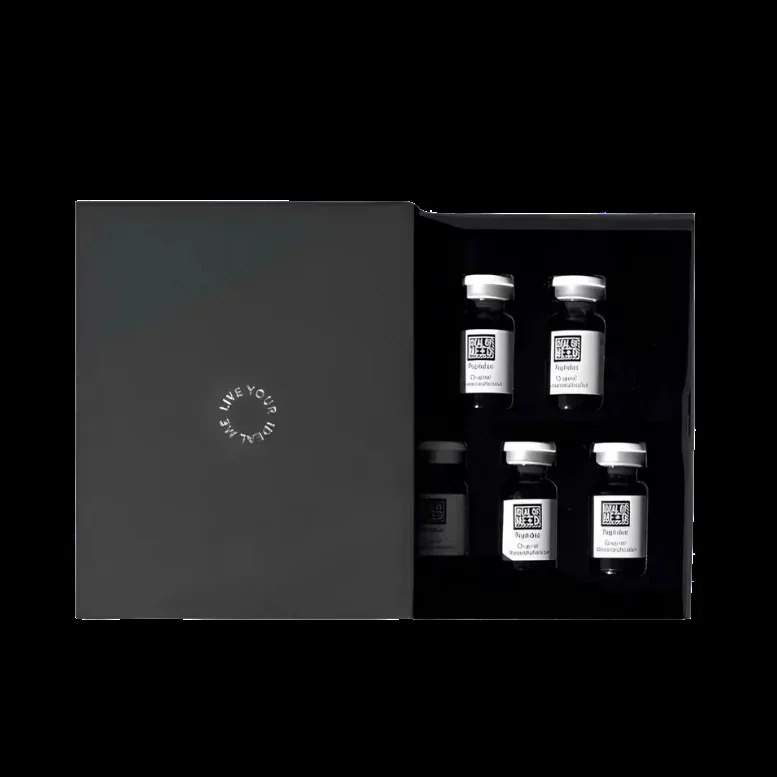
Mesotherapy for hair loss is a series of superficial micro-injections of a prepared mixture into the skin of the scalp, aimed at supporting follicles that are still present. It describes how a mixture is delivered, not what is in it: the provider chooses the mixture, and published studies have used vitamins, minerals, amino acids, peptides, growth factors and, in some protocols, drugs such as dutasteride or minoxidil.
Two things follow. First, mesotherapy is not a standardised treatment: a 2025 international consensus states there is currently no internationally recognised, evidence-based standard for its various clinical uses. Second, any effect is more likely to depend on what is in the syringe than on the injection itself, so a result for one mixture says little about another. The studies are small and varied. For how mesotherapy compares with better-evidenced treatments, see the comparison below.
What is scalp mesotherapy?
Scalp mesotherapy is a series of superficial micro-injections of a prepared mixture into the skin of the scalp. The term describes the delivery method, not the contents, which the provider chooses and which are not standardised. The word dates from 1958, and the same technique is used in other fields such as pain medicine and cosmetic dermatology.
The provider injects small amounts into or just under the scalp skin at many points, repeated as a course. A 2026 systematic review found techniques varied in needle type, depth and dosing schedule, and the 2025 international consensus notes the technique has been practised in different ways and at times regarded as alternative medicine. Two courses both called mesotherapy can differ in almost everything: what is injected, how much, how deeply, how often and for how many sessions. Some providers sell the same idea under other names, such as “scalp vitamin protocol” (SVP).
The 2025 consensus recommends that mesotherapy be carried out by licensed physicians with specific training and demonstrated competence, in a setting that guarantees asepsis. Ask who will inject you, and where.
What is in a mesotherapy mixture?
There is no standard mixture. Published studies have injected vitamins, minerals, amino acids, peptides, growth factors, dutasteride, minoxidil and other substances, alone or combined, and each provider makes its own choice. We give no ingredients, doses or schedules as “typical”, because none exist; ask any provider for the exact contents in writing.
A 2023 systematic review of 27 articles found six classes of agent, and combinations of them, in published mesotherapy studies for hair loss: dutasteride, minoxidil, growth factors or autologous preparations, botulinum toxin A, stem cells and multivitamin mixtures. A 2026 systematic review of 30 studies found multivitamin and peptide formulations the most frequently studied, followed by dutasteride, minoxidil, bicalutamide, growth factors and finasteride. Both describe protocols that vary and are not standardised.
A plausible-looking recipe would only mislead; what to ask before you pay lists the questions that draw out the real contents.
Why the ingredient probably matters more than the method
- Nutrients. Vitamins and minerals help where a deficiency has been demonstrated, which is what a blood test is for. Whether injecting a multivitamin mixture helps people whose levels are normal is not established by the studies we found.
- Drugs. Dutasteride blocks both types of the enzyme 5-alpha-reductase and so lowers DHT, the hormone behind hereditary hair loss; minoxidil acts on the growth cycle. If a course helps, a drug like these is a more plausible reason than the injection.
- Peptides and growth factors. These follow the evidence on our peptide therapy page: consistent in the laboratory, limited in people.
Attribution is a further problem. A 2026 study of peptide mesotherapy points out that three randomised trials in which dutasteride mesotherapy outperformed placebo all used mixtures that also contained D-panthenol, biotin and pyridoxine, so the drug's contribution cannot be separated from the rest.
What is the thinking behind mesotherapy for hair loss?
The idea is to place a substance in the skin close to the follicle, at a lower dose than a tablet, to act where it is needed. For a drug such as dutasteride, proponents also argue little of it reaches the rest of the body. Both are reasoned arguments rather than demonstrated results, and we found no human blood-level data for injected dutasteride.
Injecting into the skin places the substance near the follicle and may keep it there longer, so lower doses and longer intervals between sessions may be possible. Delivering a drug locally is also said to lower its exposure elsewhere in the body, which is why mesotherapy is often proposed for people who do not want to take a tablet.
Where the argument gets thinner
- Low systemic exposure is mostly assumed. Several papers describe absorption of injected dutasteride as negligible, but we found no study measuring blood levels in people after scalp injection. The absence of serious systemic side effects in published series is reassuring, but not the same as measurement.
- The drug is used off label. Oral dutasteride is approved for pattern hair loss in some markets and used off label elsewhere; we are not aware of any regulator that has approved an injectable dutasteride for hair loss. The 2025 consensus advises that drugs not authorised for the condition be used only in an experimental setting, and that off-label use be limited to substances with high-quality clinical studies behind them.
- Oral dutasteride clears slowly. Our research review of its side-effect profile notes a side effect takes far longer to wear off than with finasteride. We found no data on how long the injected form persists, so ask the prescriber what is known.
What does the research actually show?
Systematic reviews report that most published mesotherapy studies show some improvement in density or thickness, but the studies are small, use different mixtures and techniques, and follow patients briefly. A 2026 systematic review concluded injectable therapy may give a cosmetic benefit, particularly with dutasteride, and that standardised randomised trials are required before it is recommended as routine.
Read side by side, the reviews agree:
- 2022, Journal of Cosmetic Dermatology. Twelve studies (six randomised controlled trials) all reported some positive efficacy, with no significant side effect, but the authors noted the samples were too small and comparisons with other treatments insufficient.
- 2023, Journal of Dermatological Treatment. Of 27 articles, several reported statistically significant improvements in hair growth, but regimens were not standardised, adverse effects were reported, and large controlled trials were called for.
- 2025, Journal of Cosmetic Dermatology. A review of intralesional dutasteride found improvements in hair density and thickness with minimal adverse events, but methods, sample sizes and follow-up varied, and large, high-quality trials were lacking.
- 2026, Dermatologic Surgery. Thirty studies (7 interventional, 11 observational and 12 descriptive reports). Outcomes ranged from increased density and shaft diameter to stabilised shedding, and adverse events included paradoxical alopecia, scarring and acute dermatitis.
What real-world data adds
A 2022 multicentre retrospective study of 541 patients treated with dutasteride mesotherapy in routine practice found pain the most common side effect (246 patients) and detected no serious or sexual adverse events. Response to mesotherapy alone could be assessed at one year in only 86 patients, most of whom improved. Being retrospective and uncontrolled, with most patients unassessable, it cannot by itself show how well the treatment works.
What this adds up to
The direction is mostly favourable, and the 2025 consensus lists alopecia among the conditions for which mesotherapy is considered an option. It is the quality that is limited: small studies with different mixtures, no standard schedule, short follow-up and few comparisons with proven treatments can show a signal, but not how large the effect is, how long it lasts, or how it compares with finasteride or minoxidil.
Is scalp mesotherapy safe?
Most reported side effects are mild and local — pain, redness, itching — but more serious problems have been reported, including infection, scarring and patchy hair loss at injection sites. How often they occur is not known. The risk depends on the substance injected, the technique and how sterile the setting is.
What has been reported
- Common and mild. Pain during injection was the most frequent side effect in the 541-patient study above (246 patients); redness, itching and tenderness are also described.
- Patchy hair loss at injection sites. Case reports and small series describe paradoxical alopecia after dutasteride mesotherapy, sometimes persistent and with scarring features. One series of 15 patients reported non-scarring patchy loss in four after a single session, suggesting a preservative, solvent or other ingredient could be responsible. Authors disagree on how common it is: a 2022 report calls it extremely rare, a 2026 case series says it may be under-recognised.
- Other reactions. Reviews of injectable therapy list acute dermatitis and scarring, and a 2026 study summarising earlier reports adds injection-site infection, granulomatous foreign-body reactions, fat necrosis and swelling of the forehead or face. These are individual case reports of unknown frequency.
- Infection. Infections with non-tuberculous mycobacteria after cosmetic mesotherapy are documented. A systematic review of 30 articles (423 patients) found them mainly in women, mostly on the abdomen, buttocks and thighs rather than the scalp, and traced them to injections contaminated by the environment. Many needed more than one course of antibiotics, and the infections often took weeks to resolve and left scarring. These cases are not scalp treatment, but they show what an unsterile injection can do.
What you can check yourself
- Sterility. The 2025 consensus states mesotherapy must be performed with asepsis and infection prevention, and lists failure to use sterile disposable equipment among the causes of complications. Ask whether needles and syringes are new for every patient.
- The substance. Ask whether each ingredient is licensed for this route, used off label, or a compounded or unlicensed preparation. Compounded products are not assessed by regulators the way licensed ones are, and standards differ between pharmacies.
- Your circumstances. Declare allergies and medication, including supplements, and have active eczema, psoriasis or scalp infection assessed first. If you are pregnant, could become pregnant or are breastfeeding, do not have any treatment containing a DHT blocker (such as dutasteride) without your own doctor's approval: this drug class can harm the development of a male baby, the warning is well established for the tablets, and we found no data showing the injected form is exempt.
How does mesotherapy compare with proven treatments and with PRP?
Finasteride and minoxidil are the foundation, backed by large randomised trials; PRP and microneedling have more evidence than mesotherapy but less than the foundation. What is injected matters: in a 2025 Canadian expert consensus that reviewed 45 interventions, PRP and microneedling were recommended, intralesional dutasteride with near-consensus, and injectable minoxidil was not.
| Treatment | Type | Evidence | Role |
|---|---|---|---|
| Finasteride | Medical | Strong | Foundation |
| Minoxidil | Medical | Strong | Foundation |
| PRP | Medical | Reasonable but uneven | Add-on |
| Microneedling | Non-medical | Moderate | Add-on |
| Mesotherapy | Injected mixture, not standardised | Limited: small, varied studies | Unproven add-on at most |
| Hair transplant | Surgical | Does a different job: it moves follicles | When follicles are gone in an area |
How a 2025 expert consensus weighs these options
The 2025 Canadian consensus used a Delphi process among 11 physicians to review 45 interventions for androgenetic alopecia. It recommended seven: oral dutasteride, oral finasteride, topical finasteride, topical minoxidil, PRP, microneedling and oral minoxidil. Intralesional dutasteride was recommended with near-consensus; injectable minoxidil was not. That is expert opinion, not trial data, but it fits the point that what is in the syringe matters more than the fact of injecting.
Mesotherapy versus PRP
PRP starts from a defined biological material, your own platelets, though its protocols vary a great deal between clinics. Mesotherapy injects a substance chosen by the provider, so the variation is in the ingredient list itself. Our overview of non-surgical treatment calls PRP promising but less clear-cut than the foundation treatments, and mesotherapy weaker still. Neither replaces medication.
Injected versus tablet dutasteride
Oral dutasteride has been compared with oral finasteride in a meta-analysis of three studies (576 participants) that found a larger rise in hair count with dutasteride. We found no controlled trial comparing injected dutasteride with the tablet, so the two should not be treated as equivalent either way.
Who might mesotherapy be relevant for?
At most, someone with pattern thinning who still has follicles in the area, has already discussed the proven treatments with a doctor, and accepts that mesotherapy is an adjunct with limited evidence. If the aim is to avoid tablets, discuss the specific drug with a doctor, because what is injected is what matters. It is not a treatment for bald areas.
Where it can be reasonable to look into further
- You still have hair in the area. Mesotherapy is aimed at follicles that are present and producing thinner hair.
- The foundation is in place or discussed. The cause has been established and the proven options weighed with a doctor. See causes of hair loss.
- You want to avoid tablets. A reasonable wish, and a doctor can go through the alternatives, including topical formulations. If a DHT blocker is the point, discuss the specific drug, the evidence for it and its off-label status.
- Your provider can tell you exactly what is in the syringe. If not, you cannot judge the offer.
Where it is rarely the answer
- Bald or shiny areas. If the follicles are gone, no injection brings them back; the question is transplantation.
- Sudden, patchy or scarring hair loss. These need a diagnosis first. An inflamed, infected or scarring scalp should be assessed by a doctor before anything is injected into it.
- As a substitute for medication. Paying for mesotherapy while skipping finasteride or minoxidil reverses the sensible order of treatment.
Where does the evidence run out, and what should you expect?
We found no standard mixture, no agreed schedule, no long-term follow-up, and no adequately sized trial that isolates each ingredient's effect or compares injected mixtures with the proven treatments. Nothing injected regrows a follicle that has already gone. This page reflects a literature check in September 2026 and will change if larger trials appear.
Four gaps matter for anyone deciding:
- Standardisation and attribution. Mixtures, needle depth and schedules vary from study to study, and mixtures often combine several substances, so a result cannot be credited to any one — in the randomised trials where dutasteride mesotherapy beat placebo, the mixture also contained vitamin-type ingredients.
- Scale and follow-up. Reviews describe small samples and short follow-up; whether a benefit lasts after the injections stop is not established.
- Comparison. Reviews report that studies comparing mesotherapy with other treatments are insufficient, and we found no controlled trial comparing injected with oral dutasteride.
- Safety data. Serious problems are described in case reports and small series, of unknown frequency.
We give no timeline or percentage, because that would presuppose a documented effect from a specific mixture. Hair grows slowly, so any change takes months to show, and improvement during a course is not proof it caused the change, since hair loss fluctuates naturally. Ask for standardised photographs at the start and along the way, in the same light and from the same angles. For the treatments that do work, hair loss typically resumes within 6 to 12 months of stopping, and we found no data showing a course of injections is an exception.
What would change this assessment: large, independent, double-blind trials of a defined mixture against placebo and an established treatment, with follow-up long enough to show whether the effect lasts.
Does mesotherapy help with a hair transplant?
The evidence is one 2025 randomised, single-blind trial, which reported better regrowth and density than transplant alone when a peptide and growth-factor solution was injected around the operation. We found no trials of other mixtures around a transplant, so their use there is extrapolation. A transplant moves follicles and does not stop ongoing hair loss, and no injection changes that.
The two address different problems. A transplant moves follicles from where hair still grows to where they are missing — the only way to get hair back where follicles are gone. It does not stop loss in the hair you keep, so proven medication still matters afterwards. Mesotherapy can at best support hair that is still there.
There is a healing period after surgery, and treatments that break the skin should not be layered on top unless the surgeon has agreed, so tell the clinic everything you are being given. Some transplant packages list mesotherapy, PRP or peptide treatments among their extras. These can be a genuine benefit or an upsell added once you have travelled, so ask before you fly, not on the day: what is it, what does it add, and is it priced separately? Growth after a transplant follows its own schedule (shedding around weeks 2 to 3, new growth from about months 3 to 4, the final result at about 12 months), so it is hard to credit any add-on for what you see.
What should you ask before you pay?
Ask for the exact contents in writing — every active substance, its manufacturer, and whether it is licensed, off label or compounded. Ask who prepares and injects it, what the mixture is based on, how many sessions are proposed and what the whole course costs. A provider who cannot answer concretely is one you cannot assess.
- Which substances are in the syringe, at what concentrations, and what is each one meant to do?
- For each one: is it a licensed medicine for this route, an off-label use of a licensed drug, or a compounded or unlicensed preparation? Who prepares it, and to what standard?
- What is this particular mixture based on: which published study, of what size and design?
- Who injects, and are they a licensed physician with specific training in the technique?
- Is it done in a clinical setting, with new sterile needles and syringes for every patient?
- Which established treatments have I been offered first, and why is this being added?
- If the mixture is mostly nutrients, are blood tests taken first, and what happens if they are normal?
- How many sessions are proposed, what is that number based on, and what does the whole course cost, separate from any package?
- How will the effect be documented with standardised photographs, and when do we decide that it has not worked?
- What are the side effects, what happens if I get a reaction, and who do I contact?
- What happens when the course ends, and does it need to be repeated?
The contents question matters most: without it, nothing else can be judged. If the course runs unchanged whatever the blood tests show, it is not aimed at a cause. If a provider will not say what is in the syringe, do not go ahead.
Frequently asked questions about mesotherapy
What is mesotherapy for hair loss?
A series of superficial micro-injections of a prepared mixture into the scalp skin. The term describes the delivery, not the contents, which vary by provider and are not standardised. It aims to support follicles still present and cannot regrow gone follicles.
What is injected in scalp mesotherapy?
It depends on the provider. Published studies have injected vitamins, minerals, amino acids, peptides, growth factors, dutasteride, minoxidil and other substances, alone or combined. We give no typical formula because none exists. Ask for the exact contents in writing before you agree.
Does mesotherapy work for hair loss?
Some small studies report improved density or thickness, but systematic reviews call the evidence limited: small samples, varied mixtures and techniques, short follow-up, few comparisons with proven treatments. A 2026 review said standardised randomised trials are needed before it can be routine.
Does dutasteride mesotherapy work?
A 2026 review found that injectable therapy may give a cosmetic benefit, particularly with dutasteride, but the studies are small and varied, and we found no trial comparing injected with oral dutasteride. It is used off label, and case reports describe patchy hair loss at injection sites.
Is mesotherapy better than PRP?
No study we found shows that. A 2026 review described PRP as one of the most studied regenerative treatments, although its protocols also vary. Mesotherapy injects a mixture chosen by the provider, so results for one course say little about another.
Is scalp mesotherapy safe?
Most reported side effects are mild and local; pain was the most common in a retrospective study of 541 patients. More serious problems — infection, scarring, patchy hair loss at injection sites — have been reported, at unknown frequency. Safety depends on the substance, the technique and sterile conditions.
How many sessions do I need?
There is no standard schedule; studies differ in the number of sessions and intervals, and reviews note a lack of standardised regimens. We give no number we have no basis for. Ask for the total, the reason for it and the price of the whole course.
How long do the results last?
That is not established. Reviews describe follow-up as short, and we found no long-term data on whether any benefit lasts after the injections stop. For the treatments that do work, hair loss typically resumes within 6 to 12 months of stopping.
Can mesotherapy replace finasteride or minoxidil?
No. Finasteride and minoxidil have large randomised trials behind them, while mesotherapy has small, varied studies. Where mesotherapy helps at all, the likely reason is a substance in the mixture, so it is better treated as an add-on than as a substitute.
Can mesotherapy be combined with a hair transplant?
They do not rule each other out, but timing must be agreed with the surgeon. We found one 2025 randomised, single-blind trial of a peptide and growth-factor solution around a transplant, and none of other mixtures. A transplant does not stop ongoing hair loss, so proven medication still matters.
Establish what is driving your hair loss first, and ask exactly what will be injected. Mesotherapy is, at most, an adjunct with limited and uneven evidence: not a replacement for the treatments with the strongest evidence behind them, and it does not restore follicles that are already gone. A free hair analysis will tell you which category you are in before you spend anything.
Sidst opdateret: September 2026 · Redaktionelle standarder