
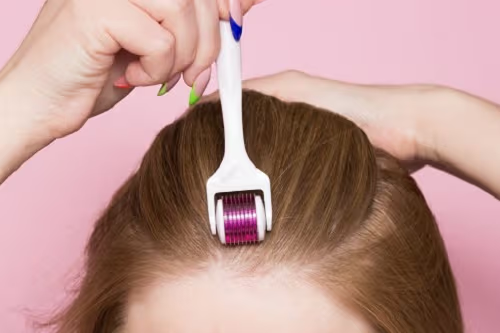
Microneedling, also called dermarolling or collagen induction therapy, uses a roller, pen or stamp fitted with fine needles to make many microscopic punctures in the scalp. The aim is a controlled healing response, and better penetration of a topical treatment applied afterwards. It is done in clinics and at home, and needle length, frequency and hygiene decide how safe it is.
Its strongest evidence is as an add-on. In a 2013 randomised trial of 100 men, weekly microneedling plus 5% minoxidil produced a larger gain in hair count at 12 weeks than minoxidil alone, and a 2025 meta-analysis of randomised trials found the same direction, with wide differences between trials. As a stand-alone treatment the evidence is much weaker, no protocol is standardised, and nothing here restores a follicle that is already gone. This page reports both halves.
What is microneedling, and how is it done?
Microneedling uses a roller, pen or stamp with fine needles to make many microscopic punctures in the scalp, creating a controlled injury that the skin then repairs. Needle length in the hair-loss studies ranged from 0.25 to 2.5 mm. It is done in clinics and at home, and it is not a hair transplant.
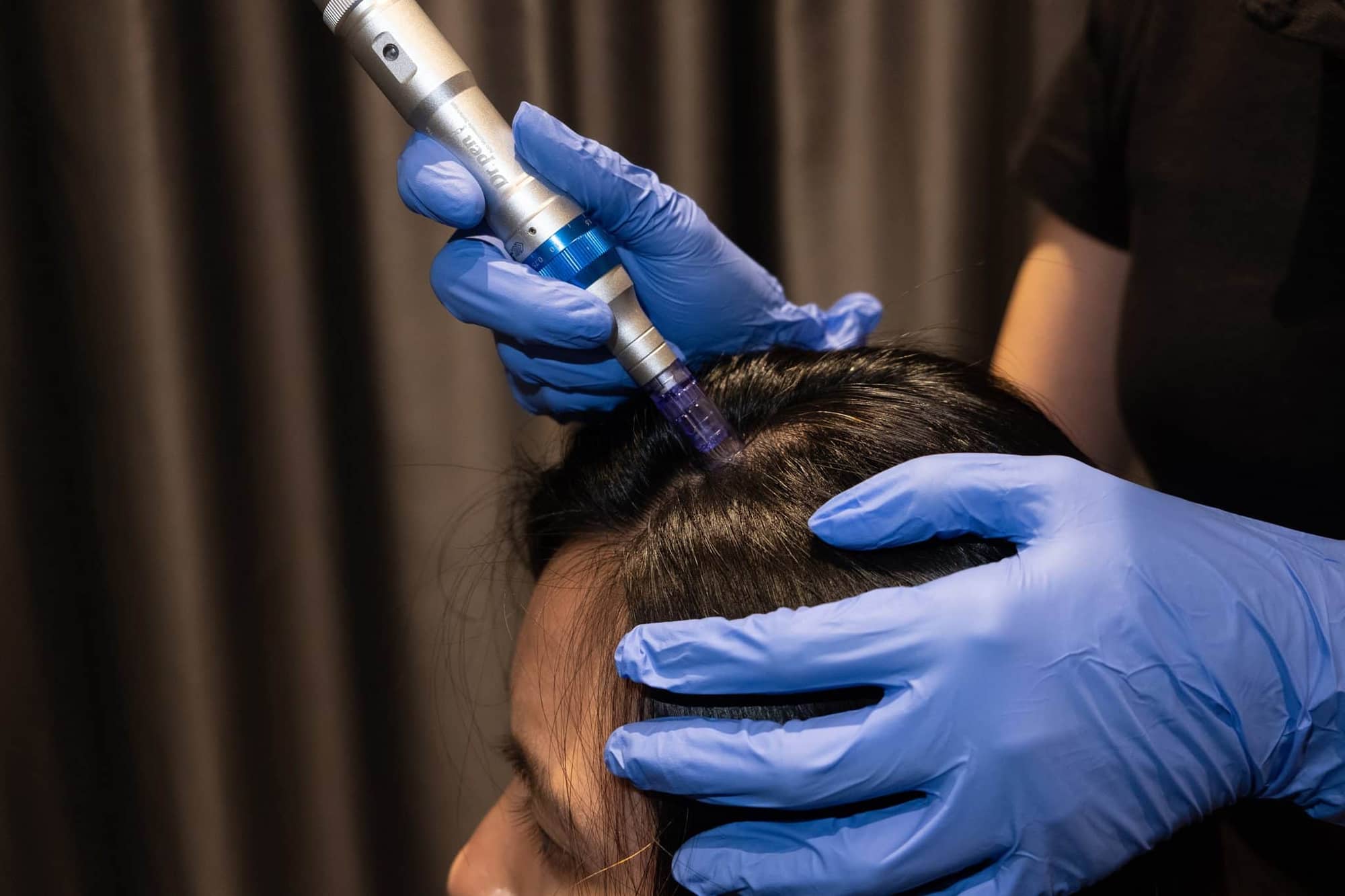
Three device types appear in the trials: manual rollers (dermarollers), automated pens (dermapens) and stamps. In the 2021 systematic review, rollers and pens were the most used.
The aim is a controlled injury, not a surgical wound. Microneedling is aimed at follicles that are still present, so it does not add hair, and where an area is bare the question is transplantation, not needling.
How does microneedling work?
Two mechanisms are proposed. The punctures trigger a wound-healing response that releases growth factors and signalling molecules thought to stimulate follicles, and the channels they create improve how well a topical such as minoxidil penetrates the scalp. The second is the more concrete; the first rests largely on animal and laboratory work.
The wound-healing idea is that the repair response releases growth factors, including platelet-derived and vascular endothelial growth factors, and activates signalling pathways such as Wnt/β-catenin that matter for the hair growth cycle. That evidence comes mainly from animal models. For stand-alone treatment of hereditary hair loss in people, the 2021 systematic review calls the mechanism speculative.
The penetration idea is simpler: a drug applied to punctured skin plausibly reaches the follicle in larger amounts. It is a large part of why the best evidence is for microneedling added to minoxidil rather than used alone, and it comes with a caution. Better absorption can also mean more irritation, which is why many protocols keep minoxidil away from the needling session itself.
What do the trials show when microneedling is added to minoxidil?
Adding weekly microneedling to 5% minoxidil beat minoxidil alone in a 2013 randomised trial of 100 men: the mean hair-count change at 12 weeks was 91.4 against 22.2 hairs/cm² (Dhurat and colleagues). A 2025 meta-analysis of randomised trials also found significantly greater hair-count gains with the combination, though the trials differed widely. The trials are small and short, so this is a promising signal, not an established standard.
The 2013 trial by Dhurat and colleagues, in the International Journal of Trichology, is the best-known result:
- Design. 100 men aged 20 to 35 with mild-to-moderate loss (Norwood-Hamilton grade III vertex or IV) were randomised to 5% minoxidil twice daily, with or without a weekly session with a 1.5 mm dermaroller, rolled until mild redness appeared. The microneedling group skipped minoxidil that day and restarted 24 hours later. Men who had used finasteride or other anti-androgens in the previous six months were excluded, and 94 completed the 12 weeks.
- Hair count. The mean change in a marked target area at week 12 was 91.4 hairs/cm² with microneedling and 22.2 with minoxidil alone (p = 0.039).
- Assessments. An evaluator blinded to group rated 40 patients in the microneedling group at +2 to +3 on a 7-point photograph scale, against none with minoxidil alone. Patients reported more than 50% improvement in 82% of the microneedling group (41 patients) against 4.5% (2 patients).
No significant adverse effect was reported. The authors called it a pilot study and noted that needle size, frequency, duration and end point were still to be answered.
Pooled analyses since then point the same way. A 2025 meta-analysis by Ahmed and colleagues (Archives of Dermatological Research; searches to September 2024) identified 12 randomised trials with 631 patients and pooled 11 for hair count. Combined treatment improved hair count more than minoxidil alone (standardised mean difference 1.32, 95% CI 0.73 to 1.92), with substantial heterogeneity between trials (I² = 88%), and a pooled analysis of six trials showed improved hair diameter. The 2021 review by English and colleagues (Dermatology and Therapy; 22 studies, 1,127 participants) found that six of the seven studies testing microneedling with 5% minoxidil beat minoxidil alone, at needle depths from 0.6 to 2.5 mm. The exception, a 0.25 mm stamp used twice weekly, found no effect. That review describes the underlying data as of relatively low quality.
Does microneedling work on its own?
Weakly and inconsistently. In the 2021 review's six microneedling-only groups, two reported a significant rise in total hair count, one a rise in hair diameter and density, and three found no effect. The evidence supports microneedling as an amplifier of a treatment that already works, not as a replacement for minoxidil or finasteride.
The review calls the data on stand-alone microneedling for hereditary hair loss limited, and the mechanism speculative. Only one of its 22 studies compared microneedling alone against an untreated control patch, and that study was in alopecia areata, not hereditary hair loss.
Microneedling does not replace finasteride in hereditary hair loss and does not create hair in completely bald zones. Where the evidence is strongest, it is used to make minoxidil work better.
Which needle length, frequency and device work best?
Nobody knows. The 2021 review could not establish best practice because studies varied so widely in devices, needle lengths, session frequency and end point, and a 2025 meta-analysis found no significant difference in hair-count results by needle depth, duration or device. Needle lengths ranged from 0.25 to 2.5 mm and sessions from twice weekly to once monthly.
- Needle length. Lengths ranged from 0.25 to 2.5 mm across the reviewed studies, with an average of 1.39 mm. Deeper is not clearly better: in a fortnightly pen trial with 5% minoxidil, the 0.6 mm needle outperformed the 1.2 mm needle, and the 2025 meta-analysis found no significant difference by depth (1 mm or less versus more than 1 mm), although its trials differed widely. Excessive depth risks scarring.
- Frequency. Sessions ranged from twice weekly to once monthly, and courses averaged about 20 weeks. The 2013 trial used weekly sessions for 12 weeks. Daily needling gives the skin no time to heal.
- Device. Rollers, automated pens, stamps and radiofrequency pens were all used. The 2021 review could not rank them, and the 2025 meta-analysis found no significant difference between rolling and electrodynamic devices.
- End point. Some studies stopped at mild redness, others at bleeding or after a set number of passes, and four did not say.
Settle needle length and frequency with a professional before starting. Those are the two points where most mistakes happen.
Is microneedling at home safe, and what are the risks?
In the 2021 review no serious adverse events were reported among 657 microneedled participants, and the usual effects were transient pain, scalp irritation and redness. The risks lie in technique and hygiene, where unsupervised home use is most exposed: an unclean or shared device can carry infection into open punctures, and needles used too deep or too often can scar.
- Hygiene. The scalp is repeatedly punctured, so every session opens a route for bacteria. Disinfect the device before and after use, never share it, and replace it regularly, because blunt needles tear skin rather than making clean channels.
- Depth and frequency. Too deep or too frequent causes chronic irritation, redness and, in the worst case, scarring that can damage the follicles it was meant to help.
- Home versus clinic. The 2013 trial used a 1.5 mm roller in a hospital dermatology department. Our guidance for home devices is the shorter end of the range, typically 0.5 to 1.0 mm, with longer needles left to a professional, and the evidence on short needles is mixed.
- Timing with minoxidil. Freshly punctured skin absorbs more and can be more irritated. The 2013 trial kept minoxidil off the scalp for 24 hours after each session, and many protocols separate the two.
- Who should avoid it. Anyone with active scalp infection or inflamed skin, eczema or psoriasis in the treated area, or a tendency to keloid scarring.
Tenderness, redness and slight bleeding are expected and depend on needle length. The 2025 meta-analysis found adverse events were more frequent with the combination than with minoxidil alone, generally mild or self-limiting.
Can you microneedle around a hair transplant?
Not on a recently transplanted area. Microneedling skin where grafts can still be dislodged, or where healing is unfinished, is harmful, and it should only be considered on fully healed skin with your surgeon's explicit agreement. The grafts need plenty of time to anchor and heal, typically many months, and microneedling is a treatment for the thinning hair you still have, not for a fresh transplant.
A transplant moves follicles; it does not stop the loss of the hair around them, and that continuing loss is where a treatment such as microneedling with minoxidil might belong later. Transplanted hairs shed at around weeks 2 to 3, new growth starts at around month 3 to 4, and the near-final result arrives at about 12 months. Through the early part of that period the healing skin and grafts should be left alone, and the date on which anything can touch the recipient area is your surgeon's decision, not a fixed rule.
The trials described on this page enrolled people with hair loss, not people who had just had a transplant, so any use around surgery is extrapolation. If you want to combine the two, tell the clinic that operated, agree the timing in advance and follow its instructions.
How does microneedling fit with minoxidil, finasteride and PRP?
It sits on top of a foundation, not in place of one. Minoxidil is its evidence partner, finasteride addresses the hormonal cause of hereditary hair loss that microneedling does not, and PRP is a separate injection treatment with its own, weaker evidence. The sensible order is finasteride and minoxidil first, cheap add-ons such as microneedling next, and more expensive extras last.
- Minoxidil. The pairing with the most evidence. Microneedling is best understood as a way of getting more from a treatment you already use, and the trials tested it with 5% topical minoxidil.
- Finasteride. A prescription DHT blocker that slows the hormonal process behind hereditary hair loss. Microneedling does not replace it, and the 2013 trial excluded men who had recently used it, so that trial does not show what microneedling adds for someone already taking it.
- PRP. Platelet-rich plasma is injected into the scalp and is sometimes combined with microneedling in clinics. It costs more, its protocols vary widely between clinics, and its evidence is promising but less clear-cut than for minoxidil and finasteride.
Microneedling suits people who already use minoxidil and want an inexpensive add-on. It is less relevant where the cause has not been established or where an area is completely bare.
Where does the evidence run out?
The evidence runs out at duration, standardisation and stand-alone use. Twenty-one of the 22 studies in the 2021 review followed people for under a year, no best needle length or schedule has been established, the studies averaged about 50 participants each, and the review describes the data as of relatively low quality.
Four limits shape how much to read into it:
- Duration. The 2013 trial measured 12 weeks. Studies shorter than a year often cannot separate a treatment effect from seasonal fluctuation in the hair cycle, and whether the gains last, or need continued sessions, is unknown.
- Standardisation. Devices, needle lengths, frequencies and end points differ so much that the review could not run a meta-analysis or set best practice.
- Controls. Participants know when they are being needled, so patient-reported results, such as the 82% figure in the 2013 trial, come from people who knew which group they were in. The review calls for placebo-controlled trials, for example with a needle-free roller, and follow-up of at least 12 months.
- Population. The 2013 trial enrolled only men aged 20 to 35 with mild-to-moderate loss, at one centre, and excluded recent finasteride users.
None of this means microneedling does not help. It means the trials support a plausible add-on effect and cannot yet say which protocol produces it, for whom, or for how long.
What should you ask before you say yes?
Ask which device and needle length will be used and how often, how the device and needles are cleaned or replaced, what it costs alone and inside any package, and which established treatments you are using alongside it. Also ask how the result will be measured and when you will take stock.
Six questions to put to the clinic:
- Which device and needle length will you use, how often, and what is that schedule based on?
- How are the device and needles cleaned, or replaced, between patients? For home use: how often should I replace mine?
- Which established treatments have I been offered first, and why is microneedling being added?
- What is the price per session and for the whole course, separate from any package?
- How will you measure whether it worked, and when do we take stock? Photographs in the same light and from the same angles at the start are the simplest way.
- If I have had a transplant, does my surgeon clear it, and from when?
A clinic that offers microneedling in place of minoxidil or finasteride is selling rather than treating.
Frequently asked questions about microneedling
What is microneedling for hair loss?
A treatment in which a roller, pen or stamp with fine needles makes many microscopic punctures in the scalp. The aim is a controlled healing response and better absorption of topical treatments such as minoxidil. It is done in clinics and at home.
Does microneedling regrow hair?
Added to minoxidil, it produced larger hair-count gains than minoxidil alone in most of the trials reviewed. On its own the evidence is weak and inconsistent, and it does not restore follicles that are already gone.
Is microneedling with minoxidil better than minoxidil alone?
In a 2013 randomised trial of 100 men, the mean change in hair count at 12 weeks was 91.4 hairs/cm² with microneedling plus minoxidil and 22.2 with minoxidil alone. A 2025 meta-analysis of randomised trials also found a significant hair-count gain with the combination, but with substantial differences between trials. These are group averages from small, short trials, not a result any individual is promised.
What needle length should be used, and how often?
Studies used needles from 0.25 to 2.5 mm and sessions from twice weekly to once monthly, and no best protocol has been established. The 2013 trial used a 1.5 mm roller weekly in a clinic. Settle needle length and frequency with a professional, and do not needle daily.
Can I do microneedling at home?
People do, but the risks lie in technique and hygiene: an unclean or shared device can carry infection into open punctures, and needles used too deep or too often can scar. Evidence for short needles is mixed, so clinic trial results should not be assumed to carry over to a home device.
Does it hurt, and is it safe?
Tenderness, redness and slight bleeding are expected and depend on needle length. In the 2021 review no serious adverse events were reported among 657 microneedled participants, and a 2025 meta-analysis found mild events were more frequent with the combination than with minoxidil alone. The main risks are infection where hygiene is poor and scarring from excessive depth or frequency.
Who should avoid microneedling?
Anyone with an inflamed or infected scalp, active eczema or psoriasis in the treated area, or a tendency to keloid scarring. It should also not be used on a recently transplanted area.
Can I use microneedling after a hair transplant?
Not on a recently transplanted area. The grafts need plenty of time to anchor and heal, typically many months, and any use afterwards should be on fully healed skin with your surgeon's explicit agreement.
Can microneedling replace finasteride or minoxidil?
No. Microneedling does not replace finasteride in hereditary hair loss and does not create hair in completely bald areas. Its best evidence is as an add-on to minoxidil.
How long until I see results?
Hair grows slowly, and treatments for hereditary hair loss are usually judged over 6 to 12 months. The 2013 trial measured results at 12 weeks, so agree in advance when you will take stock and what you will do if nothing has changed.
Start with the treatments that carry the strongest evidence. Microneedling is a low-cost add-on whose best support is in helping minoxidil work better. It is not a replacement for the established medical treatments, and it does not restore follicles that are already gone. A free hair analysis will tell you what is driving your hair loss, and where an add-on belongs in your plan, before you spend anything.
Sidst opdateret: September 2026 · Redaktionelle standarder