
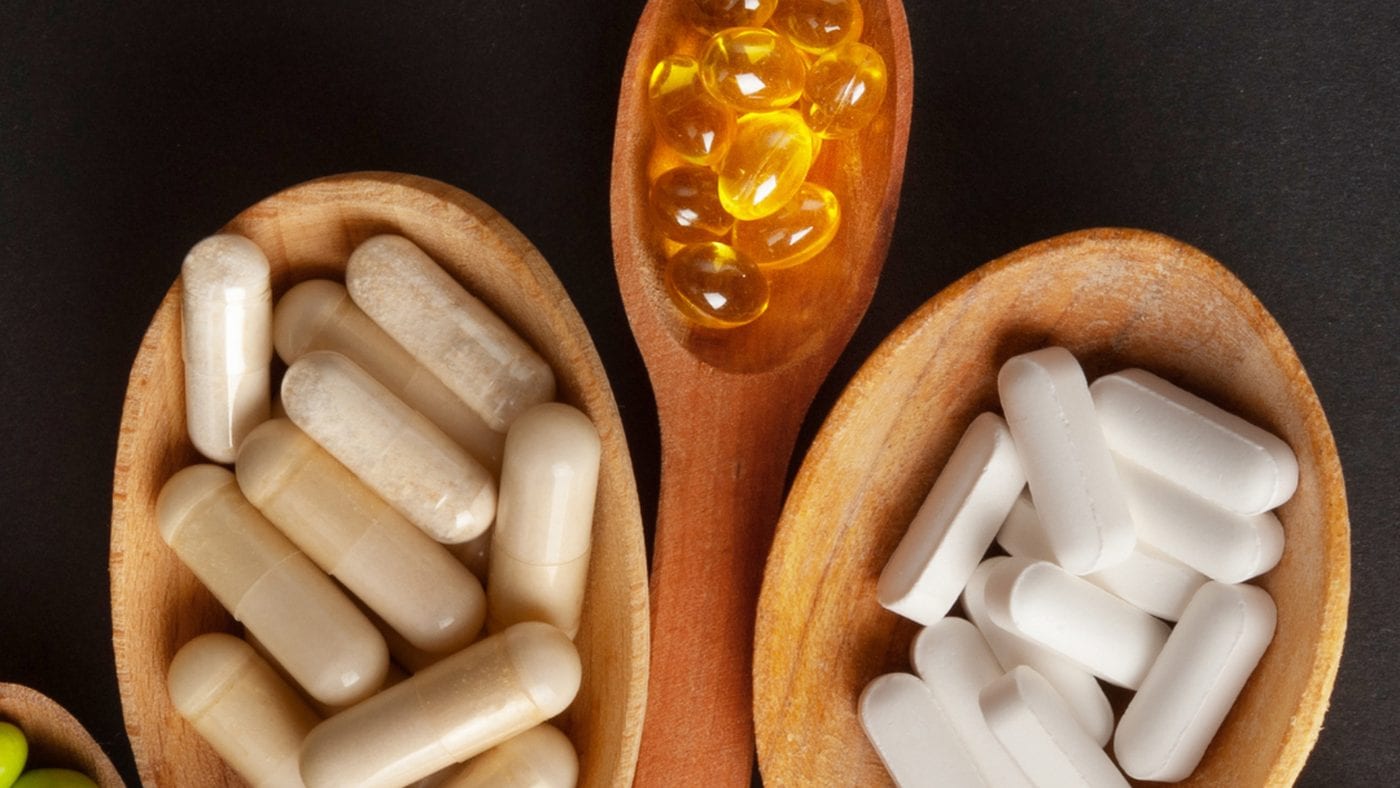
Vitamins, supplements and over-the-counter products are the most heavily marketed corner of hair loss, and the most misunderstood. The truth is simpler than the marketing: they help where there is a genuine deficiency to correct, and do very little where there is not.
This page covers the nutrients worth testing (iron, vitamin D), the one whose reputation runs well ahead of its evidence (biotin), the ones where more can backfire (selenium and vitamin A, which cause hair loss in excess, and high-dose zinc, which impairs copper absorption), the herbal “natural DHT blocker” (saw palmetto), and the over-the-counter topicals people ask about most (ketoconazole shampoo, caffeine shampoo, rosemary oil). Throughout, the useful question is diagnostic, not commercial: measure first, then correct what is actually low.
Can vitamins and supplements treat hair loss?
Only where there is a genuine nutritional deficiency to correct. Hair follicles need an adequate supply of nutrients to work normally, but once that need is met, taking more does not stimulate extra growth — and no supplement addresses the DHT sensitivity that drives hereditary (pattern) hair loss. The useful first step is a blood test, not a bottle.
The evidence points the same way again and again: people with a real deficiency often benefit from correcting it, while people with normal levels generally see little or no measurable improvement from supplements. A 2026 review of more than 100 hair transplant patients, carried out by a clinic featured on this site, reached the same conclusion — there is no single vitamin that everyone losing hair should automatically take.
Yet most commercial hair supplements are sold as though they help everyone equally. They do not. It is like watering a plant that has already had enough: another bucket serves no purpose. If your hair loss is androgenetic, the mechanism is hormonal, and a vitamin does not touch it; the treatments with real evidence do.
Which nutrients are actually worth testing?
Iron (measured as ferritin), vitamin D and thyroid function are the three with genuine diagnostic yield, especially when hair loss is diffuse or unexplained and particularly in women. In the 2026 review above, vitamin D was the nutrient most consistently associated with hair loss. Testing tells you whether there is anything to correct; supplementing blindly does not.
A blood test is cheap next to a year of supplements. If ferritin, vitamin D or thyroid function comes back low, that is something you can act on; if everything is normal, the evidence says adding supplements is unlikely to change your hair.
The individual nutrients come up below, but they all answer to one rule: find what is actually low, then correct it. It is also why a hair-loss work-up in women routinely includes these tests — the range of possible causes is wider than pattern loss alone.
Does biotin work for hair?

Only if you are genuinely deficient, which is rare in people eating normally. There is no good evidence that biotin helps hair in someone with normal biotin levels, and if your loss is androgenetic it does not address the mechanism at all. High-dose biotin can also distort common blood tests — including thyroid and cardiac assays — which is a real and underappreciated harm.
Biotin is a B vitamin. True deficiency does cause hair loss, along with skin and nail changes, but it occurs mainly with certain inherited enzyme disorders, some anticonvulsant medicines, or sustained consumption of large amounts of raw egg white. Most “support” for biotin is case reports in deficiency, or small studies of multi-ingredient products from which biotin's own contribution cannot be separated.
There is a safety issue too, and it matters most if you are being investigated for hair loss: high-dose biotin interferes with many immunoassays and can produce a falsely high or low thyroid result — and thyroid dysfunction is itself a cause of hair loss. Tell any doctor ordering blood tests that you take it, and expect to be asked to stop beforehand.
Iron and ferritin: a real, treatable cause
Iron deficiency is a genuine and testable cause of hair shedding, particularly in women, and it usually shows as diffuse shedding rather than patterned loss. The measure that matters is ferritin, not just a full blood count. But supplementing iron you do not need is not harmless: the body cannot easily excrete excess, so unnecessary iron can do more harm than good.
Ferritin reflects stored iron, and haemoglobin can look normal while those stores are depleted; ferritin also rises with inflammation, which can mask a deficiency. Clinicians treating hair loss often want it comfortably above the anaemia threshold, though the exact target is not universally agreed.
Correcting a confirmed deficiency addresses that specific cause — but it does not treat androgenetic alopecia, which has a different mechanism. Someone can have both, and fixing the iron will not fix the pattern loss. Unexplained iron deficiency also needs investigating in its own right, because the cause can matter more than the number.
Vitamin D: worth correcting, not a hair treatment
Vitamin D receptors are involved in the hair cycle, and low vitamin D is consistently associated with several types of hair loss — it was the standout nutrient in the 2026 review. But association is not causation: correcting a documented deficiency is worthwhile (for reasons well beyond hair), while taking high doses on top of normal levels is not a hair treatment, and vitamin D is fat-soluble, so it accumulates and can reach toxic levels.
Deficiency is common at northern latitudes in winter, so testing is often worthwhile — and correcting a real deficiency is sensible whether or not it changes your hair. What the evidence does not support is speculative high-dose supplementation in someone whose levels are already adequate.
Vitamin D sits alongside iron and thyroid function as one of the handful of things worth checking when hair loss is diffuse or unexplained. That is where its value lies — in the diagnosis, not in any expectation that a capsule alone regrows hair.
Zinc, selenium and vitamin A: where “more” backfires
Zinc has a real role in tissue repair and its deficiency is linked to hair changes, but it is the supplement most often taken to excess: high doses cause nausea and impair copper absorption over time. Selenium and vitamin A are the clearest warning — both cause hair loss when taken in excess, not only when deficient. With these, more is not better, and can be actively harmful.
The pattern across minerals and fat-soluble vitamins is consistent: correcting a genuine deficiency can help, but loading up beyond adequacy generally does not, and for several nutrients it does harm. Selenium toxicity (selenosis) and an excess of vitamin A are both recognised causes of hair loss — which is exactly why megadosing a “hair” multivitamin can backfire.
If you take zinc, dose it sensibly and not indefinitely, and be wary of combination products that stack several minerals at high doses. Around surgery, zinc and vitamin C have genuine roles in wound healing — but only if you are actually deficient; supplementing an already adequate diet has not been shown to speed recovery.
Saw palmetto — a “natural DHT blocker”?
Saw palmetto is promoted as a natural alternative to finasteride because it is reported to inhibit 5-alpha reductase, the same enzyme. But the hair evidence is thin and the studies small, and the one head-to-head study that has compared it directly with finasteride found finasteride clearly more effective; as a plant extract it is also not standardised, so dose and content vary between products. Presenting it as a substitute for finasteride overstates what is known.
The larger body of research on saw palmetto is in benign prostatic enlargement, where results have been mixed and the bigger trials generally disappointing. For hair specifically there is no basis for treating it as equivalent to a defined drug at a defined dose.
Two practical points. First, tell your doctor and surgeon you take it: a review of supplements and bleeding found no link between saw palmetto and bleeding, so this is about giving them a complete picture rather than flagging a known surgical risk. Second, do not assume “natural” means free of effects — anything with a real anti-androgen action has real implications, and is generally avoided in pregnancy. If you want an anti-androgen effect, the evidenced options are the honest comparison.
Ketoconazole shampoo: a modest adjunct, not a supplement
Ketoconazole is an antifungal shampoo licensed for dandruff and seborrhoeic dermatitis, where it works well. Its hair-loss claim rests on reducing scalp inflammation and possibly a mild local anti-androgen effect; the supporting studies are small and old, with modest effect sizes. It is a reasonable adjunct with limited evidence — not a primary treatment, and not a supplement.
Treating scalp inflammation is worthwhile on its own terms, whether or not it changes hair density. In practice, 2% formulations are prescription in many countries and 1% is often available over the counter; it is used a few times a week, left on the scalp for a few minutes, and alternated with a regular shampoo to limit dryness.
One caution around a transplant: no medicated shampoo should go onto a healing recipient area without your clinic's approval — antifungal shampoos can be drying exactly when crusts need to stay soft. If you use it routinely, mention it at consultation and ask when you can resume, as part of your aftercare.
Caffeine shampoo, rosemary oil and other over-the-counter topicals
These sit at the weakest-evidenced end of the shelf. Rosemary oil has one small study suggesting it performed comparably to a low-strength minoxidil, but that is a single trial. Caffeine shampoos rest largely on laboratory and manufacturer data. None is a substitute for a treatment with real evidence, and “natural” does not mean proven, or free of irritation.
There is no harm in a pleasant shampoo, and a comfortable, clean scalp is a reasonable baseline. The problem is only when these products are sold as a treatment for pattern hair loss on evidence that would not support a medicine. If a product's own marketing is the strongest evidence for it, treat the claim with caution.
If you want something that has actually been through trials, that is what topical minoxidil and the other evidenced options are; the over-the-counter topicals here sit below them, as optional extras rather than a foundation.
What to do instead, and what to ask
Get the blood work done before spending on supplements, and treat what the results actually show. Correcting a measured deficiency in iron, vitamin D or thyroid is worth doing; taking vitamins on top of normal levels is not supported by the evidence, and some in excess cause harm. No supplement stops hereditary hair loss — the treatments that do are separate.
A sensible order: test first, correct any real deficiency, avoid megadosing (especially the fat-soluble vitamins and selenium), and put the money you would have spent on speculative supplements toward the treatments with documented evidence instead. If you are preparing for surgery, disclose everything you take — supplements count as medication as far as an operation is concerned, and high-dose biotin in particular can distort pre-operative blood tests.
Questions worth asking a clinician: which of my levels are actually low; what does correcting them realistically change; and, given my type of hair loss, what has the strongest evidence behind it? If a supplement is being sold to you as the answer to pattern hair loss, that last question is the one that matters.
Frequently asked questions about supplements for hair loss
Do hair vitamins actually work?
Only where you have a genuine deficiency to correct. In people with normal levels there is little or no good evidence that supplements improve hair, and no vitamin addresses the hormonal mechanism behind pattern hair loss.
Should I take biotin for hair loss?
Not unless you are genuinely biotin-deficient, which is uncommon. It does not help people with normal levels, and high-dose biotin can distort thyroid and other blood tests — tell any doctor ordering tests that you take it.
Which blood tests are worth doing for hair loss?
Ferritin (iron stores), vitamin D and thyroid function have the most diagnostic value, especially for diffuse or unexplained shedding and particularly in women.
Can supplements cause hair loss?
Yes, in excess. Selenium toxicity and too much vitamin A both cause hair loss, and high-dose zinc impairs copper absorption over time. With these, more is not better.
Is saw palmetto as good as finasteride?
There is no good evidence for that. The hair studies are small and thin, saw palmetto is not standardised, and the one study that compared them directly found finasteride more effective, so it should not be treated as a substitute.
Does ketoconazole shampoo regrow hair?
It is an antifungal with modest, limited evidence as an adjunct — it may help by reducing scalp inflammation and possibly a mild anti-androgen effect — but it is not a primary treatment and not a supplement.
Does rosemary oil work for hair loss?
One small study suggested it performed comparably to a low-strength minoxidil, but that is a single trial. It is not established, and not a substitute for a treatment with real evidence.
Should I stop supplements before a hair transplant?
Disclose everything you take to your clinic; some (especially high-dose biotin) can distort pre-operative blood tests, and clinics often ask you to pause certain supplements around surgery. Do not start anything new post-op without asking.
If my blood tests are normal, will supplements still help?
The evidence says no — adding vitamins on top of adequate levels generally does not change hair. The money is better spent on the treatments with documented evidence.
A blood test costs a fraction of a year of supplements and tells you whether there is anything to correct at all. No vitamin addresses the DHT sensitivity that drives hereditary hair loss, and where follicles are already gone, no nutrient brings them back — that is the question a transplant answers. Establish what is actually driving your loss first; a free hair analysis will tell you whether a blood test is the sensible next step.
Sidst opdateret: September 2026 · Redaktionelle standarder