
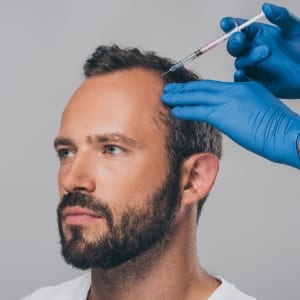
Exosomes are tiny vesicles that cells release to carry signals, growth factors among them, to other cells. Exosome therapy applies a preparation of them to the scalp, by injection or topically and often alongside microneedling, to treat hair loss. The idea belongs to regenerative medicine, and it has become one of the most heavily marketed of the newer offerings.
The published evidence is early: laboratory work and small clinical studies, with no standard protocol, and only small, short randomised trials rather than a large one establishing a lasting effect. Unlike PRP and SVF, many exosome products are not made from the patient's own body, and how they are sourced and regulated varies. Below, we separate what is known from what is not, and spell out what to ask before paying.
What are exosomes?
Exosomes are tiny vesicles that cells release to pass signals to other cells. They carry proteins, lipids, growth factors and genetic material, and the preparations sold for hair loss are often derived from stem cells and supplied as an external product rather than made from the patient's own body.
They are not cells. The interest in hair loss is that the signals they carry, growth factors among them, could in theory influence the follicle and the tissue around it.
In practice, exosome therapy means a preparation of them injected into, or applied to, the scalp, often combined with microneedling to improve uptake. It is frequently presented as the next generation after PRP. That is a marketing description, not a research finding.
What is the thinking behind exosome therapy?
That the growth factors and other signals exosomes carry may help regulate inflammation, encourage tissue repair and support the cells around the follicle. The reasoning is about supporting follicles that remain, not creating new ones, and it rests largely on laboratory and early clinical research.
Proponents argue that an exosome preparation delivers a higher and more uniform dose of these signals than PRP, without a blood draw, and that this may help prolong the growth phase and improve the environment around a thinning follicle. On paper that is a logical next step.
The mechanism is plausible, not proven. A miniaturising follicle in hereditary hair loss is still there, and that is what this approach targets, not one that has already gone.
What does the evidence actually show?
The evidence is early: mainly laboratory work and small clinical studies with short follow-up, different products and no standard protocol. The few randomised trials are small and short; we found no large one establishing a lasting effect on hair.
Small studies and early clinical observations have been reported to point towards increased hair density, particularly when exosomes are combined with microneedling. That is a reason for research, not yet a reason for confidence:
- Products. There is no uniform definition of what an exosome preparation contains, so studies of different products are not studies of the same treatment.
- Protocol. Preparation method, dose, timing and repeat schedule are still being worked out.
- Scale and duration. The studies are small and follow-up is short.
- Comparison. Exosome therapy is far from proven at the level of finasteride or minoxidil, the treatments with the strongest evidence in hereditary hair loss.
Exosome and growth-factor products are marketed heavily and studied poorly. This is a fast-moving field, and the position given here is current to September 2026.
Where do exosome products come from, and how are they regulated?
Unlike PRP and SVF, which are made from the patient's own blood or fat, many exosome products are not made from the patient's own body: they are external preparations, often derived from stem cells and supplied by a manufacturer. Exosomes are not an approved therapy for hair loss, and regulators in several countries, including the United States, have warned about the safety of unapproved products marketed as exosome treatments.
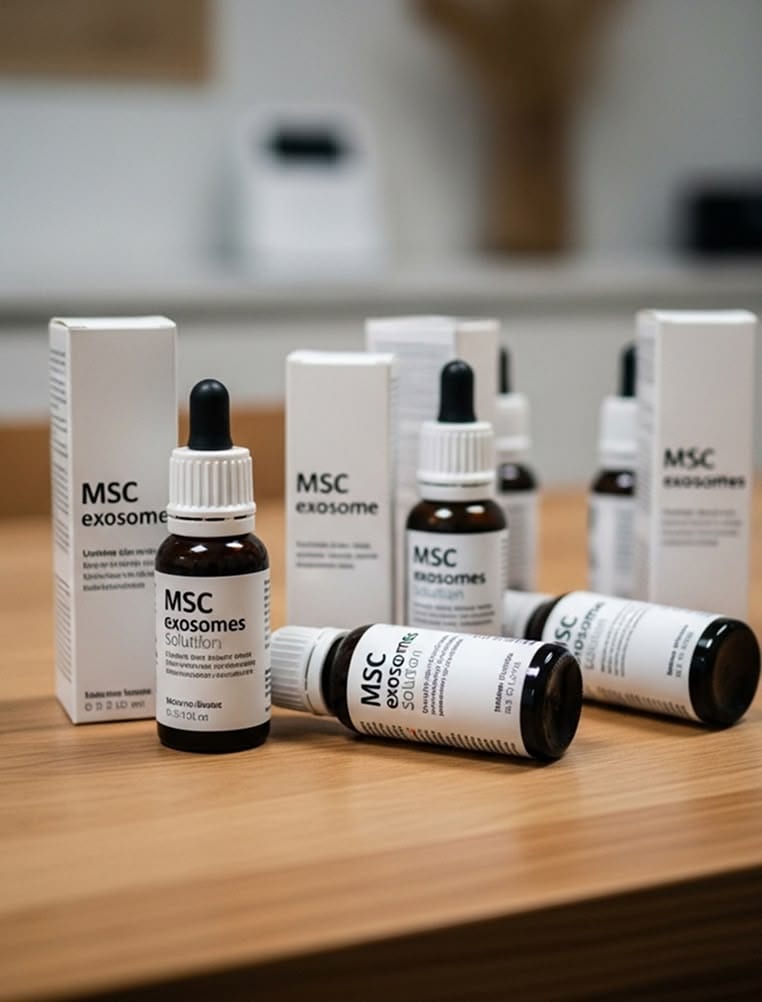
PRP and SVF are autologous: taken from a patient and returned to the same patient. Many exosome preparations are not. They are supplied products, and their content and quality vary between suppliers. There is no uniform definition of what an exosome preparation contains.
Regulatory status differs by country, and it can change. Ask which product is being used, who manufactures it, whether it is approved for this use where you are being treated, and what documentation supports where it came from.
What is known about safety?
The safety of exosome products for hair loss is not established. The clinical studies are small and short, so they cannot rule out uncommon or delayed problems, and because there is no standard for what a preparation contains or how it is made, a result with one product says little about another.
Three unknowns matter for a patient:
- Product quality. Regulators have raised concerns about the safety, sterility and lack of standardisation of unapproved exosome products, and what you receive depends on the supplier.
- Long-term effects. Follow-up in the published studies is short.
- Repeat treatment. Treatment is usually repeated to maintain any effect, and how often is not settled.
None of this is a finding of harm. It is the absence of the evidence that would let anyone say the treatment is safe with confidence. With PRP the open questions concern effect and consistency; with exosomes the safety question is still open as well.
How does exosome therapy compare with PRP?
PRP is better evidenced and is made from the patient's own blood, whereas exosome therapy is earlier-stage, often an external product, and typically priced higher. That exosomes are superior to PRP is a theoretical claim, not a proven one.
- Source. PRP: your own blood. Exosomes: often an external preparation, frequently stem-cell-derived.
- Standardisation. PRP varies between clinics. Exosome products vary between suppliers, with no uniform definition of what they contain.
- Regulation. PRP comes from your own blood and is well established. Exosomes are often not approved for this use.
- Evidence. PRP: reasonable but uneven. Exosomes: early and limited.
- Price. PRP: medium. Exosomes: typically higher.
If you want an injection-based add-on, PRP has the stronger case today, though its own evidence is uneven.
What about 'hair stem cell therapy'?
'Hair stem cell therapy' is a label that covers several different things rather than one defined treatment. It can mean cells taken from the patient's own tissue, or products derived from stem cells, which overlaps with exosome therapy. Fat-derived SVF has small published trials, and the rest of the field is early-stage.
Clinics usually stress that these treatments do not use embryonic stem cells. Most draw on regenerative cells from the patient's own tissue, such as fat or a small scalp biopsy, or on products derived from stem cells, with the aim of releasing the growth factors and signalling molecules that support existing follicles.
- Fat-derived cells. SVF comes from the patient's own fat and has published trials that are small but consistent in direction.
- Stem-cell-derived products. This category overlaps with exosomes and shares their evidence and regulatory position.
- Claims to 'activate' the scalp's own stem cells. Loosely defined. Ask exactly what is used and what evidence supports it.
Research into stem cells and hair multiplication is promising, but there is as yet no documented treatment that can grow new follicles. None of these approaches stops hereditary hair loss, and none replaces a transplant in an area that is already bald. Protocols vary between clinics, and the best cell sources, preparation methods, intervals and patient selection are still being worked out.
Do exosomes help around a hair transplant?
That is not demonstrated. Some clinics offer exosomes at or after surgery on the reasoning that they may support healing and graft recovery, but we could not find published trial evidence showing that they improve graft survival or growth, so the use is extrapolation. Exosomes have not been shown to be necessary for a good transplant result.
A transplant moves follicles into areas that have none; exosomes, if they work at all, are aimed at supporting follicles that are still present. They address different problems, and neither replaces the other.
The reasoning is that the signals exosomes carry may help the scalp heal while grafts re-establish a blood supply. That is plausible, but it has not been demonstrated for this purpose. The result is still governed by the surgeon's technique, graft survival and your aftercare, and by the usual timeline: shedding at weeks 2–3, new growth from about months 3–4 and a near-final result at about 12 months. At best an add-on can offer a marginal advantage; it cannot rescue a poorly executed procedure.
If exosomes are offered as part of a healing and aftercare package, ask what they add, what they cost separately and what evidence the clinic is relying on. Packages often stack several adjuncts, and stacking uncertain effects does not produce an established one. Decide in advance, not in the chair on the day of surgery.
Where does the evidence run out?
There is no standard product, dose or schedule, no long-term follow-up, and only small, short randomised trials rather than a large one establishing a lasting effect on hair. Exosome products are marketed heavily but studied poorly, and their composition varies enormously between suppliers.
Four gaps matter for anyone weighing this up:
- Product. With no uniform definition of an exosome preparation, two treatments called exosome therapy may not be comparable.
- Protocol. Researchers are still working out the best preparation method, timing, dose and repeat schedule, including for transplant patients.
- Duration. Whether any effect lasts, and whether treatment must be repeated to maintain it, is not established.
- Independence. Until there are solid, independent studies and a clear regulatory framework, early patients are in effect paying to take part in an under-documented market.
What should you ask before you say yes?
Ask where the preparation comes from and who makes it, whether it is approved for this use where you are being treated, what evidence supports it beyond the clinic's own experience, what it costs in total, and what it is expected to achieve that an established treatment would not. A reputable provider will answer honestly, including about the uncertainty.
Six questions worth asking:
- What is in the preparation, where does it come from, and who manufactures it?
- Is it approved for this use in the country where I am being treated, and can you show me the documentation?
- What evidence do you rely on beyond your own clinic's experience, and was it in patients like me?
- How many treatments do you propose, what is that schedule based on, and what is the total price, separate from any package?
- Which established treatments have I been offered first, and why is this being added?
- What would the same money buy in treatment with better documentation?
A clinic that presents exosome therapy as a breakthrough you must not miss, or that pushes it on the day of surgery, is selling rather than treating.
Frequently asked questions about exosome therapy
Is exosome therapy approved for hair loss?
Exosomes are not an approved therapy for hair loss, and regulators in several countries, including the United States, have warned about the safety of unapproved products marketed as exosome treatments. Ask your clinic what applies where you are being treated.
Where do exosomes come from?
Often from a manufacturer rather than from you. Preparations are frequently derived from stem cells, and unlike PRP (your own blood) or SVF (your own fat), many are not made from the patient's own body. Content and quality vary between suppliers.
Are exosomes the same as stem cells?
No, but they are related. Exosomes are small vesicles released by cells, often stem cells, and they are not cells themselves. Exosome therapy is also early-stage and is not an approved therapy for hair loss.
Does exosome therapy work for hair loss?
Early studies have been reported to point towards increased hair density, but they are small and short and use different products, and we found only small, short randomised trials, none establishing a lasting effect. It is promising research rather than a proven treatment.
How long does the effect last?
Unknown. Follow-up in the published studies is short, and whether treatment must be repeated to maintain any effect is not settled.
Is it safe?
It has not been established. The clinical studies are small and short, and there is no standard for what a preparation contains or how it is made, so a result with one product says little about another. Regulators have warned about the safety of unapproved products marketed as exosome treatments.
Is it better than PRP?
That is a theoretical claim, not a proven one. PRP has the larger evidence base and is made from your own blood, while exosome products are earlier-stage, often external and typically priced higher.
Will it work if I am already bald in that area?
No. Exosomes, if they work at all, are aimed at follicles that are still present but thinning. Where follicles are gone, no injection brings them back.
Can it replace finasteride or minoxidil?
No. Exosome therapy is far from proven at the level of either, so it should not be treated as a replacement. At most it is an investigational supplement, not a foundation.
Should I pay for exosomes as part of a hair transplant package?
It is not demonstrated to improve transplant results, and it has not been shown to be necessary for a good one. If it is offered, ask what it adds, what it costs separately, and decide in advance rather than on the day of surgery.
Establish what is driving your hair loss first. Exosome therapy is an investigational option, not a replacement for the treatments with the strongest evidence behind them, and it does not restore follicles that are already gone. A free hair analysis will tell you which category you are in before you spend anything.
Sidst opdateret: September 2026 · Redaktionelle standarder