

Hyperbaric oxygen therapy, or HBOT, means breathing close to 100% oxygen inside a chamber pressurised above sea level. It is an established hospital treatment for conditions such as decompression sickness and problem wounds. Some clinics offer it after a transplant, reasoning that extra oxygen may support healing while grafts have no blood supply of their own.
The evidence for that use is small and points one way on early recovery: less early shedding in a 34-patient randomised trial, and better healing, less pain and better sleep in a 2026 prospective cohort of 220 FUE patients. Both have limits, and no study has measured whether HBOT changes how many grafts are growing at 12 months. At most it supports healing, not new hair. This page reports both halves.
What is hyperbaric oxygen therapy, and how does a session work?
HBOT means breathing close to 100% oxygen inside a chamber pressurised above sea-level pressure; oxygen alone or pressure alone does not count. The hair-transplant studies used 2.0 to 2.4 atmospheres absolute (ATA) for 60 to 90 minutes per session. You lie in a single-person chamber or sit in a larger multiplace chamber, and you have to equalise your ears as the pressure rises.
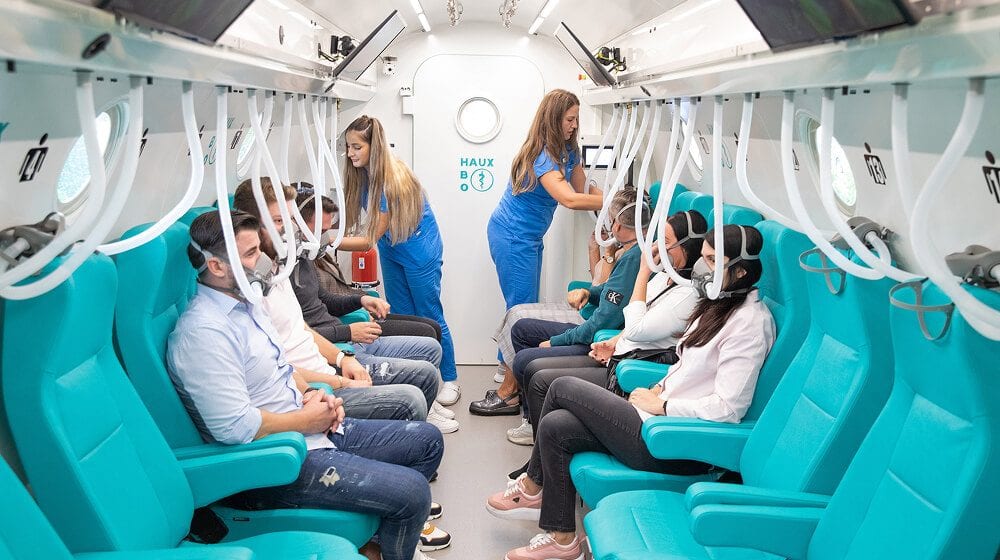
One atmosphere absolute is sea-level pressure; the 2.0 to 2.4 ATA used in the studies is roughly the pressure 10 to 14 metres underwater. Pressurising and depressurising take several minutes each, felt in the ears as on a descending aircraft.
A monoplace chamber is a sealed single-person cylinder you lie in; a multiplace chamber is a room-sized vessel where several people sit and breathe through a mask or hood, which most find easier to tolerate.
Soft, inflatable chambers marketed as "mild hyperbaric" typically reach about 1.3 ATA and are often run on oxygen concentrators rather than 100% oxygen. None of the published hair-transplant protocols used one, so their results do not describe what a soft chamber delivers.
Why might extra oxygen help a healing scalp?
A newly placed graft has no blood supply of its own for the first days and survives on oxygen diffusing in from surrounding tissue. Under pressure, far more oxygen dissolves in plasma and can reach tissue that red cells cannot, and hyperbaric oxygen also influences inflammation and vessel growth. The reasoning is coherent, but it is a reason to test the treatment, not evidence that it works.
At sea level almost all blood oxygen rides on haemoglobin, already about 97% saturated, so breathing more adds little. Oxygen dissolved in plasma rises with pressure and can reach tissue across swelling, or across a gap where capillaries have not yet formed.
Thom's review in Plastic and Reconstructive Surgery describes hyperbaric oxygen as acting less as a delivery system than as a signal, through reactive oxygen and nitrogen species. Systematic reviews and randomised trials support it for refractory diabetic wounds and radiation injury. For compromised skin grafts and flaps — the closest parallel to a transplant — support rests on animal studies and a few clinical trials.
A transplanted follicular unit is, in a limited sense, a very small free graft, so the analogy is reasonable. It remains an analogy.
What do the published studies of HBOT after a hair transplant report?
Small, and pointing one way on early recovery. A 2021 randomised trial of 34 patients found less early shedding and less itching or folliculitis with HBOT. A 2026 observational cohort of 220 FUE patients reported better self-rated healing, less pain and better sleep, and a blinded review of photographs agreed. What no study has done is measure whether HBOT changes how many grafts are growing at 12 months.
As of September 2026, four studies bear on the question, and their designs differ enough to be worth taking one at a time:
- Randomised trial, 34 patients. Fan and colleagues (Journal of Cosmetic Dermatology, 2021) compared 17 patients given 100% oxygen at 2.0 ATA for 60 minutes daily for seven days after FUE with 17 controls. Early shedding was 27.6% with HBOT against 69.1%, and itching or folliculitis 11.8% against 35.3%. Nine-month survival was 96.9% against 93.8%, which was not statistically significant.
- Prospective cohort, 220 patients (observational). A 2026 observational cohort of 220 male FUE patients, run and reported by a clinic featured on this site, compared no HBOT (55 patients), one session (97) and two (68) in a hard-shell chamber at 2.4 ATA for 90 minutes, all under one surgeon using identical technique and aftercare. On day 11 patients scored recovery out of 10, higher being better, for none, one and two sessions: healing 5.7, 7.3 and 8.0; pain and soreness 4.3, 7.8 and 8.8; sleep 4.4, 8.6 and 9.3; redness resolution 3.8, 5.2 and 5.7. A medical team blinded to group scored day-10 photographs 5.3, 8.6 and 9.7. Both HBOT groups scored significantly higher than no HBOT; because patients chose their own group rather than being randomised, that is an association rather than proof of cause, and one session versus two did not differ significantly.
- Case report, 5 patients. Giardiello and colleagues (Cureus, 2025) gave five men 90-minute sessions at 2.4 ATA daily for six days, starting four to six hours after surgery. Scabs cleared within three to five days and graft integration was reported at 97 to 99%, with no control group.
- Volunteer study, 9 healthy people. Lee and colleagues (Bioengineering, 2026) gave 50 sessions at 2.0 ATA over three months. Follicle density, hairs per follicle and hair volume trended upward, but not significantly. It was not a transplant study.
Where does the evidence run out?
The evidence runs out at 12 months and at cause and effect. The randomised trial had 34 patients and could not have detected a three-point difference in survival, the 220-patient cohort was observational with patients choosing their own group, and no study has followed graft counts to 12 months. Sceptics discount small HBOT studies for these design reasons, not because the mechanism is implausible.
Four gaps decide how much weight to give it:
- Size. Survival after competent FUE is already high (93.8% in the trial's control arm), so an adjunct could add only a little, and detecting two or three points near 95% would need several hundred patients per arm, not 17. The trial's survival figure is therefore neither for HBOT nor against it; its large differences — in early shedding and in itching or folliculitis — are the more credible findings.
- Design. In the cohort, patients chose whether to have HBOT, so the result shows association, not cause and effect. It also excluded people with diabetes, treated hypertension, HIV and other significant illness, so it says nothing about them.
- Measurement. Most cohort measures were self-reported. The blinded photograph review agreeing with them is the design's strongest feature, but it scored day-10 photographs, not the final result. None of the transplant studies used a sham-pressure control, so the extra attention of daily sessions cannot be separated from the oxygen.
- Independence. The cohort was run and reported by a clinic featured on this site, and none of the other studies replicates its design. Dong and Jin's correspondence noted that the randomised trial did not clearly describe outcomes by sex or explain hair-loss medication use in its exclusion criteria, and neither point was resolved.
Settling it would take a multicentre randomised trial: several hundred patients per arm, blinded hair counts in a marked recipient area at 12 months, and a sham-pressure control. Oxygen cannot be patented, so there is no obvious sponsor, and today's evidence may stand for some time.
Does HBOT reduce swelling or make recovery more comfortable?
The measured findings concern comfort, not swelling. The randomised trial reported less itching and folliculitis, and the 220-patient cohort reported less pain, better sleep and faster fading of redness by day 11. Reduced swelling is the most widely advertised benefit, yet no study reported it as a separate result.
Swelling of the forehead and eyes peaks on days two to four, driven mainly by fluid infiltrated during surgery, and ordinary aftercare already handles it — for the first nights, sleep with your head raised.
The cohort's blinded reviewers scored swelling and oedema among their criteria, but that is a single score per group, not a swelling figure.
The comfort findings hang together better. Sleep showed the widest gap in the cohort — 4.4 out of 10 without HBOT, 9.3 with two sessions — and the trial found roughly a third the rate of itching and folliculitis, though these are scores from patients who chose the treatment.
What schedule and timing did the studies use?
The two published protocols began on the day of surgery or the day after and ran daily for six or seven days, at 2.0 ATA for 60 minutes in the randomised trial and 2.4 ATA for 90 minutes in the five-patient report. The 220-patient cohort gave one or two 90-minute sessions at 2.4 ATA. No study has compared pressures, session lengths, start times or session counts, so there is no evidence-based schedule.
The mechanism argues for early treatment: the theoretical benefit targets the days before a graft has its own blood supply. In the cohort, a second session added no significant gain over one. Three things go past what the studies tested:
- Starting a week or more after surgery, or during the shedding phase at weeks 2 to 3, which is a normal part of the growth cycle rather than an oxygen problem.
- Courses of fifteen or more sessions, or "maintenance" programmes. The only long course studied, 50 sessions in healthy volunteers, was not a transplant study.
- Higher pressures or longer sessions than those used in the studies.
Practical limits also shape timing. A large FUE session can run six to eight hours, sedation may push the first session to the next day, since you must be alert enough to equalise your ears, and a daily course ties you to one place for a week. This page describes what was studied, not a dosing recommendation; your surgical team and the hyperbaric service set the schedule.
What are the risks, and who should not have HBOT?
With proper screening, HBOT has a good safety record. Middle-ear barotrauma is the most common adverse effect; sinus barotrauma, temporary short-sightedness over repeated sessions, confinement anxiety and, rarely, oxygen-toxicity seizures make up most of the rest. Untreated pneumothorax is the one universally recognised absolute contraindication, and a longer list of conditions needs a hyperbaric physician's assessment first.
Heyboer and colleagues' review in Advances in Wound Care calls HBOT among the safest therapies in use, with side effects that are real but largely dose-dependent.
- Ear and sinus barotrauma. Unequalised pressure pulls the eardrum inward, causing pain and occasionally fluid, bleeding or perforation. Congestion, a cold, allergic rhinitis and recent ear surgery raise the risk, and sinuses can be affected too.
- Oxygen toxicity. At high oxygen pressure and long exposure, seizures can rarely occur. They are self-limiting and are why protocols specify both pressure and time. Lung effects matter mainly in long daily courses.
- Eyes and comfort. Temporary short-sightedness can develop over repeated sessions. Claustrophobia is a common reason courses are abandoned, and in an elective setting it is a good reason to stop.
A hyperbaric physician, not a hair surgeon, should assess anyone with obstructive lung disease, recent ear, sinus or chest surgery, a seizure disorder, an active respiratory infection, high fever, certain chemotherapy drugs, pregnancy or an implanted device. Tell the hyperbaric service about every medication, including finasteride, dutasteride and oral minoxidil, and expect screening before you pay for a course.
Who might HBOT be relevant for, and what about smokers and diabetics?
The evidence speaks, weakly, to people who want a more comfortable first fortnight, can attend daily sessions and pass hyperbaric screening. Smokers and people with diabetes are often mentioned because both impair healing, but no hair-transplant study has enrolled or analysed either group, so any benefit for them is untested extrapolation.
It may be worth considering if you have had bad folliculitis before, find the shedding phase distressing, or are staying near a hyperbaric facility anyway. The case is weak if you fly home days after surgery, find enclosed spaces hard, or would rather spend the money on the hair you still have.
Smoking. Nicotine narrows small vessels and carbon monoxide reduces the oxygen blood can carry, just when grafts depend on diffusion. Dissolved oxygen travels independently of haemoglobin, so the theory that HBOT could partly compensate is coherent but untested. Stopping smoking, on the window your surgeon sets, has a real basis and costs nothing. Offering HBOT as a reason for a larger, denser session in a smoker is the risky pitch.
Diabetes. HBOT's strongest evidence is in refractory diabetic wounds — foot ulcers and other chronic wounds in tissue with established microvascular disease. A hair transplant in well-controlled diabetes is an elective wound in well-perfused scalp, so that evidence does not transfer automatically, and the cohort excluded people with diabetes. Glycaemic control and a conservative surgical plan have a basis; discuss chamber sessions with your diabetes team and your clinic.
Large sessions. No hair-transplant study has examined HBOT for preventing recipient-area necrosis, so it should not change how large or dense a session your surgeon considers safe.
How does HBOT compare with PRP and LLLP as adjuncts?
They address different problems at different times. HBOT is aimed at the first weeks of healing and given as a one-week course, whereas PRP and LLLP are mainly studied for thinning native hair over months. Their literatures are larger but concern treating androgenetic alopecia, not protecting new grafts, so none of the three has shown that it increases how many transplanted follicles grow.
- Burden. HBOT is daily chamber attendance for about a week. PRP is a blood draw and scalp injections repeated over months. LLLP, low-level laser and light therapy, is usually a home device used briefly over months.
- Evidence. PRP and low-level laser therapy have randomised trials and meta-analyses in hereditary hair loss, with well-documented weaknesses. HBOT's transplant-specific literature is far smaller but addresses the right question: recovery after surgery.
- What each protects. A transplant moves follicles; it does not stop ongoing hair loss. HBOT does nothing for the native hair around the grafts, which is what PRP and LLLP are studied for.
- Stacking. No study has tested HBOT with PRP, LLLP or exosome products after a transplant, so a bundled package has never been evaluated.
If you use adjuncts at all, pick at most one, ask for it to be priced separately, and put the established medical treatments first.
What should you ask before you say yes?
Ask what pressure the chamber reaches and whether you breathe 100% oxygen, who operates it and screens you, how many sessions are proposed and on what basis, what it costs separately from the surgery, and what the clinic expects it to achieve. Hair transplantation is not an approved indication for HBOT, so use afterwards is off-label and paid for by you.
Six questions worth asking:
- What pressure does the chamber reach, in ATA, and do I breathe 100% oxygen or concentrator output? A soft chamber at about 1.3 ATA is not the studied treatment.
- Is it a hard chamber run by hyperbaric-trained staff, on site or elsewhere, and who screens me for contraindications before I pay?
- How many sessions, on which days, and on what basis? Neither published protocol supports fifteen sessions or a maintenance course.
- What does it cost per session and in total, is it separate from the surgical fee, does the price fall if I decline it, and what happens to the fee if I cannot tolerate the chamber?
- What do you expect it to do for me, and on what evidence: a study in transplant patients, or in something else?
- Which established treatments have I been offered first, and why is this being added?
Very few hair clinics own a hard chamber, so many refer to an outside facility, and some describe a soft one. Hair transplantation is not on the Undersea and Hyperbaric Medical Society's approved-indications list, so do not expect insurance or a health system to pay. We quote no prices: we have found no verifiable published figures for post-transplant HBOT. A clinic promising more hair at 12 months is promising something no study has measured.
Frequently asked questions about HBOT
What is hyperbaric oxygen therapy?
Breathing close to 100% oxygen inside a chamber pressurised above sea-level pressure, usually 2.0 to 2.4 ATA for 60 to 90 minutes in the hair-transplant studies. Both the pressure and the oxygen are required; oxygen through a mask at normal pressure is not HBOT.
Is HBOT an approved part of hair transplant care?
No. Hair transplantation is not on the Undersea and Hyperbaric Medical Society's list of approved indications, so HBOT afterwards is off-label and self-funded. That describes its regulatory and funding status, not whether it works.
Does HBOT make transplanted hair grow better?
Unknown. No study has measured graft counts or density at 12 months. In the randomised trial, nine-month survival was 96.9% with HBOT and 93.8% without, which was not statistically significant in 34 patients.
Does HBOT speed healing or reduce swelling?
The studies point to less early shedding, less itching and folliculitis, less pain, better sleep and faster fading of redness. Swelling was not reported as a separate result, and the cohort that reported the comfort findings was observational.
How many sessions did the studies use?
The randomised trial used seven daily 60-minute sessions at 2.0 ATA, and the five-patient report six daily 90-minute sessions at 2.4 ATA. The 220-patient cohort compared none, one and two sessions and found no significant gain from the second. No study has compared schedules, so there is no evidence-based number.
Is it safe, and does it hurt?
With proper screening the safety record is good, and sessions are not painful. The most common problem is ear pain from pressure (middle-ear barotrauma) if the ears are not equalised. Sinus pain, temporary short-sightedness, claustrophobia and, rarely, oxygen-toxicity seizures also occur.
Will HBOT help smokers or people with diabetes?
Untested. No hair-transplant study has enrolled or analysed either group, and the 220-patient cohort excluded people with diabetes. Stopping smoking and good glycaemic control are the measures with a basis.
Is a soft or "mild" hyperbaric chamber the same thing?
No. Soft chambers typically reach about 1.3 ATA and often use concentrator oxygen, whereas the published hair-transplant protocols used hard chambers at 2.0 to 2.4 ATA with 100% oxygen. Their results do not apply to a soft chamber.
Is HBOT better than PRP or LLLP?
They address different problems. HBOT is a one-week course aimed at early healing, while PRP and LLLP are studied for thinning native hair over months, and none of the studies described here compares them after a transplant.
Can HBOT regrow hair or replace medication?
No. HBOT is aimed at healing after surgery and does not restore follicles that are already gone. A transplant moves follicles but does not stop ongoing hair loss, so finasteride and minoxidil remain the foundation for the hair you keep.
Choose the surgeon and the technique first. HBOT is an optional adjunct that may make the first fortnight easier, not a substitute for good surgery, careful aftercare or the treatments that protect the hair you keep, and it does not restore follicles that are already gone. A free hair analysis will tell you what is driving your hair loss, and which extras, if any, are relevant for you, before you spend anything.
Sidst opdateret: September 2026 · Redaktionelle standarder