
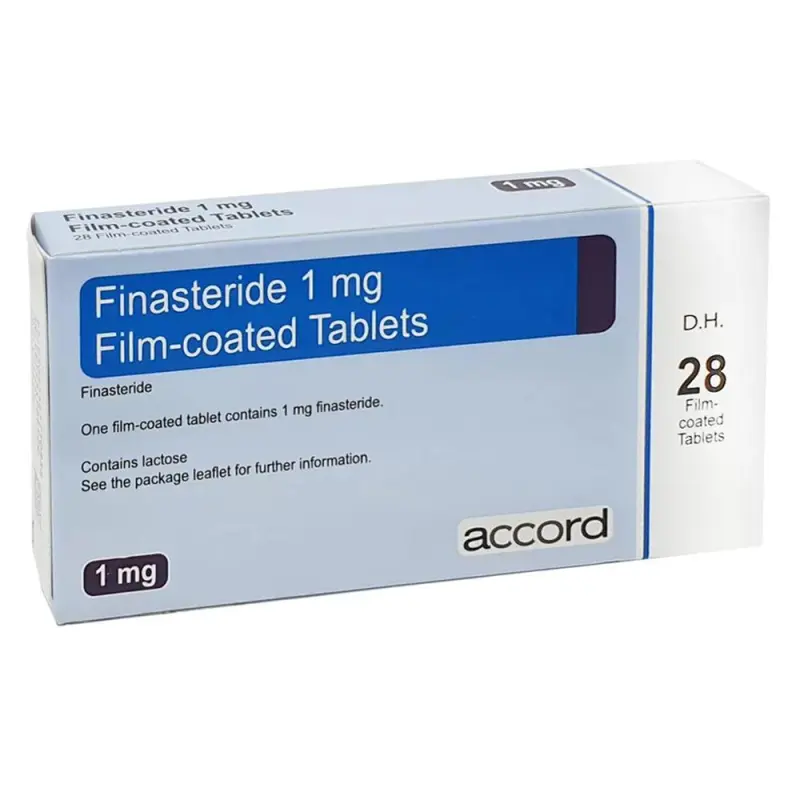
Finasteride and dutasteride are the two drugs that treat pattern hair loss by lowering DHT, the hormone that drives it in genetically susceptible follicles. Finasteride 1 mg is approved for hair loss in many countries; dutasteride is approved for it in some markets and used off-label in others.
They are the most effective medical option for holding on to hair in men, and also the most debated, because of questions about sexual side effects. This page sets out what the trials measured, how the two drugs differ, what is and is not established about that debate, and what happens when treatment stops.
How does finasteride work for hair loss?
Pattern hair loss is driven by DHT, a potent androgen made from testosterone by the enzyme 5-alpha reductase, which progressively shortens the growth phase of susceptible follicles until the hair is no longer visible. Finasteride blocks the type II form of that enzyme, substantially lowering DHT, which slows the miniaturisation and in many men allows partial recovery.
The drug does not add anything to the follicle; it removes a signal that was shrinking it. That is why the most useful way to think about the benefit is not against your current hair but against where you would be without treatment. In the trials, much of the gain is loss prevented rather than hair regained.
It is taken as a daily tablet, and its effect lasts only as long as you keep taking it. Establishing what is actually driving your hair loss comes first: these drugs treat androgenetic alopecia, not the other causes of shedding.
What do the trials show finasteride achieves?
The registration studies followed men with vertex hair loss over one and two years and found finasteride produced clinically significant increases in hair count while the placebo groups kept losing hair; five-year follow-up showed the improvement held while untreated loss continued. It also increases the proportion of hairs in the growth phase.
The comparison that matters is the gap between the treated and placebo groups, and it widens over time: treated men hold roughly steady or improve, while placebo men decline. That is also why stopping later can feel like rapid loss — it is the deferred decline arriving, not a new harm.
The evidence is strongest for the vertex and mid-scalp; the frontal hairline responds less reliably. Results are measured in months, with the accepted assessment point at six to twelve months.
What does finasteride not do?
Finasteride does not regrow hair from areas that are genuinely bare, where the follicles are gone; it does not work everywhere equally, being weakest at the frontal hairline; it does not act quickly, with the earliest meaningful assessment months away; and it does not cure anything, since the effect depends on continued use.
This matters most when planning surgery. A transplant is what addresses an area that is already bare, because it moves follicles there; medication protects and can thicken the hair that still exists behind and around it. The two do different jobs, and the best outcomes usually combine them.
How is dutasteride different from finasteride?
Finasteride blocks only type II 5-alpha reductase, while dutasteride blocks both type I and type II, suppressing DHT more completely; a meta-analysis of three studies (576 men) found dutasteride increased total hair count by about 29 hairs more than finasteride. Dutasteride also has a much longer half-life, so it clears from the body far more slowly after stopping.
The direction is consistent across comparisons — dutasteride appears modestly more effective — while the size of the advantage varies by study and endpoint and is not established with precision.
Regulation differs too. Finasteride 1 mg is approved for androgenetic alopecia in many countries; dutasteride is approved for it in some markets and used off-label in others, where it is more commonly licensed for an enlarged prostate. Which is appropriate is a prescribing decision that should weigh age, plans to father children, and tolerance of that longer washout.
How common are the sexual side effects?
In the registration trials, decreased libido, erectile dysfunction and ejaculation disorders were each reported at low single-digit percentages, only slightly above placebo — and they were reported in the placebo arms too, which shows expectation contributes to what gets recorded, without meaning the symptoms are imagined. A meta-analysis found no significant difference in these rates between finasteride and dutasteride.
These effects are real, uncommon in the trial data, and reversible on stopping for most men who experience them. The role of expectation is well documented, which is why an open conversation with a prescriber matters more than a forum thread, in either direction.
Because dutasteride persists far longer in the body, any side effect it does cause takes considerably longer to clear — a legitimate reason for someone anxious about reversibility to start with finasteride.
What is post-finasteride syndrome, and is it real?
Post-finasteride syndrome refers to sexual, physical or psychological symptoms reported by a minority of men that continue after stopping the drug. It is genuinely unresolved: documented cases exist and regulators in several countries have updated labelling to reflect reports of persistent symptoms, but causation, incidence and mechanism are not established. The honest position is that the risk is not zero, is not well quantified, and appears to affect a small minority.
Anyone telling you it is definitely nothing, or definitely common, is going beyond the evidence. Study designs that could settle it are difficult to run, so the uncertainty is likely to persist for some time.
The practical response is proportion rather than fear: report symptoms early rather than persisting silently, and consider whether a lower-exposure topical formulation, discussed below, is appropriate if systemic exposure is your main concern.
What happens if you stop taking finasteride?
Because finasteride has a relatively short half-life, DHT returns toward its previous level within weeks of the last dose, and susceptible follicles resume miniaturising on the schedule they followed before. Gains are generally lost over roughly the following year, returning you to where you would have been without treatment — the deferred loss arriving, not extra loss.
A rough timeline: DHT is back to baseline within about four weeks, with no visible change yet; shedding increases between months three and six; gains are progressively lost from months six to twelve; and after about a year, hair approximates its untreated trajectory.
Dutasteride behaves the same way in principle, but its long half-life means the return is slower and less predictable in its timing. Either way, this is why the decision to start is really a decision about whether to continue indefinitely.
Why isn't finasteride prescribed to women?
DHT is needed for normal development of male external genitalia before birth, so a drug that blocks its production can interfere with the development of a male fetus. That is why women who could become pregnant are not prescribed finasteride, and are advised not to handle crushed or broken tablets, since the drug can be absorbed through skin. Its efficacy evidence in women is also weaker and less consistent than in men.
Women with pattern hair loss more often use topical or low-dose oral minoxidil, spironolactone (off-label, with contraception required), or treatment of an underlying cause, which is more often relevant in women. Some specialists do prescribe a 5-alpha reductase inhibitor off-label to specific groups, as a considered decision rather than a default.
Because female hair loss has a much wider set of possible causes, our guide to hair loss in women starts, correctly, with diagnosis rather than a drug.
What about topical finasteride?
Topical finasteride aims to concentrate the benefit at the scalp while reducing the circulating levels responsible for the most-discussed side effects. Studies show it does lower serum DHT less than the oral drug, with evidence of scalp efficacy — but systemic absorption is measurable, not absent. Topical use lowers systemic exposure rather than removing it, so it is not a way to take finasteride without a medical conversation.
A few practical points. Availability varies, with licensed products in some markets and compounding elsewhere, which brings its own quality-control questions; formulations differ in concentration and vehicle, so evidence for one does not carry over to another; and the same contact-transfer precaution applies — avoid skin contact with others, particularly women who could become pregnant.
How do these drugs fit with a hair transplant, and where does the evidence run out?
The usual sequence is to be established on medication before surgery, so any early shedding has resolved and a hairline can be designed on realistic assumptions about your native hair. Finasteride is generally continued through surgery; topical products are commonly paused around it. What the evidence does not settle is the exact size of the side-effect risk, the persistence question, and how much any one person will benefit — which is why this is a prescriber's decision, not a purchase.
A hairline drawn on the assumption that you will keep taking medication looks different if native hair behind it later resumes thinning, so decide before surgery whether you intend to continue indefinitely. Never stop a prescribed systemic medication on your own initiative around a procedure.
Before starting, it is reasonable to ask a prescriber how the benefit compares with doing nothing in your case, what the side-effect data actually show, what a lower-exposure route would change, and what fathering children means for timing. If you decide against these drugs, our guide to non-surgical treatment covers the alternatives.
Frequently asked questions about finasteride and dutasteride
How long does finasteride take to work?
Results are measured in months, with the accepted assessment point at six to twelve months. An early increase in shedding in the first weeks is not a sign of failure.
Is dutasteride more effective than finasteride?
The comparative trials point that way — dutasteride suppresses DHT more completely and gave modestly higher hair counts — but its much longer half-life means any side effect clears more slowly. Which is appropriate is a prescribing decision.
Are the sexual side effects common?
In the trials they were reported at low single-digit rates, only slightly above placebo, and reverse on stopping for most men who experience them. Whether symptoms persist in a minority after stopping is genuinely contested.
What is post-finasteride syndrome?
A reported pattern of symptoms continuing after stopping, in a minority of men. Cases exist and some regulators have updated labelling, but causation, incidence and mechanism are not established. The risk is not zero and not well quantified.
Will I lose the hair if I stop?
Yes. Over roughly the following year, hair returns to the trajectory it would have followed untreated. This is the deferred loss arriving, not extra loss caused by stopping.
Can women take finasteride?
It is generally not prescribed to women who could become pregnant, because it can affect a developing male fetus, and its efficacy evidence in women is weaker. Women more often use minoxidil or spironolactone.
Is topical finasteride safer?
It lowers systemic exposure but does not remove it — serum DHT is still reduced. It may suit someone concerned about systemic effects, but it still requires a prescriber and carries a contact-transfer precaution.
Can I combine finasteride with minoxidil?
Yes. They act by different mechanisms and are commonly used together. Whether both suit you is a prescribing decision.
Should I be on medication before a hair transplant?
Usually yes. Being established beforehand keeps drug-related shedding separate from post-operative shedding and lets the surgeon design a hairline on realistic assumptions. Decide before surgery whether you will continue long-term.
These drugs protect the hair you have; they do not restore follicles that are already gone, and where an area is bare the question is transplantation. Whether to start, and whether to keep going indefinitely, is a decision to make with a prescriber and ideally before any surgery. A free hair analysis will tell you where you actually stand first.
Sidst opdateret: September 2026 · Redaktionelle standarder