
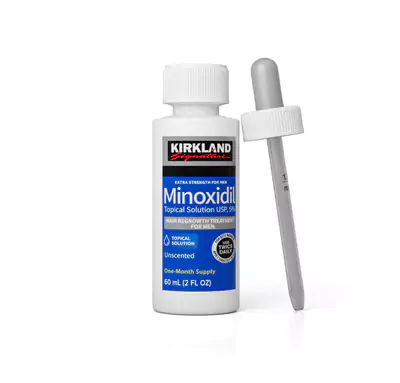
Minoxidil is the most widely used drug for hair loss and the only topical treatment formally approved for it. It began as a tablet for severe high blood pressure in the 1970s; its most conspicuous side effect, unwanted hair growth, is what turned it into a hair treatment once it was reformulated as a solution applied to the scalp.
Today it is used two ways: as the approved topical solution or foam, and as the original tablet at low, off-label doses, known as low-dose oral minoxidil. This page sets out what each form does, what the trials and the largest safety study actually measured, and where the evidence still runs out.
How does minoxidil work for hair loss?
Minoxidil is a vasodilator that, applied to the scalp or taken as a tablet, lengthens the growth phase of the hair cycle and can enlarge miniaturising follicles so they produce thicker hairs. Its exact mechanism in pattern hair loss is not fully understood, but the practical effect is measured as more and thicker hairs for as long as treatment continues.
Minoxidil was developed as an oral drug for severe hypertension. Its scalp effect is thought to involve opening potassium channels and improving blood flow around the follicle, and to act on the hair cycle by extending the anagen (growth) phase and moving follicles out of the resting phase. Researchers are candid that the full mechanism in androgenetic alopecia is not settled.
That mechanism has two practical consequences. Minoxidil leaves the hormonal driver of pattern loss untouched, which is exactly what finasteride targets — so the two are often paired for their different modes of action. And because it works only while you keep using it, the gains fade within months of stopping.
What is the difference between topical and oral minoxidil?
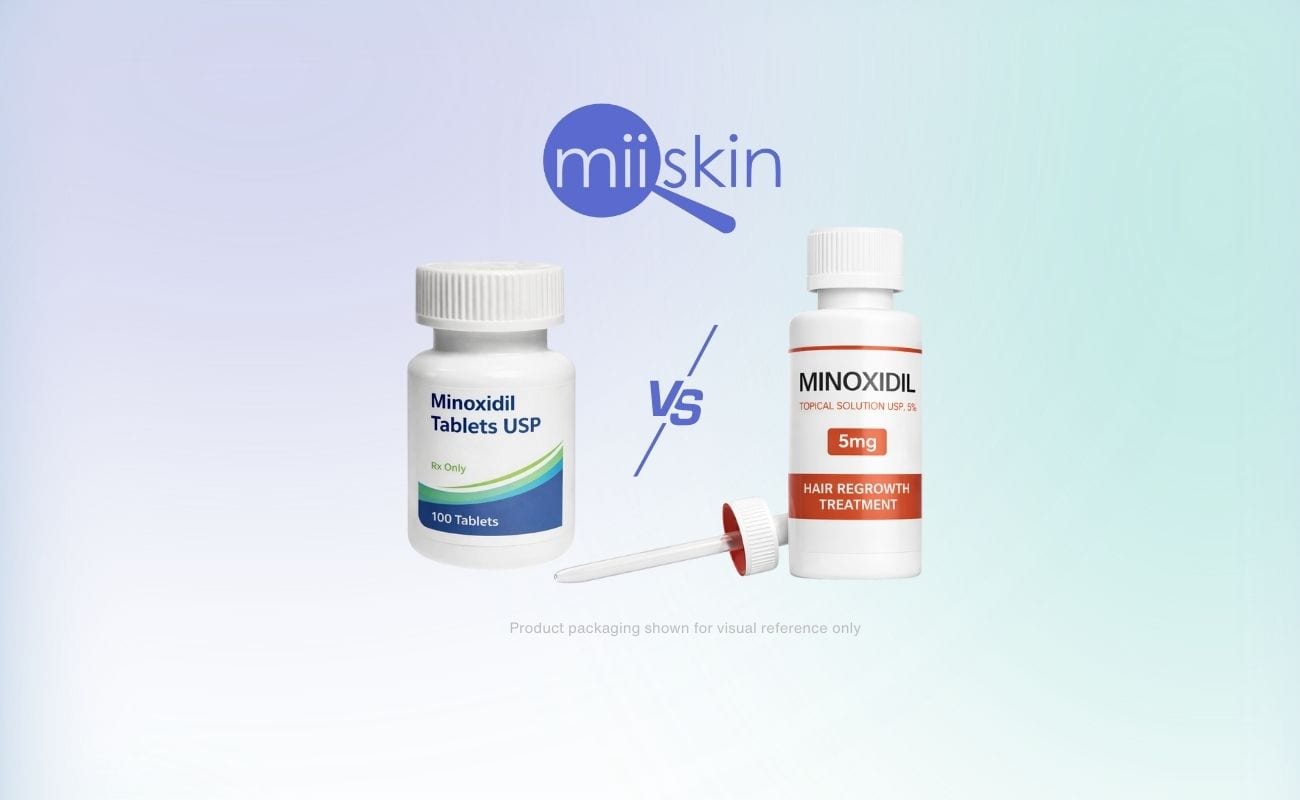
Topical minoxidil is a solution or foam applied to the scalp once or twice a day; it is approved for pattern hair loss and sold without a prescription in most countries. Oral minoxidil is the original tablet, prescribed at low, off-label doses for hair. The tablet's main advantage is that it removes the daily-application problem and reaches the whole scalp evenly.
Topical minoxidil acts where it is applied and keeps systemic exposure low, but it has to be used every day, can leave residue, and can irritate the scalp. Poor adherence is the most common reason it fails in practice.
The tablet solves the adherence problem but is a systemic drug, so its effects are not confined to the scalp. Which form suits someone depends less on potency, as the trial below shows, than on whether they will keep applying a solution and how they tolerate a systemic medication.
Is low-dose oral minoxidil approved, and what counts as “low dose”?
No regulator has approved a minoxidil tablet for hair loss, so oral use is off-label; the main formally approved drugs for pattern hair loss are topical minoxidil and finasteride 1 mg, with dutasteride approved for it in some markets. “Low dose” conventionally means any daily dose below 5 mg, typically 0.5–1 mg for women and 2.5–5 mg for men, far below the tens of milligrams once used for blood pressure.
Off-label does not mean unstudied or improper; a great deal of routine medicine is off-label. It does mean the evidence comes from observational series, cohorts and a small number of trials rather than the large registration studies a licence requires.
A 2024 international consensus of dermatologists settled on starting doses of 1.25 mg/day for adult women and 2.5 mg/day for adult men, usually started low and adjusted for tolerance and response. Those are starting points from expert agreement, not a dose for any individual.
Is oral minoxidil more effective than topical minoxidil?
The one direct randomised trial did not show that it is. A 2024 study in JAMA Dermatology of 90 men found oral minoxidil 5 mg was not superior to topical minoxidil 5% on terminal hair density at 24 weeks. The tablet's real argument is adherence, not extra potency.
In that trial, the differences in terminal hair density were 3.1 hairs/cm² frontally and 23.4 hairs/cm² at the vertex, neither statistically significant. A secondary photographic assessment favoured the tablet at the vertex by 24% (95% confidence interval 0 to 48), with no difference frontally — a confidence interval that touches zero, on a secondary endpoint, is a hint rather than a finding.
So at these doses and over 24 weeks, the tablet performed on par with a product sold without a prescription, while carrying a systemic side-effect profile. For someone who cannot tolerate the solution, or will not keep using it, that parity is itself the case for the tablet.
Does a higher dose of oral minoxidil grow more hair?
Across the studies published so far, higher doses have gone with better measured outcomes: a 2022 meta-regression of six studies linked each additional 1 mg/day to about 47 more hairs per square centimetre of total density at six months. But side effects rose with the dose too, and the analysis compared group averages rather than individuals, so it shows an association, not proof that raising your own dose will raise your hair count.
The same analysis linked each extra 1 mg/day to roughly 9 more terminal hairs/cm² and a small increase in shaft diameter — alongside a rise in hypertrichosis and in cardiovascular adverse events. Benefit and burden move together, which is the central trade-off in dosing this drug.
The authors were explicit that the design was ecological and cannot establish cause, and that randomised trials would be needed to prove a dose-response. Consistent enough to guide prescribing, then, but not proof.
What are the side effects of minoxidil?
The most common side effect of oral minoxidil is unwanted body or facial hair (hypertrichosis): it affected about 15% in the largest safety study of 1,404 patients, while lightheadedness, fluid retention and a faster heartbeat each affected under 2%, and only 1.7% stopped treatment because of any side effect. Topical minoxidil more often causes scalp irritation, itching or flaking.
In that retrospective multicentre study, hypertrichosis was the effect people underestimate — at roughly one in seven it is common enough to discuss before the first tablet, not after. The head-to-head trial recorded hypertrichosis in 49% of the oral arm versus 25% of the topical arm, headache in 14% of the oral arm, and scalp eczema (16%) and itching (11%) as the typical topical problems.
Read that with two caveats. The safety study was retrospective, so mild effects are probably undercounted, and “minor cosmetic effect” in clinical language can mean visible hair on the face, forearms or back for the person living with it.
Who should not take oral minoxidil?
The 2024 consensus lists hypersensitivity to minoxidil, significant drug interactions, and several heart conditions — a history of pericardial effusion or tamponade, pericarditis, heart failure, and pulmonary hypertension with mitral stenosis — as well as phaeochromocytoma and pregnancy or breastfeeding as contraindications. A history of a fast or irregular heartbeat, low blood pressure or reduced kidney function calls for assessment rather than automatic exclusion.
Because oral minoxidil is systemic and was originally a blood-pressure drug, the cautions are mostly cardiovascular. That is exactly why it is a prescription-and-monitoring decision, not something to source online and self-dose.
Topical minoxidil carries far less systemic exposure, but it is not risk-free either: it should not be applied to broken or inflamed skin, and its own vasodilator effect is one reason it is usually paused around transplant surgery.
Does minoxidil work for women?
Yes — topical minoxidil is the mainstay of medical treatment for female pattern hair loss and has the strongest evidence in women. Low-dose oral minoxidil is also used off-label, at typically lower doses than in men; women made up about two-thirds of the largest published safety cohort. Unlike finasteride, minoxidil is not teratogenic to a male fetus, so the possibility of pregnancy does not rule it out in the same way — but it is still not recommended during pregnancy or breastfeeding, in either the topical or the oral form.
Female hair loss has a much wider set of causes than male pattern loss — iron deficiency, thyroid disease, telogen effluvium and others — so the first step is diagnosis, not a bottle. Our guide to hair loss in women covers the assessment, and finasteride is generally not prescribed to women of childbearing potential for reasons set out on that page.
How does minoxidil fit around a hair transplant?
Topical minoxidil is commonly paused shortly before surgery and kept off the healing recipient area afterwards, because it irritates the scalp and is a vasodilator; it is usually resumed around two to four weeks once healing allows, on clinic instruction. Being established on treatment months beforehand also avoids confusing minoxidil's own early shedding phase with post-operative shock loss.
Starting minoxidil just before surgery can trigger a shedding phase that overlaps with normal post-operative shedding; both are temporary, but together they are alarming and impossible to attribute to one cause. Stable treatment beforehand keeps them apart.
Medication and surgery do different jobs: a transplant moves follicles into bare areas, while minoxidil protects and thickens the native hair that remains. A hairline designed on the assumption that you will keep taking medication looks different if you later stop, which is why the decision to continue long-term belongs before surgery, not after.
What minoxidil cannot do, and where the evidence runs out
Minoxidil cannot regrow hair where the follicles are already gone; it works on follicles that still exist but are shrinking. The direct oral-versus-topical evidence rests on a single 90-man trial, the dose-response data are associational rather than causal, and there is no strong long-term trial pitting minoxidil against the alternatives. It is a maintenance treatment, not a cure, and its gains reverse within months of stopping.
So the evidence has real limits. The head-to-head comparison rests on one small study; the dose-response finding is ecological, so it guides prescribing without proving cause; and because the effect depends on continued use, minoxidil is a long-term commitment, not a course you finish.
Before starting, it is reasonable to ask a prescriber which form fits your situation, what to expect and by when (meaningful assessment is at three to six months, not weeks), how unwanted hair growth would be managed, and — for the tablet — whether your heart and blood-pressure history should be checked first. If you are weighing medication against surgery, our guide to non-surgical treatment sets out the wider set of options.
Does adding tretinoin to minoxidil make it work better?
Mostly it helps minoxidil get in rather than grow more hair than minoxidil already can. Tretinoin, a topical retinoid, thins the outer layer of skin and increases how much minoxidil is absorbed, and a small 2007 randomised trial in the American Journal of Clinical Dermatology found that adding 0.01% tretinoin let 5% minoxidil work about as well once a day as 5% minoxidil used twice a day. The gain is a simpler routine, not a higher ceiling.
The reasoning is pharmacological. Minoxidil has to cross the outer skin barrier and then be converted to its active form, minoxidil sulfate, inside the follicle. Tretinoin disrupts that barrier and raises the skin absorption of minoxidil several-fold, which is why a once-daily application can keep pace with the usual twice-daily routine.
What the evidence does not show is extra regrowth beyond what minoxidil delivers alone. The studies are small and dated, they tested whether the combination keeps up rather than whether it pulls ahead, and tretinoin carries its own cost: redness, peeling and irritation that some scalps will not tolerate, along with greater sun sensitivity. It is a prescription retinoid in most countries, so this is a routine to set up with a doctor rather than a self-mixed experiment. Used sensibly, the real argument for adding tretinoin is convenience and the better adherence that comes with a once-daily step, which is the same thing that drives most real-world minoxidil results.
Frequently asked questions about minoxidil
Is minoxidil available without a prescription?
Topical minoxidil, as a solution or foam, is available without a prescription in most countries. The oral tablet is prescription-only and used off-label for hair loss, so it requires a doctor.
How long before minoxidil works?
Meaningful assessment is at three to six months, not weeks. Judging it at week six is too early. Some users notice increased shedding early as follicles cycle, which is not a sign of failure.
Does minoxidil cause shedding when you start?
An early increase in shedding can happen as follicles are pushed into a new growth cycle. It is usually temporary. Starting just before a transplant is discouraged because it can overlap with post-operative shedding.
What happens if I stop minoxidil?
The gains are lost within months and hair returns to the trajectory it would have followed untreated. Minoxidil maintains hair; it does not permanently change it.
Is oral minoxidil better than the topical version?
The one direct randomised trial did not show it to be superior on hair density. Its advantage is adherence — a daily tablet is easier to keep up than a twice-daily solution — not greater potency.
How common is unwanted body hair on oral minoxidil?
In the largest safety study it affected about 15% of patients, the most common side effect. It is dose-related and reverses on stopping, but is common enough to discuss before starting.
Can women use minoxidil?
Yes. Topical minoxidil is the best-evidenced medical treatment for female pattern hair loss, and low-dose oral minoxidil is used off-label at lower doses. Pregnancy and breastfeeding are contraindications for the oral form.
Can I use minoxidil together with finasteride?
They act on different mechanisms and are commonly used together. Whether both are appropriate for you is a prescribing decision; the combination is not automatically better for everyone.
Is minoxidil safe long-term?
The largest safety study found side effects were mostly cosmetic and rarely led to stopping, but it was retrospective, and oral minoxidil is a systemic drug with cardiovascular cautions. Long-term use should be monitored by the prescriber.
Minoxidil treats the hair you still have; it does not bring back follicles that are gone, and where an area is truly bare the question is transplantation, not a bottle or a tablet. Establish what is driving your loss first. A free hair analysis will tell you which treatments are worth your time before you spend anything.
Sidst opdateret: September 2026 · Redaktionelle standarder