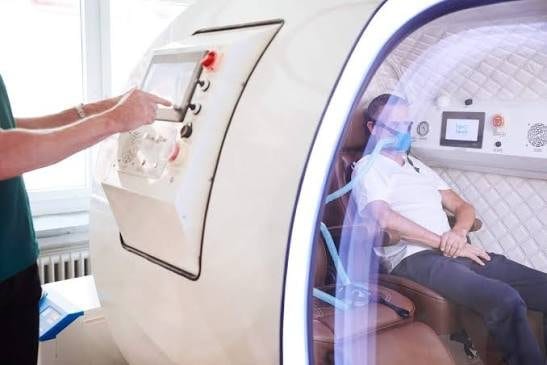
Barotrauma and other HBOT risks
Middle ear barotrauma is the most common adverse effect of hyperbaric oxygen therapy.
Middle ear barotrauma is the most common adverse effect of hyperbaric oxygen therapy. Sinus barotrauma, temporary myopia, confinement anxiety and, rarely, CNS oxygen toxicity seizures make up most of the remainder. The overall safety record is good, with proper screening.
Is hyperbaric oxygen therapy safe overall?
Heyboer and colleagues, writing the standard reference on HBOT adverse effects in Advances in Wound Care, describe hyperbaric oxygen therapy as remaining among the safest therapies used today, with serious complications uncommon in screened patients at standard clinical pressures — though informed consent still requires disclosing the real, if small, risks involved.
It would be misleading to open a risk article without the context. The standard reference on HBOT adverse effects, Heyboer and colleagues in Advances in Wound Care, describes hyperbaric oxygen therapy as remaining among the safest therapies used today. Serious complications are uncommon in screened patients treated at standard clinical pressures.
That said, the same review makes the case that providers need to identify, understand and quantify these effects properly — for prevention, for management, and for informed consent. Informed consent is the relevant word for a cosmetic adjunct. You are being asked to accept a small but real risk in exchange for a benefit that, in this indication, is not established.
What causes middle ear barotrauma during hyperbaric oxygen therapy?
Middle ear barotrauma, HBOT's most common adverse effect, occurs when unequalised pressure pulls the eardrum inward as the chamber pressurises, causing pain and sometimes fluid, bleeding or perforation. Congestion, colds, allergic rhinitis and recent ear surgery raise the risk; prevention relies on equalising early and often and pressurising slowly.
This is by a wide margin the most common adverse effect of hyperbaric therapy, and it is a direct consequence of the physics rather than of the oxygen.
As the chamber pressurises, the air in your middle ear compresses. Unless you equalise — swallowing, yawning, or a Valsalva manoeuvre — the pressure difference pulls the eardrum inward. That produces pain, and if it continues, fluid or bleeding behind the drum and occasionally perforation.
The risk rises with the rate and magnitude of pressure change, and it rises steeply if you cannot equalise well. Nasal congestion, a cold, allergic rhinitis or recent ear surgery all make it more likely. After a long hair transplant procedure, mild congestion is common, which is worth mentioning to the hyperbaric staff rather than pushing through.
Prevention is mostly technique and pacing: equalise early and often during descent, tell the operator immediately if you feel pressure building, and accept a slower pressurisation. Decongestants are sometimes used, but that is a decision for the hyperbaric service.
What is sinus barotrauma and what causes it?
Sinus barotrauma occurs by the same mechanism as ear barotrauma: a blocked sinus ostium traps gas that cannot equalise during pressure change, causing frontal or maxillary pain and occasionally a small nosebleed. It's less common than ear barotrauma; congestion is the main risk factor, so congested sessions should be postponed.
What are the CNS and pulmonary risks of oxygen toxicity in HBOT?
CNS oxygen toxicity, the effect limiting every hyperbaric protocol's pressure and duration, can rarely provoke a seizure at high oxygen partial pressure; it's self-limiting and doesn't indicate a seizure disorder. Pulmonary oxygen toxicity is a cumulative effect of prolonged high-dose exposure causing chest discomfort and cough, relevant mainly in long daily courses, not short protocols.
Central nervous system
CNS oxygen toxicity is the effect that sets the upper limit of every hyperbaric protocol. At sufficient oxygen partial pressure and exposure duration, hyperbaric oxygen can provoke a seizure. It is rare at standard clinical pressures and durations, it is self-limiting once the oxygen dose is reduced, and it does not indicate an ongoing seizure disorder — but it is the reason protocols specify both pressure and time, and the reason a seizure history requires specialist assessment before treatment.
Warning symptoms can precede it, which is one of the reasons hyperbaric staff want patients alert and able to report how they feel.
Pulmonary
Pulmonary oxygen toxicity is a cumulative effect of prolonged high-dose oxygen exposure, producing chest discomfort and cough. It is a consideration in long courses of daily treatment rather than in a six- or seven-session protocol, but it is part of why extended 'maintenance' courses deserve a specific justification.
Does hyperbaric oxygen therapy cause vision changes?
Temporary myopia — a shift toward short-sightedness — is a recognised effect of repeated HBOT exposure, developing over a course of treatment and resolving over weeks to months afterward. Long courses carry a recognised association with cataract progression, though that is not a realistic concern in a six-session protocol.
Is confinement anxiety a reason to stop HBOT treatment?
Claustrophobia and confinement anxiety are common enough to be a leading practical reason HBOT courses are abandoned, particularly in monoplace chambers. This is a genuine adverse effect, not a character failing, and in an elective cosmetic context it is a perfectly good reason to stop treatment.
How does HBOT's risk compare to its benefit for hair transplant patients?
For approved indications the benefit clearly outweighs the risk, but for an elective hair-transplant adjunct the trade is different: the published randomised trial found reduced early shedding (27.6% vs 69.1%) and less folliculitis/itching (11.8% vs 35.3%), with nine-month survival of 96.9% vs 93.8% — not a statistically significant difference.
For an approved indication — a diabetic foot ulcer that is not healing, late radiation injury — the balance is clear, because the benefit is well established and the alternative is often serious.
For an elective hair transplant adjunct, the balance is different. The published randomised trial found reduced early shedding (27.6% versus 69.1%) and less folliculitis and itching (11.8% versus 35.3%), with nine-month survival of 96.9% versus 93.8% and no statistically significant difference. That is what you are accepting a small procedural risk in exchange for.
It may still be a reasonable trade for some patients. It is not a trade anyone should make without being told what sits on each side of it.
Sources
- Heyboer M, Sharma D, Santiago W, McCulloch N. Hyperbaric Oxygen Therapy: Side Effects Defined and Quantified. Advances in Wound Care, 2017;6(6):210-224. pubmed.ncbi.nlm.nih.gov/28616361
- Thom SR. Hyperbaric oxygen: its mechanisms and efficacy. Plastic and Reconstructive Surgery, 2011;127 Suppl 1:131S-141S. pubmed.ncbi.nlm.nih.gov/21200283
- Fan Z, Gan Y, Qu Q, Wang J, Lunan Y, Liu B, Chen R, Hu Z, Miao Y. The effect of hyperbaric oxygen therapy combined with hair transplantation surgery for the treatment of alopecia. Journal of Cosmetic Dermatology, 2021;20(3):917-921. pubmed.ncbi.nlm.nih.gov/32770782
- Undersea and Hyperbaric Medical Society. Indications for Hyperbaric Oxygen Therapy (approved indications list). uhms.org/resources/hbo-indications.html
This article summarises published research and standard clinical practice. It is general educational information, not medical advice, and it does not replace the instructions your own surgical team gives you. Where their guidance differs from anything here, follow theirs.
Get a no-obligation assessment against fixed criteria, directly on WhatsApp.