
What is a perfect hairline? What the evidence says about proportion, age and natural design
There is no single perfect hairline height. What holds up is proportion, a soft natural shape, and a position that still looks right in thirty years.
You cannot look up a perfect hairline; it is not a measurement. The two classical proportion rules, the rule of thirds and the golden ratio, are artistic ideals that real measured faces break. A hairline that suits a man at 25 can look wrong at 55, because his hair loss keeps moving. What makes one look real is proportion used as a guide, a soft irregular edge, a shape that matches the person's sex, and a conservative height that allows for the hair he has not lost yet.
Talk to an expert
WhatsAppWhat is a perfect hairline?
There is no single perfect hairline. A hairline looks right when it suits the proportions of your face, has a soft and slightly irregular edge, matches your sex and age, and sits high enough to still look natural once your face has aged.
People have chased a formula for beauty since antiquity, and researchers still try. One team measured modern beauty-contest winners and found their proportions no longer matched the classical ideals, and differed from one country to the next. The ideal shifts with the era and the population. For a hairline, that rules out a target number. What you want is a line that frames the face in proportion and looks like it grew there.
Does the rule of thirds or the golden ratio define the ideal hairline?
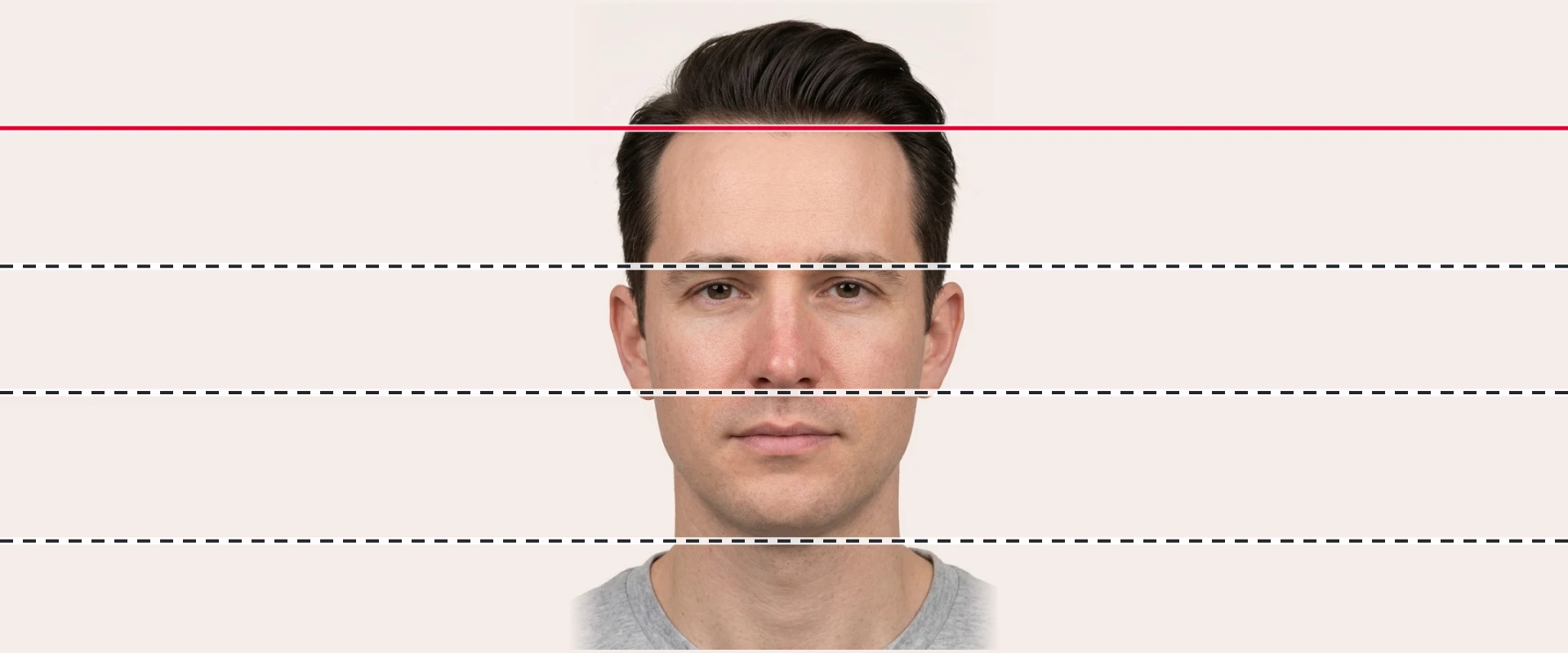
Only loosely. The classical canon splits the face into three equal thirds (hairline to brow, brow to nose base, nose base to chin), an idea that runs back to Vitruvius and Leonardo da Vinci as an artistic rule of proportion. When researchers measured real faces, these canons usually failed, so the rule of thirds is a guide, not a law.
The proportion studies of Da Vinci and Vitruvius, and the later golden-ratio theories of beauty, were artistic ideals: informed guesses about harmony, not measurements of real heads. Two studies make the point. When Farkas and colleagues measured faces across Chinese, Vietnamese, Thai and North American groups, the three sections of the facial profile came out equal in none of them. When another team measured Miss Universe winners, the facial golden ratios were statistically invalid. Use the upper third, hairline to brow, as a rough check that the forehead is in proportion, not as a way to place a hairline to the millimetre.
How high should a natural hairline sit?
High enough to read as an adult hairline, not a teenager's. A common surgical rule of thumb puts it a finger's breadth or more above your highest forehead crease, which keeps the forehead in proportion with the rest of the face. The right height depends on your face shape, your sex, and how your hairline will change as you age.
Surgeons design for the mature adult hairline, which sits higher than the low line of adolescence and recedes a little at the temples. They do not rebuild the hairline a man had at 16. A review of current practice found that careful hairline design, planned alongside medication to hold the hair behind it, accounts for much of why modern transplants look natural and last. You are choosing a height for the next thirty years, not for the mirror today.
Why does a hairline that is too low look unnatural, especially in young men?
Because your own hairline keeps moving back, and a low line placed in your twenties does not move with it. A hairline set too low or too straight can look good at 25, but pattern hair loss carries on, and by 50 or 60 the natural hairline has retreated far behind the line that was placed. The low front is then left far in front of the hair around it, and that looks worse with age. Sound design plans for decades.
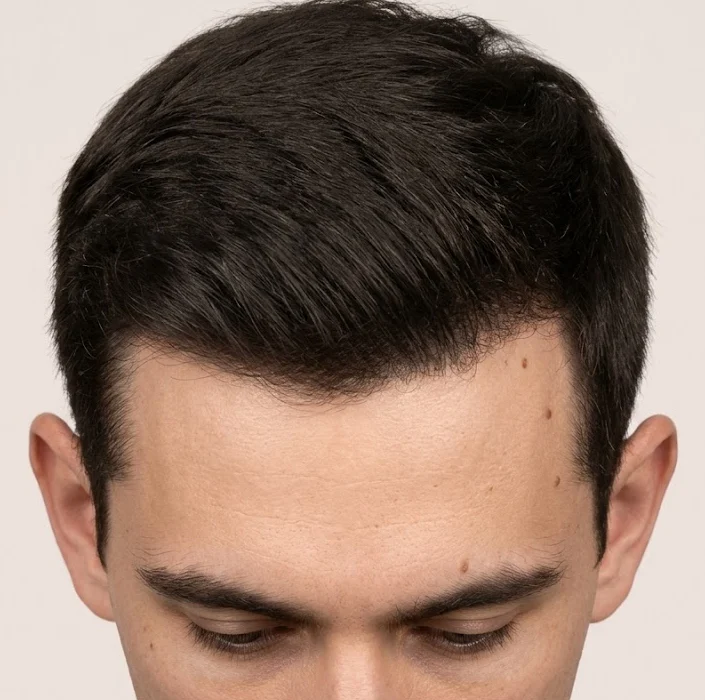
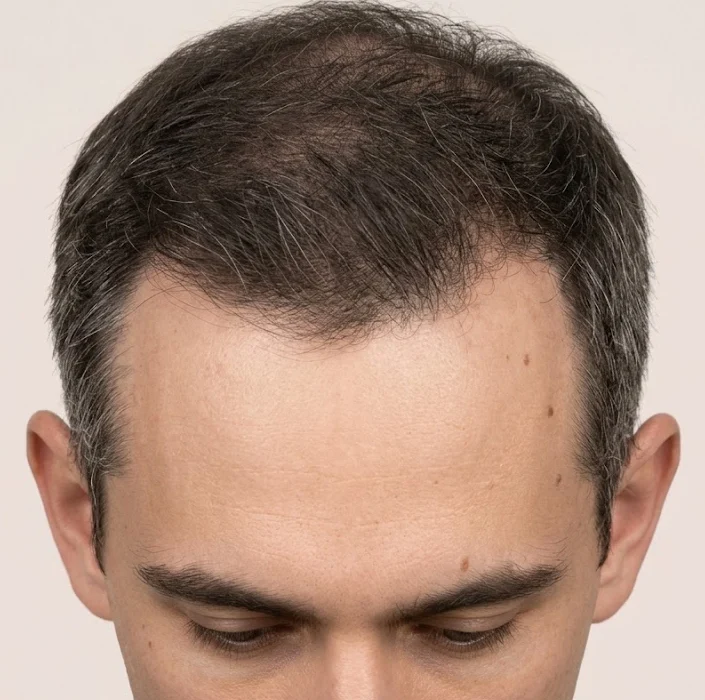
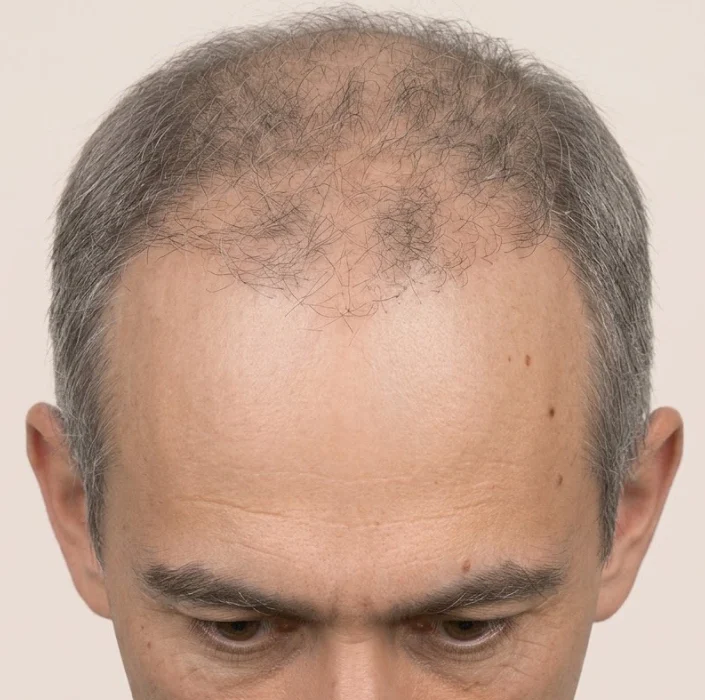
Pattern hair loss is progressive and follows recognised patterns, which is what the Norwood scale and the BASP classification describe. A surgeon who gives a young man the low, straight line he asks for spends a limited, non-renewable donor supply on the wrong priority, and builds a result that looks stranger each decade as the surrounding hair retreats. The line that still looks right at 55 is the higher, conservative one. A good clinic will often talk a young patient out of the lowest hairline he wants, and that conversation matters more than almost anything else in the consultation.
What is the difference between a male and a female hairline?
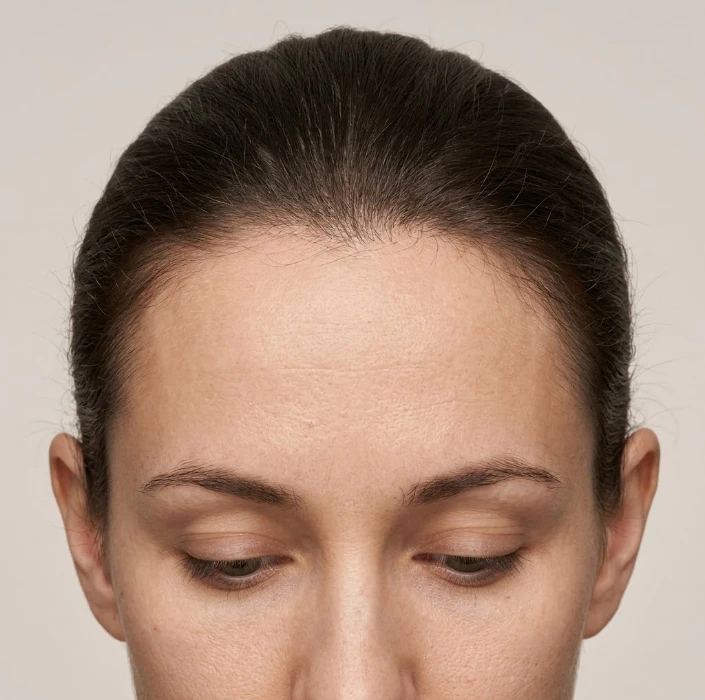
A woman's hairline sits lower and rounder with no temple recession; a man's sits higher with a defined frontotemporal angle. A 2023 study of attractive faces found forehead height at the centre is similar in both sexes, while the forehead is significantly higher at the sides in men.
When researchers sorted real hairlines by shape, the M-shaped and rectangular ones read as masculine and the rounded one read as feminine. A natural male hairline is therefore not a low straight line. It has recession at the corners and a soft, broken edge at the front. Shaping a man's hairline like a woman's, low and rounded with no recession, is one of the clearest signs of a transplant that has gone wrong. Matching the shape to the patient's sex matters as much as matching the height.
How does a good hairline transplant look?
Like it was always there. A natural transplanted hairline leads with single hairs in a soft, irregular front zone, builds density behind it, follows the direction the hair grows, and sits at a mature, age-appropriate height with a frontotemporal angle that fits the patient's face and sex.
A poor result shows a hard straight border, a wall of grafts at one density, a line set too low for the age, and hairs pointing the wrong way. A good one does the reverse: an irregular edge, single-hair grafts leading the front, density that builds behind them, and a position that will still read as natural in twenty years. A recent review credits this kind of deliberate hairline design, together with medication to protect the hair behind it, for the natural, lasting results modern transplants now reach. When you compare clinics, look for it in their before-and-after photos, and expect a careful surgeon to plan the line with you rather than hand you the lowest one you ask for. For how a hairline transplant is actually carried out, see our guide to hairline transplants.
Sources
- Burusapat C, Lekdaeng P. What Is the Most Beautiful Facial Proportion in the 21st Century? Comparative Study among Miss Universe, Miss Universe Thailand, Super Model, and General Population. Plastic and Reconstructive Surgery – Global Open, 2019;7(2):e2044. pubmed.ncbi.nlm.nih.gov/30881823
- Le TT, Farkas LG, Ngim RC, Levin LS, Forrest CR. Proportionality in Asian and North American Caucasian faces using neoclassical facial canons as criteria. Aesthetic Plastic Surgery, 2002;26(1):64-69. pubmed.ncbi.nlm.nih.gov/11891603
- Salinas CA, Liu A, Sharaf BA. Analysis of Hairline and Forehead Sexual Dimorphic Aesthetics in 60 Celebrities Using Artificial Intelligence. Plastic and Reconstructive Surgery – Global Open, 2023;11(7):e5107. pubmed.ncbi.nlm.nih.gov/37427151
- Sirinturk S, Bagheri H, Govsa F, Pinar Y. Study of frontal hairline patterns for natural design and restoration. Surgical and Radiologic Anatomy, 2017;39(6):679-684. pubmed.ncbi.nlm.nih.gov/27830323
- Lee WS, Ro BI, Hong SP, Bak H. A new classification of pattern hair loss that is universal for men and women: basic and specific (BASP) classification. Journal of the American Academy of Dermatology, 2007;57(1):37-46. pubmed.ncbi.nlm.nih.gov/17467851
- Queen D, Avram MR. Hair Transplantation: State of the Art. Dermatologic Surgery, 2025;51(9):874-881. pubmed.ncbi.nlm.nih.gov/40354670
This article summarises published research and standard clinical practice. It is general educational information, not medical advice, and not a recommendation about any specific procedure. A hairline design should be assessed in person by a qualified surgeon who weighs your pattern of loss, your donor supply and your long-term outlook.
Get a no-obligation assessment against fixed criteria, directly on WhatsApp.