
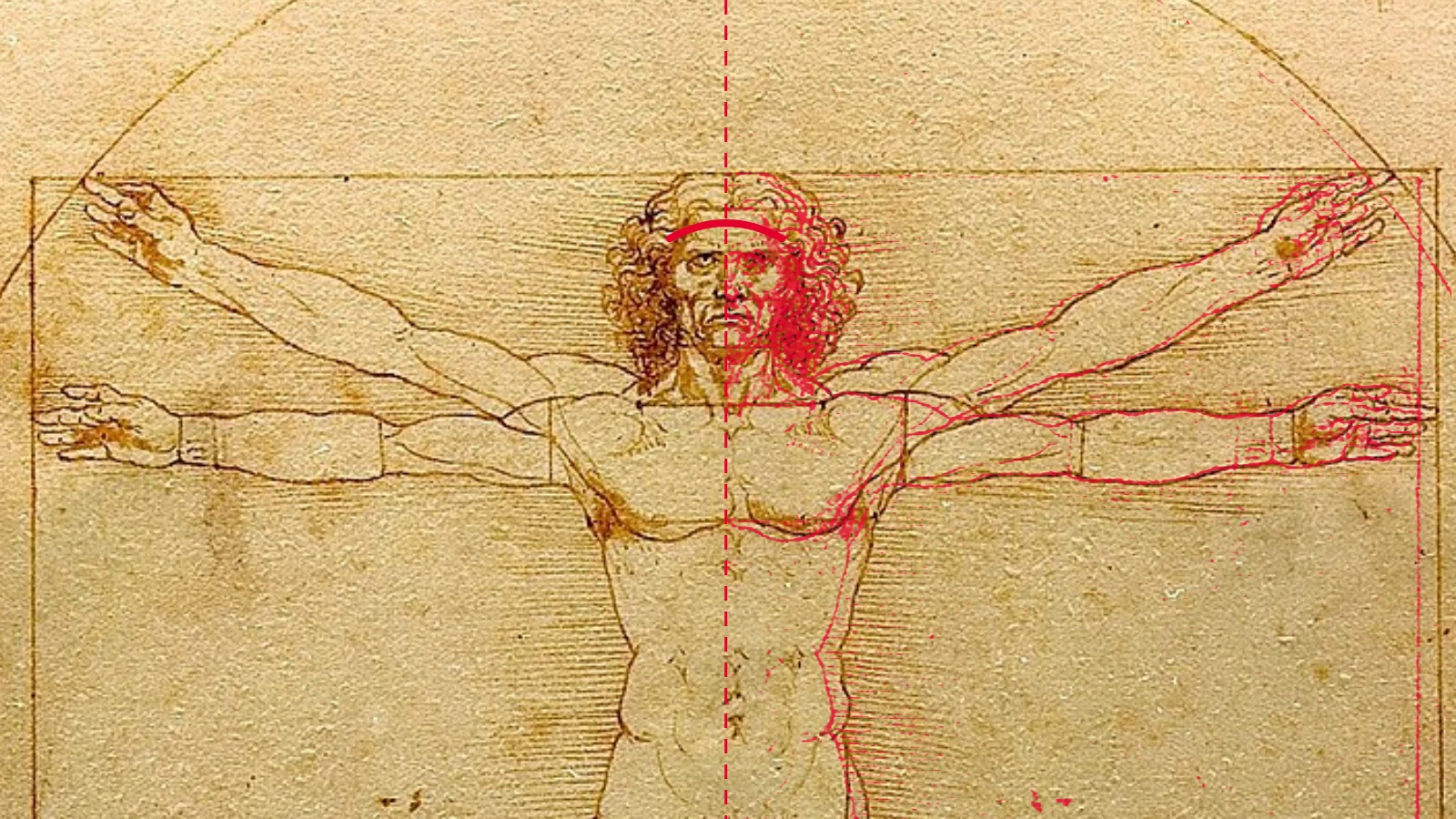
Looksmaxxing explained: what it is, what science says, and why perfect symmetry is overrated
Looksmaxxing is the internet's attempt to optimise the human face with a ruler and a forum. This post covers where it came from, what the symmetry research shows, and why a perfectly symmetrical face is less of a prize than the forums claim. It also covers what looksmaxxing gets right and wrong about hair, and when a transplant makes sense.
Talk to an expert
WhatsAppWhat is looksmaxxing?
Looksmaxxing is the deliberate, measured attempt to maximise physical attractiveness, with the face as the main target. People in the scene sort the methods into softmaxxing (skincare, grooming, haircuts, the gym, sleep) and hardmaxxing (surgery, injections and do-it-yourself procedures). A 2026 analysis in the Journal of Stomatology, Oral and Maxillofacial Surgery uses both terms in its title. We explain the difference in softmaxxing vs hardmaxxing.
The scene has its own vocabulary. A short field guide:
- Mewing: pressing the tongue against the roof of the mouth in the belief that it reshapes the jaw.
- Canthal tilt: the angle of the line between the inner and outer corner of the eye. A "positive" tilt means the outer corner sits higher.
- Bonesmashing: hitting the facial bones in the hope of reshaping them. Please do not try it.
- PSL scale: a hierarchical scale from the forums for rating facial attractiveness. Researchers describe "sub5" as a label for men or boys who see themselves as unattractive.
If you have ever opened a selfie and checked whether your eyes tilt the right way, you have done a little looksmaxxing. The scene does it on purpose, with a forum and a ruler. We run a hair transplant site, so we will get to the hairline.
Where did looksmaxxing come from?
The Portsmouth team (Solea and Sugiura, 2025, Crime, Media, Culture) analysed 25 months of data, including four looksmax.org posts, eight Incels.Wiki pages, 23 accounts and 332 TikTok videos. They traced content and language from incel forums to TikTok. They argue that accounts with roots in incel communities rebrand their content as "looksmaxxing" to reach wider audiences and avoid bans, and that the PSL scale and looksmaxxing language dress up misogyny and racism as self-improvement.
A separate 2025 study in Sociology of Health & Illness analysed 8 072 comments from a looksmaxxing forum with about 6 million unique visitors a month. Users picked men's faces apart in detail, including asymmetries and brow ridges. They urged big bodily changes such as leg-lengthening surgery or mewing, and they treated men who fell short as failures. The authors concluded that communities like this harm the health of the men who take part.
A viewer who watches a thirty-second video about jawlines and sleep may never see the forums behind the vocabulary. The research describes where the ideas came from and what the community does. It makes no claim about every viewer.
What is looksmaxxing trying to achieve?
The aim is a face that scores well on a short list of traits: a strong jaw, a positive canthal tilt, clear skin, good hair and, above all, symmetry. The scene treats beauty as an engineering problem. You measure, find the defect and apply the fix.
It may be the only hobby where the main equipment is a ruler and the main evidence is a screenshot. The brow ridge has had a remarkable decade, and nobody asked it.
A decent idea sits inside all this. Wanting to look healthy and well kept is normal, and plenty of the habits help your health anyway. Trouble starts when the goal shifts from looking like yourself on a good day to matching a template. A template has no room for what makes a face look like a person.
Is facial symmetry actually attractive?
To a point, yes, and the forum and the journals agree on this. Gillian Rhodes reviewed the field in the Annual Review of Psychology (2006). Her critical review and meta-analyses concluded that averageness, symmetry and sexual dimorphism are all attractive in male and female faces and across cultures. In 1999 Perrett and colleagues varied only the shape of the face and held skin texture constant. Faces with more symmetrical shapes got higher attractiveness ratings, male and female alike.
Looksmaxxers did not invent the idea. They took a real finding and built a lifestyle on it. Enjoy the agreement while it lasts.
Is a perfectly symmetrical face the goal?
The evidence does not make the case, and it is messier than the forums admit. Start with a fact that clashes with the whole project: nobody has a face with perfect symmetry. In a 2023 study of 30 young adults, none of the faces had an asymmetry index of zero. When assessors compared each face with a symmetrised digital copy, the copy won in 91.2% of cases. So symmetry helps. Other studies find the opposite.
- In 1995 Swaddle and Cuthill made faces more symmetrical without changing the size of the features. Raters judged the faces less attractive. The authors explain that real faces carry natural, consistent asymmetries, and that removing them may make a face look unemotional. (Perrett's group suggested in 1999 that earlier negative results may have come from the image processing. Read the whole literature, not one paper.)
- In a 2007 study in the Annals of Plastic Surgery, 200 to 250 judges rated edited faces. Slight asymmetry at the sides did not hurt attractiveness at all. Asymmetry near the midline hurt a lot. A face with a mirror-image pair of moles got the worst ratings of all, while a single mole off to the side rated higher than one near the middle. Yes, someone ran that study, and yes, it was peer reviewed.
- A 2021 study in Acta Psychologica found that symmetry raises attractiveness when it makes a face look more normal and lowers it when it makes the face look less normal.
- A 2024 study in the Journal of Personalized Medicine found no evidence that faces with perfect symmetry look less attractive. Raters also could not tell faces apart by symmetry within the group of asymmetrical faces or within the group of very symmetrical ones. Perception has thresholds.
The studies disagree on whether perfect symmetry gains or loses. Taken together they point to three things: real faces never have perfect symmetry, differences within a range are hard for people to see, and the effect depends on where the asymmetry sits and on whether the face still looks normal. A face with perfect symmetry exists in one place, a mirrored photo, and people in mirrored photos tend to look like their own unsettling twin.
A caution about the research itself. Most of it uses photographs that volunteers rate under lab conditions, and a face in a photograph does not walk into a room like a person. The findings describe tendencies across many raters, not rules for one face. Nobody falls in love with an asymmetry index.
Get your free, no-obligation hair analysis
What works, and what is a bad idea?
Soft methods are dull and cheap: sleep, skincare, sun protection, a good haircut, strength training, decent posture. Nobody needs a forum to hear that sleep helps.
Doctors worry about the hard end. The 2026 analysis mentioned above tracked online talk about dangerous do-it-yourself facial trends. "Bonesmashing" drew 2 518 mentions in twelve months, with an estimated reach of 32 million, and YouTube carried 43.7% of the discourse. Pediatrics published a 2026 article titled "From Mewing to Peptides: Looksmaxxing as an Emerging Pediatric Concern", and the Journal of Adolescent Health followed in November 2026 with a paper for clinicians who see adolescent boys and young men.
Mewing gets its own paragraph. The American Association of Orthodontists says "there's no current research that suggests the technique provides any benefit to your jawline or oral health". It also warns that excessive pressure can disrupt the natural alignment of teeth. If you want to change how your face looks, see a qualified clinician. Leave the hammer and the vial from the internet alone.
If rating your face takes over your days, talk to your doctor. Another measurement will not help.
What does looksmaxxing get right and wrong about hair?
Hair is the one item on the looksmaxxing checklist that is not bone, and medicine can change the result. The Portsmouth press release lists minoxidil for hair loss among the "seemingly harmless beauty hacks" in looksmaxxing content on TikTok, so hair is on the menu.
What it gets right
A hairline frames the face, and hair loss is a medical condition with documented options. Finasteride (prescription-only) and minoxidil are the two treatments approved and well documented for hereditary hair loss. A transplant can restore hair once the loss has settled. Our guide to slowing hair loss without surgery covers the medical side.
What it gets wrong
- It treats the hairline as a number to minimise. A hairline set too low looks unnatural, most of all on young men, and it looks worse each year as the natural hairline moves back. Right beats low. We explain why in what a perfect hairline looks like.
- It treats symmetry as the target. A natural hairline has a soft, irregular edge. A line drawn with a ruler looks like it was drawn with a ruler. The next section covers the evidence.
- It ignores the order of events. Surgeons consider a transplant once hair loss has stabilised, from around 25, because the operation does not stop the surrounding hair from thinning. Medication often runs alongside it. Early hair loss calls for a doctor, not a procedure booked from a screenshot.
What a sensible route looks like
- Find the cause. Hair loss has several, and they are not all hereditary.
- Use documented medical treatment first, if it suits you.
- Ask whether you are a candidate for a transplant at all, and learn the red flags when choosing a clinic.
- Expect to wait. The transplanted hair sheds in weeks 2 to 3, starts to grow back around months 3 to 4, and the final result takes about 12 months. A transplant will not finish in time for Friday night.
Why does a natural hairline need to be asymmetric?
The symmetry debate turns practical here. Patients often assume that identical left and right hairlines mark a good transplant. The surgical literature points the other way.
Nature is lopsided. A 2025 study in the Journal of Craniofacial Surgery measured the direction of hair growth along the hairline in 125 East Asian men with no more than minimal hair loss. On the right, hairs sat at an average angle of about 55 degrees, against about 33 degrees on the left, a gap of about 22 degrees. Among the men, 8.8% skewed the other way. The authors note that many patients assume perfect symmetry matters most, and they conclude that symmetrical designs may look unnatural while embracing the asymmetry gives more harmonious results. It is one study of one population, and it measured growth direction, not outline.
The outline varies too. Researchers who photographed 200 young Turkish adults sorted the front hairline into five contours: round, M-shaped, rectangular, bell-shaped and triangular. M-shaped was the most common among the men, at 46%. Rectangular and M-shaped contours looked more masculine and round ones more feminine. So there is no single "male hairline" to copy. There are several, and each is uneven in its own way.
The sexes differ at the temples. A 2023 analysis of 60 attractive celebrities (30 white women and 30 white men) found similar forehead height at the centre in men and women, but different hairlines at the temples. Men's hairlines ran flatter and slanted upward at the sides, while women's curved downward. Above the lateral eyebrow, forehead height averaged 4.16 cm in men and 3.51 cm in women. We show the shape difference in our hairline article.
What bad looks like. In a 2006 paper on 120 transplant patients, the authors reported that earlier patients had complained about a straight front hairline that looked unnatural and about hair that looked like "sprouted grass". The authors drew the line from the midline and the two temporal recession points, placed grafts in an irregular pattern instead of rows, and put single-hair grafts at the very front, angled with the natural growth.
What to look for:
- An irregular edge, not a ruler line.
- Single hairs at the front, with density building behind them.
- Hairs pointing in a natural direction, which differs a little from side to side.
- A shape that fits your sex, your face and your age.
- A surgeon who tells you that perfect symmetry is not the goal.
A good surgeon plans the asymmetry and lets the left and right sides differ the way real ones do. If a clinic promises a hairline you could use to check that a picture frame hangs level, choose another clinic. Our hairline transplant guide explains how the work is done, and the red flags page shows what to look for in before-and-after photos.
The sane version
- Looksmaxxing is a real subculture with forum roots, and researchers say part of its content has been rebranded for a wider audience.
- Symmetry attracts up to a point. The studies disagree on what happens when you push it to perfect, and nobody has a face with perfect symmetry to test it on.
- Soft methods are cheap and reversible. Hard, do-it-yourself methods are the ones clinicians warn about.
- According to the American Association of Orthodontists, no current research shows that mewing helps the jawline.
- If measuring your face starts to make you feel worse, stop and talk to someone.
- Hair is where medicine can help: diagnosis first, medication second, surgery only for the right candidate.
- A natural hairline is asymmetric by design. An identical left and right gives the game away.
Take the sleep, the sunscreen and a good haircut. Leave the hammer.
Sources
- Rhodes G. The evolutionary psychology of facial beauty. Annu Rev Psychol 2006;57:199-226. doi:10.1146/annurev.psych.57.102904.190208 (PubMed 16318594)
- Perrett DI, Burt DM, Penton-Voak IS, Lee KJ, Rowland DA, Edwards R. Symmetry and human facial attractiveness. Evol Hum Behav 1999;20(5):295-307. doi:10.1016/S1090-5138(99)00014-8
- Swaddle JP, Cuthill IC. Asymmetry and human facial attractiveness: symmetry may not always be beautiful. Proc Biol Sci 1995;261(1360):111-116. doi:10.1098/rspb.1995.0124 (PubMed 7644543)
- Springer IN, Wannicke B, Warnke PH, Zernial O, Wiltfang J, Russo PA, et al. Facial attractiveness: visual impact of symmetry increases significantly towards the midline. Ann Plast Surg 2007;59(2):156-162. doi:10.1097/01.sap.0000252041.66540.ec (PubMed 17667409)
- Zheng R, Ren D, Xie C, Pan J, Zhou G. Normality mediates the effect of symmetry on facial attractiveness. Acta Psychol (Amst) 2021;217:103311. doi:10.1016/j.actpsy.2021.103311 (PubMed 33933836)
- Harun NA, Adam KBC, Abdullah NA, Rusli N. Is a symmetrical face really attractive? Int J Oral Maxillofac Surg 2023;52(6):703-709. doi:10.1016/j.ijom.2022.09.031 (PubMed 36220682)
- Eißing FL, Dirksen D, Runte C, Jung S. Limits in the perception of facial symmetry: a prospective study. J Pers Med 2024;14(11):1109. doi:10.3390/jpm14111109 (PubMed 39590601)
- Kim J, Wan J, Jang T, Yi KH. Natural asymmetry in hair growth direction: implications for hairline design in male patients. J Craniofac Surg 2025;36(7):e843-e845. doi:10.1097/SCS.0000000000011231 (PubMed 40100127)
- Sirinturk S, Bagheri H, Govsa F, Pinar Y. Study of frontal hairline patterns for natural design and restoration. Surg Radiol Anat 2017;39(6):679-684. doi:10.1007/s00276-016-1771-1 (PubMed 27830323)
- Salinas CA, Liu A, Sharaf BA. Analysis of hairline and forehead sexual dimorphic aesthetics in 60 celebrities using artificial intelligence. Plast Reconstr Surg Glob Open 2023;11(7):e5107. doi:10.1097/GOX.0000000000005107 (PubMed 37427151)
- Tan Baser N, Cigsar B, Balci Akbuga U, Terzioglu A, Aslan G. Follicular unit transplantation for male-pattern hair loss: evaluation of 120 patients. J Plast Reconstr Aesthet Surg 2006;59(11):1162-1169. doi:10.1016/j.bjps.2006.03.041 (PubMed 17046625)
- Solea AI, Sugiura L. Digital Subcultural Diffusion Theory: rebranding the incel ideology through looksmaxxing, sub5s and the PSL scale. Crime Media Cult 2025 (published online). doi:10.1177/17416590251387245 University of Portsmouth news release, 17 November 2025.
- Halpin M, Gosse M, Yeo K, Handlovsky I, Maguire F. When help is harm: health, lookism and self-improvement in the manosphere. Sociol Health Illn 2025;47(3):e70015. doi:10.1111/1467-9566.70015 (PubMed 40069550)
- Grillo R, Fernandes LA, Rodrigues Dos Santos LA, Lima BC, Brozoski MA, Spagnol G. Dangerous trends on social media related to facial esthetics: analysis of looksmaxxing and its softmaxxing and hardmaxxing practices. J Stomatol Oral Maxillofac Surg 2026;127(5):102971. doi:10.1016/j.jormas.2026.102971 (PubMed 42674114)
- Mekhail J, Howard C, Milanaik R. From mewing to peptides: looksmaxxing as an emerging pediatric concern. Pediatrics 2026;158(3):e2026077705. doi:10.1542/peds.2026-077705 (PubMed 42580741)
- Ganson KT, Piatkowski T, Nagata JM. Looksmaxxing among adolescent boys and young men: increasing awareness among clinicians. J Adolesc Health 2026 (published online 6 November). doi:10.1016/j.jadohealth.2026.07.034 (PubMed 42993115)
- Leber C. Does mewing actually reshape your jaw? American Association of Orthodontists, aaoinfo.org. Published 25 March 2025, modified 29 June 2026.
This article is general information, not medical advice. All studies were checked against PubMed, Crossref or the publisher on 7 November 2026.
Written by the Hårtransplantation.dk research desk. Cover image: Leonardo da Vinci, Vitruvian Man (c. 1492), public domain; photograph by Luc Viatour, with red annotation added.
Get a no-obligation assessment against fixed criteria, directly on WhatsApp.