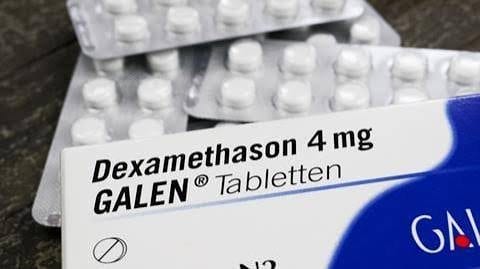
Dexamethasone taper protocols post-op
Some clinics prescribe a short tapering course of corticosteroid after surgery, specifically to reduce the forehead swelling that peaks around days two to four.
Some clinics prescribe a short tapering course of corticosteroid after surgery, specifically to reduce the forehead swelling that peaks around days two to four. It is targeted at comfort and appearance rather than at the result.
What is a dexamethasone taper used for after a hair transplant?
Post-operative swelling is fluid from anaesthetic and the inflammatory response tracking downward under gravity into the forehead and sometimes the eyelids, typically appearing on days two to four and settling within about a week. A short dexamethasone course dampens the inflammatory component, reducing swelling for comfort and appearance during the first week.
Does a dexamethasone taper improve hair transplant graft survival?
No. Dexamethasone is not given to improve graft survival, and there is no good evidence that it does. Graft survival is determined by handling, hydration, out-of-body time and recipient site quality, none of which a steroid changes, so presenting a steroid taper as improving your result would be overstating it.
How should you take a dexamethasone taper after surgery?
Take the dexamethasone taper at the times and doses specified, since tapers are stepped deliberately, and do not extend it because swelling persists. Do not stop it abruptly partway through unless told to, take it with food, and report mood changes, marked sleep disturbance or unusual thirst.
- Take it at the times and doses specified; tapers are stepped deliberately
- Do not extend it because swelling persists
- Do not stop abruptly partway through unless told to
- Take with food
- Report mood changes, marked sleep disturbance or unusual thirst
Who should discuss a dexamethasone taper with their surgeon before surgery?
People with diabetes, since corticosteroids raise blood glucose, plus anyone with glaucoma, a history of peptic ulcer, significant mood or psychiatric history, or already on other steroid medication should raise it before surgery. Not everyone needs a steroid course, since elevation and posture already do much of the work.
- People with diabetes, since corticosteroids raise blood glucose
- People with glaucoma
- People with a history of peptic ulcer
- People with significant mood or psychiatric history
- Anyone on other steroid medication
Not everyone needs a steroid course, and elevation plus posture already do much of the work. Our article on reducing post-op swelling covers the non-drug measures.
Sources
- Bernstein RM, Rassman WR. Graft Anchoring in Hair Transplantation. Dermatologic Surgery, 2006;32(2):198-204. pubmed.ncbi.nlm.nih.gov/16442039
This article summarises published research. It is general educational information, not medical advice, and it is not a recommendation to start, stop or change any medication. Prescription drugs carry contraindications and interactions; discuss them with a doctor who knows your medical history.
Get a no-obligation assessment against fixed criteria, directly on WhatsApp.