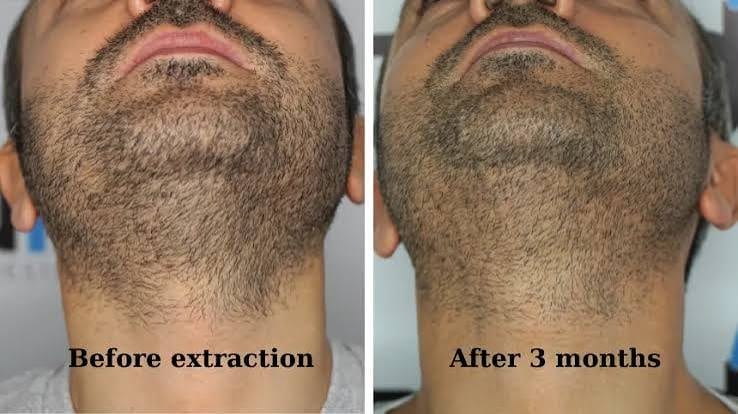
Healing differences: beard donor vs scalp donor
Beard donor sites generally heal quickly and are well concealed by regrowing facial hair, but the face is more visible during the healing window and beard follicles behave differently once transplanted.
Beard donor sites generally heal quickly and are well concealed by regrowing facial hair, but the face is more visible during the healing window and beard follicles behave differently once transplanted. The trade-off is speed and concealment against visibility and hair character.
Why is the beard used as a secondary donor source in hair transplants?
When scalp donor supply is limited, the beard is the most commonly used secondary source because it is usually dense with thick hairs, and that thickness is useful for adding bulk to a mid-scalp or crown region. It is rarely appropriate for a hairline, where fine hair matters more than coarse.
How does the beard donor extraction site heal after a hair transplant?
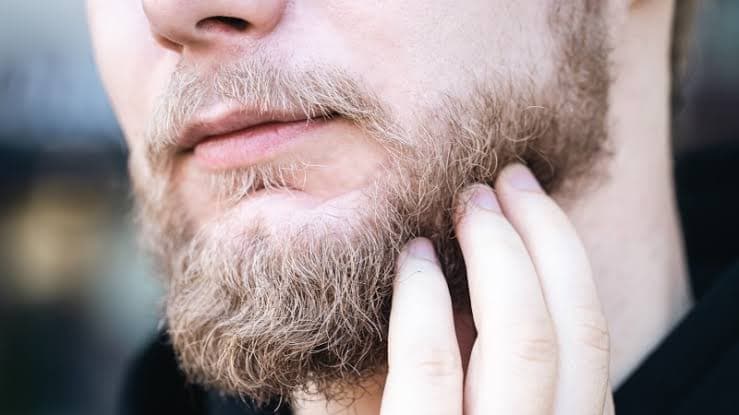
Facial skin generally heals quickly, and small punch sites close fast, though redness lasting days to a few weeks is more visible than on a scalp because it's on the face. Small pinpoint marks usually fade, regrowing beard hair conceals the area, and ingrown hairs or folliculitis can occur, as with ordinary shaving.
- Facial skin generally heals quickly, and small punch sites close fast
- Redness for days to a few weeks, more visible than on a scalp because it is on the face
- Small pinpoint marks that usually fade
- Regrowing beard hair conceals the area effectively once it returns
- Ingrown hairs and folliculitis can occur, as they do with ordinary shaving
How does beard donor hair differ from scalp donor hair?
Beard donor differs from scalp donor in visibility, since a scalp donor area can be hidden by hair but a face cannot, and the area usually can't be shaved during healing. Beard hair is coarser, often straighter or wirier, can differ in colour, and keeps its beard characteristics after transplant rather than adopting scalp hair's.
- Visibility. A scalp donor area can be covered by hair; a face cannot.
- Shaving. The area usually needs to be left alone during healing.
- Hair character. Beard hair is coarser, often straighter or more wiry, and can differ in colour.
- Growth behaviour. Transplanted beard hair retains beard characteristics rather than adopting scalp hair's.
- Density limits. Over-harvesting leaves visible patchiness in the beard, which is its own cosmetic problem.
What questions should you ask before using beard hair as a donor source?
Before using beard hair as donor, ask how many grafts will be taken and how that affects beard appearance, where the grafts will be placed and why there rather than elsewhere, how coarse beard hair will be blended with finer scalp hair, and what the plan is if you later want a fuller beard.
- How many grafts do you plan to take, and how will that affect beard appearance?
- Where will beard grafts be placed, and why there rather than elsewhere?
- How will you blend coarse beard hair with finer scalp hair?
- What is the plan if I later want a fuller beard?
Our guide to donor supply covers what limits graft numbers overall.
Sources
- Bernstein RM, Rassman WR. Graft Anchoring in Hair Transplantation. Dermatologic Surgery, 2006;32(2):198-204. pubmed.ncbi.nlm.nih.gov/16442039
This article summarises published research and standard clinical practice. It is general educational information, not medical advice, and it does not replace the instructions your own surgical team gives you. Where their guidance differs from anything here, follow theirs.
Get a no-obligation assessment against fixed criteria, directly on WhatsApp.