
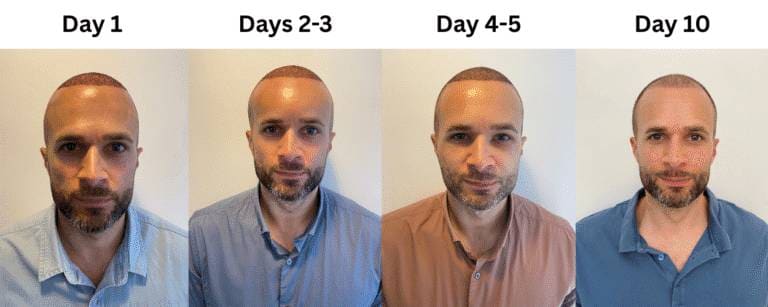
The first 10 days after a hair transplant
Day by day: washing, crusts, sleep and medication, so that the new grafts get the best possible start.
Talk to an expert
WhatsAppWhy the first 10 days matter so much
The newly placed grafts are in their most vulnerable phase immediately after the operation. They have not yet established their own blood supply and sit loosely in the recipient channels during the first days. Everything you do, or refrain from doing, in this period directly affects how many of the follicles survive and grow.
The good news: after roughly 10-14 days the grafts are anchored, and the risk of dislodging them is largely gone. Patience and discipline now pay off for decades.
Day by day
Day 0-1: mild swelling of the forehead and around the eyes is normal; sleep with your head elevated (30-45 degrees) on a neck pillow. Do not touch the recipient area.
Day 2-4: the first gentle medical wash according to the clinic's instructions, usually a lotion that softens, rinsed off carefully without pressure.
Day 5-7: the crusts begin to loosen; continue the daily, gentle washes.
Day 8-10: most crusts have fallen off, and the scalp looks calmer.
How to wash correctly
How you wash matters. Use the lotion or foam and shampoo the clinic gives you. Never direct a hard jet of water at the grafts; instead, pour water gently over them with your hand or a cup. Dab, do not rub. Use your fingertips, never your nails.
The crusts must fall off by themselves, so never pick at them. Removing a crust too early can pull the follicle with it. After roughly day 7-10, gentle circular finger movements can help the last crusts come away during washing.
Get your free, no-obligation hair analysis
Sleep, swelling and medication
Sleep with your head elevated for the first 3-5 nights to reduce swelling, and many use a neck pillow so that the back of the head (the donor area) does not rub against the pillow. Swelling that "sinks" down towards the eyes around day 2-4 is normal and temporary.
Take the medication you were given (painkillers, possibly antibiotics and an anti-inflammatory) as prescribed. Always follow your clinic's specific protocol rather than general advice.
Avoid this during the critical phase
- No sweating and no hard training: avoid the gym, running and saunas for at least 2-3 weeks
- No direct sun on the scalp; wear a loose hat when you are outside
- No smoking and no alcohol during the first days; they impair blood flow and healing
- No chlorinated water or sea bathing for several weeks
- Avoid bending your head far down and knocking your head
See the whole course, including growth month by month, in the full aftercare guide.
Diet, rest and expectations
Healing happens from within. Make sure you get plenty of fluids, protein and rest during the first days: the body is building a new blood supply to the grafts, and that takes resources. Avoid stressing the scalp with rough movements, and do plan a couple of quiet days at home where you can follow the washing protocol in peace.
As for expectations: the scalp looks worst around day 2-5, with crusts, redness and swelling. That is entirely normal and subsides quickly. Shock loss also comes later (see why in the growth timeline), so do not be alarmed when it does.
© IdealofMeD Research Academy. Republished with permission.
Get a no-obligation assessment against fixed criteria, directly on WhatsApp.