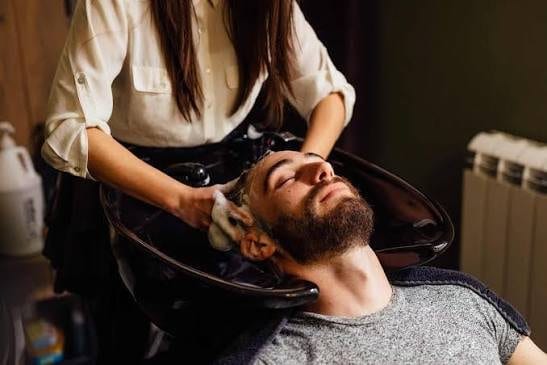
When it's safe to wash your hair again
Leaving the scalp unwashed feels careful, but hard, dry crusts are more likely to catch and pull out a graft than soft ones.
Most clinics start a gentle washing routine within the first few days, because softening crusts steadily is safer than letting them harden. The date is set by your clinic, not by a general rule, and the technique matters far more than the timing.
Why does hair washing start so soon after a hair transplant?
Leaving the scalp alone is not the safest option: crusts that dry hard bond firmly to the graft and are more likely to catch and pull one out on a pillow or collar. A steady, gentle wash routine instead softens crusts so they release on their own timetable, generally between days seven and fourteen.
What is the typical hair-washing protocol after a transplant?
A common pattern is a first gentle wash around days two to four, often demonstrated at the clinic, then daily washing: lather shampoo in your hands first, apply foam to the recipient area by hand without pressure, rinse with a low-pressure flow or cup pour rather than a direct jet, and pat or air dry.
Clinics vary, and yours takes precedence. A common pattern is a first gentle wash somewhere around days two to four, often demonstrated at the clinic before you travel home, then daily washing thereafter.
- Lather the prescribed shampoo in your hands first, never directly on the head
- Apply foam to the recipient area by hand, without pressure or rubbing
- Rinse with a low-pressure flow, cup poured or the shower held well back, never a direct jet
- Pat dry or air dry; no towel rubbing on the recipient area
What should you avoid when washing your hair in the first two weeks after a transplant?
In the first two weeks, avoid aiming a shower jet at the grafts, use lukewarm water only rather than hot, do not scrub, scratch or use fingernails, skip regular shampoo or conditioner unless your clinic has cleared it, and keep a hair dryer away from the recipient area.
- No shower jet aimed at the grafts
- No hot water; lukewarm only
- No scrubbing, scratching or fingernails
- No regular shampoo or conditioner unless cleared
- No hair dryer on the recipient area
What happens to your washing routine after the grafts anchor?
From around day nine, grafts are no longer at risk of being dislodged and washing can gradually become more normal. Even then, most clinics advise easing back rather than resuming full-force showering immediately, since the skin is still healing at that point.
Our aftercare guide sets out the full routine.
Sources
- Bernstein RM, Rassman WR. Graft Anchoring in Hair Transplantation. Dermatologic Surgery, 2006;32(2):198-204. pubmed.ncbi.nlm.nih.gov/16442039
- Parsley WM, Perez-Meza D. Review of factors affecting the growth and survival of follicular grafts. Journal of Cutaneous and Aesthetic Surgery, 2010;3(2). jcasonline.com
This article summarises published research and standard clinical practice. It is general educational information, not medical advice, and it does not replace the instructions your own surgical team gives you. Where their guidance differs from anything here, follow theirs.
Get a no-obligation assessment against fixed criteria, directly on WhatsApp.