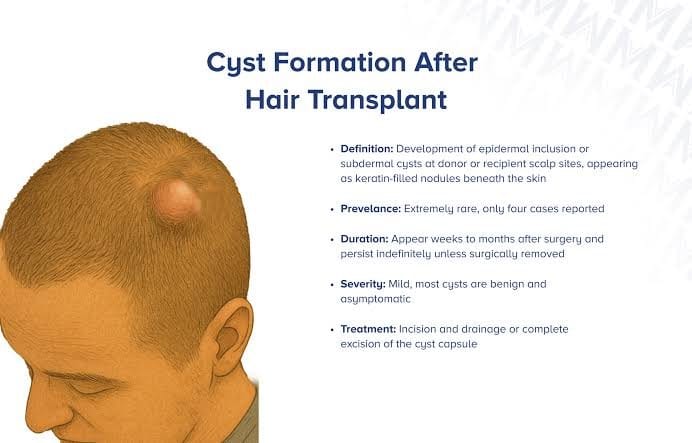
Cyst formation in the recipient area
A firm bump that turns up weeks after surgery is usually a trapped hair working its way out.
Small cysts in the recipient area are a recognised and usually minor post-operative event, typically appearing weeks after surgery as firm bumps where a hair has failed to break the surface or a fragment of tissue was buried. Most settle on their own or with simple clinic treatment.
What are cysts in the recipient area after a transplant?
A cyst here is a small, closed pocket under the skin. Common causes are a regrowing hair that cannot break through the surface and coils beneath it, or a small fragment of graft tissue buried rather than sitting at the correct depth. They present as firm, sometimes tender bumps, a few millimetres across.
When do cysts typically appear after a hair transplant?
Cysts typically appear from a few weeks after surgery onward, as hair begins to regrow, which distinguishes them from the crusting and swelling of the first fortnight. Numbers vary from one or two bumps to a cluster, and a cluster is worth reporting to your clinic sooner rather than waiting.
How are recipient-area cysts usually treated?
Many recipient-area cysts are simply observed, since they often resolve without intervention as the trapped hair works free. Clinics may recommend warm compresses to encourage release, simple drainage by a clinician if a cyst is persistent or uncomfortable, and treatment for associated inflammation where the cyst has become inflamed.
- Observation. Many resolve without intervention as the trapped hair works free.
- Warm compresses, if your clinic advises them, to encourage release.
- Simple drainage by a clinician where a cyst is persistent or uncomfortable.
- Treatment for associated inflammation, where the cyst has become inflamed.
What should you not do about a recipient-area cyst?
Do not squeeze, needle or pick at a cyst. The recipient area is dense with newly established follicles, so forcing it risks damaging them, introducing infection, and leaving a mark that outlasts the cyst itself. Report anything that is enlarging, hot, painful or accompanied by fever rather than waiting.
Cysts are uncommon, and the ordinary course of recovery is described under aftercare.
Sources
- Bernstein RM, Rassman WR. Graft Anchoring in Hair Transplantation. Dermatologic Surgery, 2006;32(2):198-204. pubmed.ncbi.nlm.nih.gov/16442039
This article summarises published research and standard clinical practice. It is general educational information, not medical advice, and it does not replace the instructions your own surgical team gives you. Where their guidance differs from anything here, follow theirs.
Get a no-obligation assessment against fixed criteria, directly on WhatsApp.